Written by Best Prompt Generator for AI Team
Reviewed by our team before publishing — learn more about us


Written by Best Prompt Generator for AI Team
Reviewed by our team before publishing — learn more about us
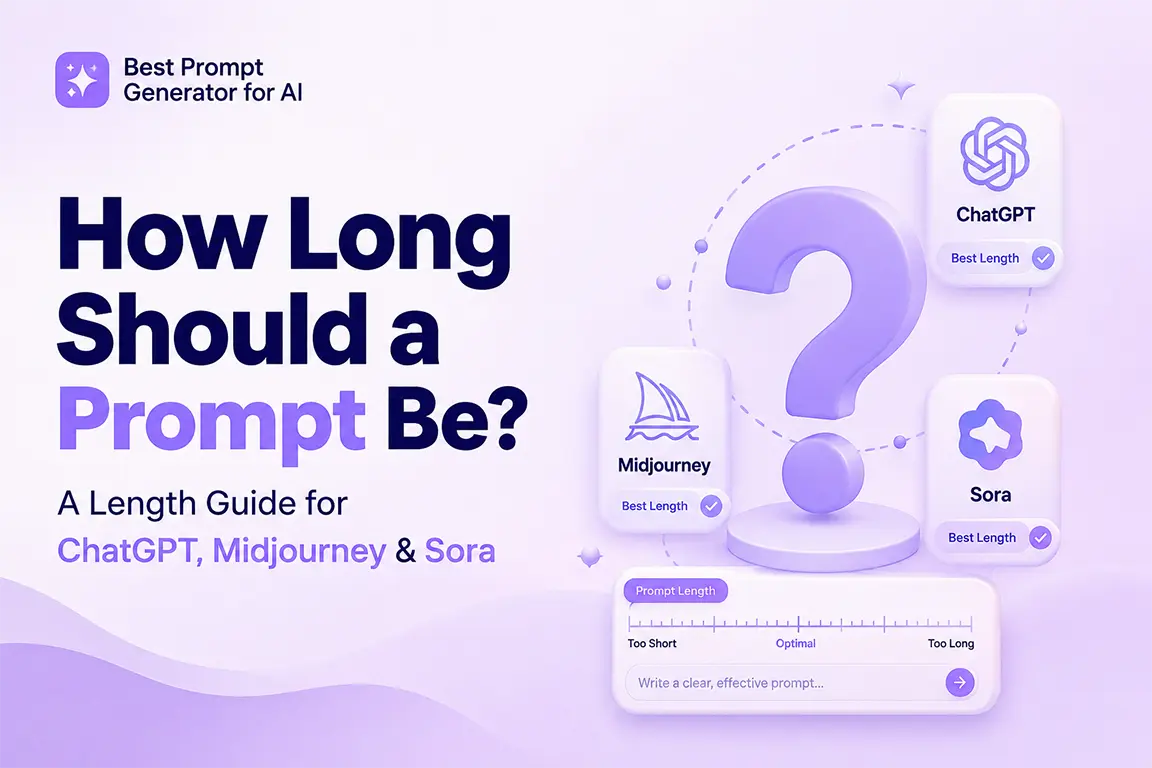
How long should an AI prompt be? There is no fixed ideal length. An AI prompt should be as long as necessary to clearly explain your task, context, and desired result, but no longer than needed.
Simple tasks may require only a sentence, while complex requests may need several sentences or paragraphs with additional instructions and constraints. The goal is not to write the longest prompt, but to provide the right amount of useful information for the AI to understand what you want.
There is no fixed number of words that makes a prompt effective.
For a simple request, a short prompt is often enough.
For example:
Explain what SEO is in simple language.
This prompt is short, but the task is clear.
However, if you need a detailed result, you may need to provide more context:
Write a beginner-friendly blog post explaining what SEO is. Use simple language, include examples, add clear H2 headings, and keep the tone helpful and professional.
The second prompt is longer because the task has more requirements.
So, the answer to how long should a prompt be is simple: use the amount of detail required to clearly explain your goal. The best prompt is not necessarily the longest one. It is the one that gives the AI enough context without adding unnecessary or confusing instructions.
The ideal AI prompt length depends on three main factors:
Simple tasks may need only a few words or a single sentence. More complex tasks may require additional context, examples, formatting requirements, and constraints.
For example, asking AI to generate ten blog title ideas does not require a long prompt:
Give me 10 SEO-friendly blog title ideas about AI prompts for beginners.
But creating a complete content brief may require more information:
Create an SEO content brief for a beginner guide about AI prompts. Include search intent, suggested headings, important questions, primary keywords, secondary keywords, and a recommended article structure.
Both prompts can be effective because the amount of detail matches the task. The best prompt length for AI is the length that provides enough useful information without making the instructions unnecessarily complicated.
Neither short nor long prompts are automatically better.
A short prompt works well when:
A longer prompt works better when:
For example:
Short prompt:
Write an article about AI prompts.
This gives the AI a general direction but leaves many decisions open.
Detailed prompt:
Write a 1,500-word beginner-friendly article about how to write AI prompts. Use simple language, include examples, explain common mistakes, use H2 and H3 headings, and maintain a helpful and professional tone.
The longer version gives the AI more direction and can produce a result closer to your expectations.
The important point is simple: prompt clarity matters more than prompt length.
Many people also ask: how detailed should an AI prompt be?
The answer depends on how much control you need over the final result.
A useful prompt can include:
You do not need to include every element in every prompt.
For a simple task, too much detail can make the prompt unnecessarily complicated. For a complex task, missing important details can lead to an inaccurate or generic result.
For example:
Create a social media caption for a new SEO tool.
This may be enough if you are open to different results.
But if you have a specific goal, you can add more details:
Create a short and engaging LinkedIn post introducing a new AI SEO tool for digital marketers. Use a professional but friendly tone, explain one key benefit, and end with a clear call to action.
The second prompt gives the AI a clearer understanding of the desired result.
There is no fixed ChatGPT prompt length.
For simple questions, one sentence may be enough. For content creation, analysis, planning, or complex workflows, a prompt may need detailed context, formatting instructions, examples, and constraints.
Short prompts are useful for:
Example:
Give me five blog ideas about AI tools.
Medium-length prompts work well for:
Example:
Create a blog outline about AI prompt writing for beginners. Include an introduction, practical examples, common mistakes, and FAQs.
Explore Nano Banana 2 prompts for better AI images
Longer prompts are useful when you need more control.
For example:
Write a beginner-friendly guide explaining how to write effective AI prompts. The audience is people who are new to ChatGPT and other AI tools. Use simple language, practical examples, clear H2 and H3 headings, and explain how users can improve unclear prompts.
For prompt length for ChatGPT, include enough context to describe the task, audience, format, and desired result. There is no need to add unnecessary words or repeat the same instruction multiple times.
The ideal Midjourney prompt length depends more on visual specificity than word count.
When creating an image, describe the visual elements that matter most, such as the subject, environment, style, lighting, mood, and composition.
A simple prompt might be:
A futuristic city at sunset.
This can create an interesting image, but the result may vary significantly.
A more detailed prompt could be:
A futuristic city at sunset, tall glass buildings, flying vehicles, soft golden light, cinematic composition, realistic details, wide-angle view.
The additional information gives the AI more direction.
For Midjourney, focus on the most important visual elements:
Avoid adding unrelated styles, objects, colors, or moods simply to make the prompt longer. Too many competing instructions can make the creative direction less focused.
The ideal Midjourney prompt length is long enough to describe the image you want while remaining clear and focused.
Explore the best AI image prompts for Midjourney
Sora prompts often need more detail than simple image prompts because video involves movement, timing, camera direction, and changes within a scene.
Instead of focusing only on word count, explain what happens, how the subject moves, how the camera behaves, and what the environment looks like.
A simple prompt could be:
A person walking through a city.
This may create a result, but it leaves many creative decisions to the AI.
A more detailed prompt could be:
A woman walks through a modern city street during early morning. The camera follows her from behind as she walks past cafés and tall buildings. Soft sunlight reflects on the street, and the scene has a realistic cinematic style.
This prompt describes:
For video generation, details about movement and camera direction can be more valuable than simply adding more descriptive words.
When considering Sora prompt length, include the information needed to explain what happens in the scene and how you want the video to look and feel.
A simple way to understand AI prompt length is to think about prompts in three levels.
A basic prompt is short and direct.
Write a product description for an AI writing tool.
This works well when you only need a general result.
An advanced prompt adds important details.
Write a product description for an AI writing tool designed for marketers. Use a professional tone, highlight time-saving benefits, and keep the description under 150 words.
This gives the AI more direction and control.
An expert-level prompt may include detailed context, audience information, structure, style, constraints, and examples.
Write a 150-word product description for an AI writing tool designed for digital marketers and content teams. Focus on speed, content quality, and ease of use. Use clear and persuasive language, avoid technical jargon, include three key benefits, and end with a short call to action.
The difference between basic, advanced, and expert prompts is not simply word count. The real difference is the amount of useful instruction.
If you’re unsure how much detail to include, a Smart AI Prompt Generator can help you build the prompt progressively. Start with a basic prompt for simple tasks, use advanced instructions when you need more context, or choose an expert-level prompt for complex requirements and structured outputs.
No. A longer prompt does not automatically create a better answer, image, or video.
A prompt can become less effective when it contains:
For example:
Write a short detailed simple professional casual highly technical beginner-friendly article that is both formal and conversational.
This prompt contains conflicting instructions.
A clearer version would be:
Write a beginner-friendly article using simple and professional language.
The goal of effective AI prompts is to provide useful direction, not to use the maximum possible number of words.
If you are unsure how long your prompt should be, use this simple structure:
Task + Context + Important Details + Desired Output
For example:
Task: Write a blog introduction.
Context: The topic is AI prompt writing.
Important details: The audience is beginners.
Desired output: Use simple language and keep it under 150 words.
Combined prompt:
Write a blog introduction about AI prompt writing for beginners. Use simple language, explain why prompt quality matters, and keep the introduction under 150 words.
This structure helps you add useful details without making your prompt unnecessarily long. It is a simple approach for anyone looking for an AI prompt guide.
Students can also use AI tools to study smarter
Use a short prompt when the task is straightforward.
Examples include:
Examples:
Explain AI prompts in simple language.
Give me five name ideas for an SEO tool.
Summarize this paragraph.
Short prompts work well when you do not need precise control over every part of the output. If the first result is not what you expected, you can add more details in your next prompt.
Use a longer prompt when the output needs to follow specific requirements.
Longer prompts are useful for:
For complex AI workflows, JSON Prompt Creation can make longer prompts easier to organize. Instead of combining every instruction into one large paragraph, you can separate the task, context, audience, format, constraints, and other requirements into structured fields.
For example:
This can make complex prompts easier to organize and understand.
The best prompt length for AI often comes from testing and refining your instructions.
You do not need to write the perfect prompt on the first attempt.
Start with a clear request and review the result. If something important is missing, add only the information needed to improve it.
For example:
First prompt:
Write an article about AI prompts.
If the result is too broad:
Write a beginner-friendly article about AI prompts.
If you need more structure:
Write a beginner-friendly article about AI prompts with an introduction, practical examples, common mistakes, and FAQs.
This step-by-step approach allows you to improve the prompt without adding unnecessary information from the beginning.
Here are some common mistakes to avoid.
A very short prompt may not provide enough context.
For example:
Write content.
The AI does not know the topic, audience, tone, or format.
More words do not always mean more clarity. Include information that actually affects the result.
Avoid requesting opposite styles or goals unless you clearly explain how they should be balanced.
You usually do not need to repeat the same instruction several times. State the requirement clearly once.
Different AI tools need different types of information.
ChatGPT may need context and output instructions. Midjourney benefits from visual details. Sora may require descriptions of action, movement, scenes, and camera direction.
So, how long should a prompt be?
The answer is simple: long enough to clearly explain what you want, but not so long that unnecessary or conflicting details reduce clarity.
A simple question may only need one sentence. A detailed blog, image, or video request may require multiple instructions.
The right AI prompt length depends on the task, the AI tool, and the level of control you need.
For ChatGPT prompt length, focus on the task, context, audience, and desired format. For Midjourney prompt length, describe the most important visual elements without overcrowding the prompt. For Sora prompt length, explain the subject, action, environment, movement, and visual direction when needed.
Start with a clear prompt, then add details only when they improve the result. Whether you use a basic, advanced, or expert-level prompt, clarity is more important than word count.

About the author
Best Prompt Generator for AI Team
Best Prompt Generator for AI Team is the small team behind bestpromptgeneratorforai.com, based in Rajkot, Gujarat, India. We build free tools that turn a rough idea into a clear, structured prompt for ChatGPT, Claude, Gemini, Midjourney and other AI tools, and we publish practical guides and prompt examples for creators, marketers and everyday users. Every tool and article is written and reviewed by our team before it is published. Questions or corrections: info@bestpromptgeneratorforai.com. Our tools are free to use, with an optional Pro plan for higher monthly limits.
Enter a subject and AI will instantly build the best form for you — up to 10 smart fields.
Searching best fields for your subject…
These fields were crafted specifically for your prompt type.
Generating your optimised prompt…