AI Prompt Generator for Text, Image & Video Content

Create Smart, Creative & High-Quality AI Prompts for Images, Videos, Content, Marketing, Coding & More in Seconds

In the rapidly evolving world of artificial intelligence, creating the perfect prompt has become one of the most important skills for businesses, creators, marketers, designers, developers, and content writers. Whether you want to generate stunning images, realistic AI videos, engaging blog articles, social media captions, business ideas, coding scripts, or marketing campaigns, the quality of your prompt directly affects the quality of the AI-generated output.

That’s exactly what this tool is built for — turning a rough idea into a structured, ready-to-use prompt in seconds.

AI prompt generator for text, image and video content

Generate Prompts for Video, Image & Text

Generate Trending, High-Quality AI Prompts for Images, Video & Content

How Our AI Tool Works

Step 1: choose your tool

Step 1

Select Your Tool

Select the tool you need — Free Prompt Generator, Image Creator, Business Idea Generator, or any other AI-powered solution.

Step 2: fill in your details

Step 2

Fill Your Details

Provide simple inputs like topic, goal, tone, industry, audience, or style preferences. No technical knowledge required.

Step 3: generate and copy your prompt

Step 3

Generate & Copy

Click the “Generate” button and our AI engine instantly creates optimized prompts or content based on your inputs.

What Is an AI Prompt Generator?

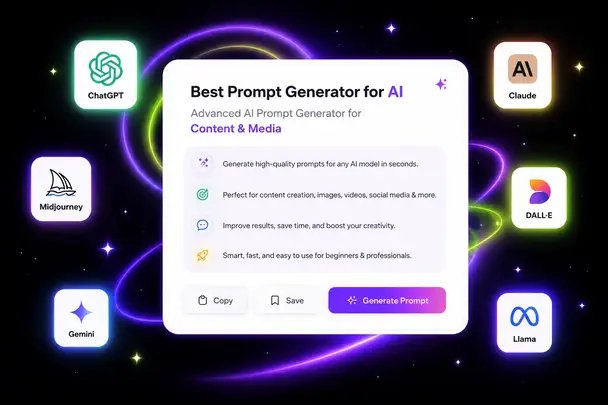
Best Prompt Generator for AI preview

This free tool is an advanced online platform designed to help users instantly create optimized prompts for multiple AI tools and use cases. It lets you generate AI text prompts, AI image prompts, AI video prompts, ChatGPT prompts, Midjourney prompts, marketing prompts, SEO prompts, coding prompts, and content writing prompts with ease. It’s built for creators, marketers, developers, designers, businesses, and content writers who want faster, smarter, and more effective AI-generated results.

The platform also supports social media prompts, business prompts, product description prompts, storytelling prompts, and creative prompts, helping users improve productivity, creativity, branding, and digital marketing performance. Whether you want to create stunning AI images, cinematic AI videos, engaging blog articles, social media campaigns, or advanced AI-generated content, it provides a simple and powerful solution for generating high-quality AI prompts instantly.

What Is Prompt Engineering, and Why Does Structure Matter?

Prompt engineering is the practice of writing instructions for an AI model so it reliably produces the output you actually want. It isn’t about magic phrases — it’s about giving the model the same information a skilled freelancer would ask for before starting a project: what the goal is, who it’s for, what format the result should take, and what “good” looks like.

Structure matters because AI models don’t infer context the way a colleague does. A vague request forces the model to guess at your audience, tone, and format — and it will guess wrong as often as it guesses right. A structured prompt removes that guesswork by specifying it up front, which is why the same idea, phrased two different ways, can produce a generic paragraph or something genuinely useful.

In practice, a well-structured prompt usually answers five questions before the model ever generates a word: who is this for, what should it accomplish, what tone or style fits, how long or in what format should it come back, and what should it explicitly avoid. Leave any of those five open and the model fills the gap with an average, generic guess — answer them up front and the first draft is usually close enough to use.

Specifically: the platform includes more than 70 individual prompt generators covering writing, images, video, business, and technical use cases, and a free plan with 20 prompts included, no credit card required.

Faster results icon

Faster Result

Better results icon

Better Quality

More control over AI output icon

More Productivity

AI-powered prompts icon

AI-Powered

Popular AI Tools

AI prompt generator icon

AI Prompt
Generator

AI image prompt creator icon

AI Image
Prompt Creator

Business idea generator icon

Business Idea
Generator

Social media content generator icon

Social Media
Content Generator

Study notes generator icon

Study & Notes
Generator

Resume and cover letter generator icon

Resume & Cover
Letter Generator

How This Differs From Typing Directly Into ChatGPT

You can always type a request straight into ChatGPT — for simple questions, that’s often enough. The gap only shows up once the task gets specific.

The difference shows up on anything more specific: a blog outline for a particular audience, a product description in a certain tone, a video script with a defined structure. Typing directly means you’re responsible for remembering every detail — audience, tone, format, length, constraints — and phrasing all of it clearly in one message. Skip a detail and you get a generic result, then spend several follow-up messages correcting it.

This tool front-loads that process. It prompts you for the details a good instruction needs, then assembles them into a single structured prompt, so the first result is closer to what you actually wanted. You can still paste that prompt into ChatGPT, Gemini, Claude, or any other model afterward — the generator doesn’t replace those tools, it just gets you a better starting point.

The gap gets bigger the more prompts you write in a week. One well-phrased request is easy to type from memory; doing it consistently, for a dozen different tasks, is where most people start skipping details and getting inconsistent results. A generator that asks the same questions every time — audience, tone, format, constraints — keeps that quality consistent whether it’s your first prompt of the day or your fiftieth.

For a ready-made list, see our 30 best ChatGPT prompts to save time.

Before & After: What Structure Changes

Here’s the same request, written two ways — as a quick ask, and as a structured prompt. Four examples, one pattern.

Example 1 — Blog intro. Before: “write an intro for a blog about coffee.” After: “Write a 100-word blog intro for home baristas switching from drip to espresso. Tone: friendly, slightly informal. Open with a relatable frustration, end with a one-sentence promise of what the post covers.” The second version tells the model who it’s for and what job the paragraph needs to do — the first leaves all of that to chance.

Example 2 — Product description. Before: “describe my running shoes.” After: “Write a 60-word product description for a lightweight running shoe aimed at first-time marathon trainers. Highlight breathability and arch support, use an encouraging tone, and end with a call to action.” The structured version produces sales copy; the vague one produces a spec sheet.

Example 3 — Social caption. Before: “caption for a gym post.” After: “Write an Instagram caption for a gym progress photo, under 40 words, motivational tone, include one relevant emoji and a question to drive comments.” The first produces something generic enough to fit any gym post ever written; the second produces something you could actually publish.

Example 4 — SEO meta description. Before: “meta description for a page about running shoes.” After: “Write a 150-character meta description for a running shoe product page targeting ‘best running shoes for marathon training,’ with a clear benefit and a soft call to action, no exclamation marks.” The vague version needs three or four rewrites to fit a character limit and match search intent; the structured one is usually ready to paste in.

Notice what all four examples have in common: none of the “after” prompts use special syntax or technical jargon. They just spell out audience, format, tone, length, and one thing to avoid. That’s the whole method — this tool exists to ask you for those five details every time, so you don’t have to remember them yourself, and to assemble them into a prompt that’s ready to use the moment it’s generated.

How This Compares

A quick, honest look at where this tool actually saves time — and where it doesn’t.

FeatureThis ToolWriting Prompts ManuallyGeneric Prompt Generators
Time to a usable promptSeconds — fill in a few fieldsMinutes, plus rework if details are missingSeconds, but often generic templated text
Prompt-engineering knowledge neededNone — structure is built inHelpful, but easy to skip a detailNone, but less tailored to your input
Covers text, image, and video promptsYes, all three in one toolYes, but you structure each format yourselfVaries — most cover only one format
Asks for audience, tone, and format up frontYes, built into every generatorOnly if you remember to include itRarely asked for explicitly
CostFreeFree (just your time)Often free, with paid tiers for more prompts
Output ready to paste into ChatGPT, Midjourney, Sora, etc.YesYes, once writtenYes

Frequently Asked Questions About AI Prompt Generation

Built for Every Kind of Creator

This tool is built for:

Bloggers · Freelancers · Students
Startup Founders · Digital Marketers · YouTubers

And anyone else who writes AI prompts regularly.

This is an online platform that helps users create powerful, optimized, and creative prompts for AI tools like ChatGPT, Midjourney, Gemini AI, Claude AI, Runway ML, Leonardo AI, Canva AI, Perplexity AI, Notion AI, GitHub Copilot, Jasper AI, Copy.ai, Synthesia, Pika Labs, Kaiber AI, HeyGen, Stable Diffusion, DALL·E, Grammarly AI, Fireflies AI & More.

An AI Prompt Generator uses structured input and intelligent formatting to create detailed prompts that improve the quality, accuracy, and creativity of AI-generated results.

This image prompt generator helps users create professional prompts for AI art tools, including realistic images, anime art, cinematic scenes, product photography, digital illustrations, and more.

Generated prompts can be used with popular AI image platforms such as Midjourney, DALL·E, Stable Diffusion, Leonardo AI, Adobe Firefly, Canva AI, and Bing Image Creator.

This video prompt generator creates advanced prompts for AI video generation tools, helping users generate cinematic scenes, animated videos, social media reels, advertisements, and storytelling content.

AI video prompts can work with platforms like OpenAI Sora, Runway ML, Pika Labs, Kaiber AI, Synthesia, HeyGen, and other AI video generators.

Yes, a well-structured AI prompt can significantly improve the quality of AI-generated text, images, videos, marketing content, and creative outputs.

AI prompt generators are useful for bloggers, marketers, designers, developers, YouTubers, agencies, students, entrepreneurs, social media creators, e-commerce brands, healthcare professionals, B2B sales teams, and businesses.

Detailed prompts help AI tools understand the exact style, tone, structure, creativity, and output expectations, resulting in more accurate and professional results.

Yes, BestPromptGeneratorForAI.com is designed for both beginners and advanced users, making AI prompt creation simple, fast, and effective.

Yes. A free ChatGPT prompt generator can be used for writing, marketing, SEO, education, research, brainstorming, business planning, social media, coding, and many other tasks. The prompt should be customized according to the specific goal.

An AI prompt builder generally helps users construct prompts by organizing different instructions and requirements, while an AI prompt generator focuses on producing a complete prompt from the information provided. In practice, the terms are often used interchangeably.

An AI prompt maker can help users create clearer and more detailed instructions, which may lead to more relevant responses. However, the final quality also depends on the AI model, the information provided, the complexity of the task, and how the output is reviewed.

Start Generating Powerful AI Prompts Today

Get hand-crafted, ready-to-use AI prompts for content, design, and marketing. Start creating smarter and faster today.
chart

Let Us Help You Succeed