Written by Best Prompt Generator for AI Team
Reviewed by our team before publishing — learn more about us


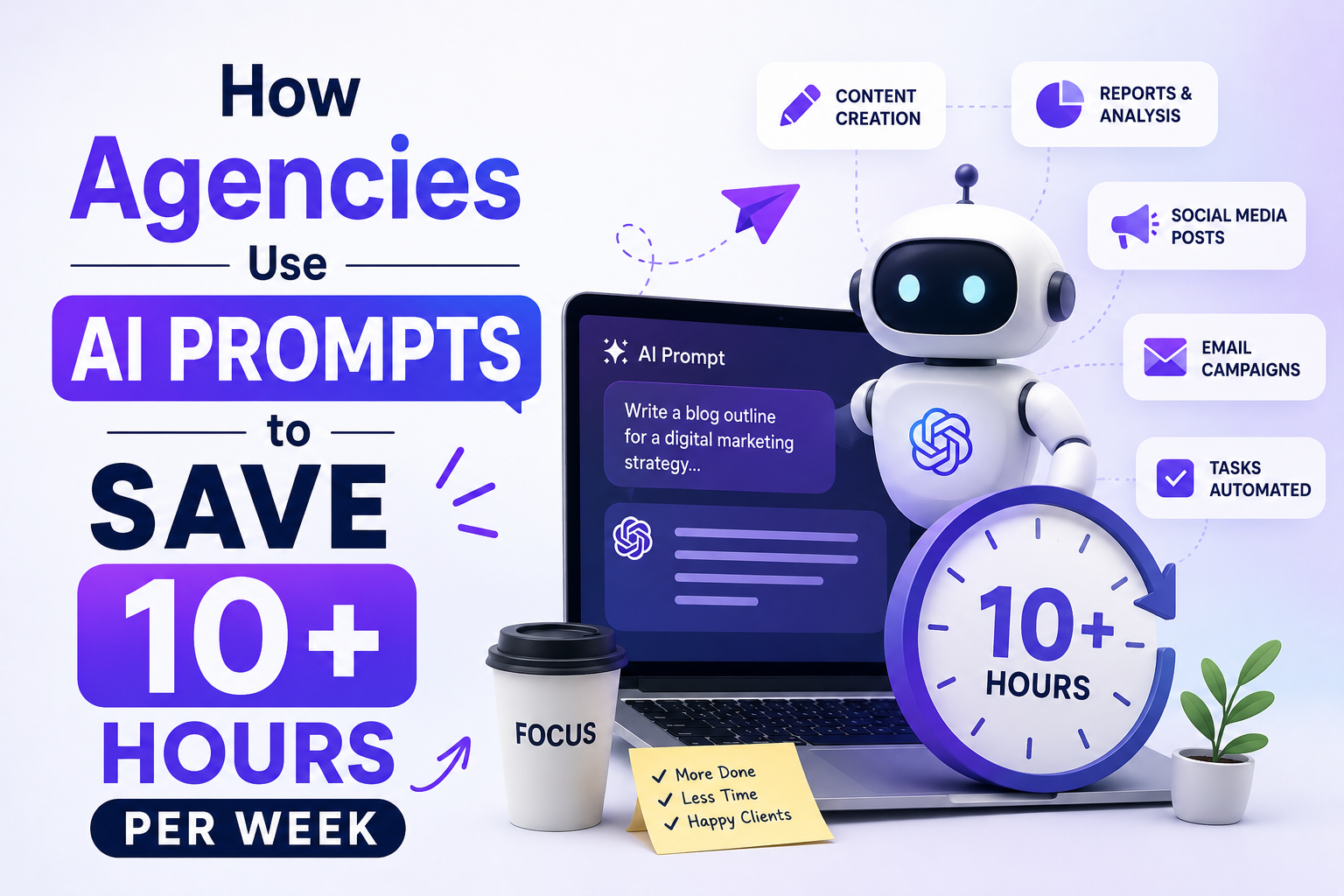
AI Prompts for Agencies help teams save 10+ hours per week by automating repetitive tasks, improving workflow speed, and generating better-quality content, ideas, and strategies faster. Agencies use AI prompts to create client proposals, write marketing copy, analyze data, plan campaigns, generate social media content, draft emails, and streamline project management. By using well-designed prompts, agencies can reduce manual work, improve productivity, and allow teams to focus more on creative and strategic tasks.
Running an agency means managing multiple responsibilities at the same time. From creating content and handling client communication to preparing reports, brainstorming ideas, and managing projects, agency teams often spend long hours completing repetitive tasks.

Many agencies are now using artificial intelligence (AI) to improve productivity, reduce manual work, and deliver better results for clients. One of the most effective ways agencies use AI is through AI prompts for agencies.
In this guide, we will explore how agencies use AI prompts, the benefits of AI prompts for agencies, practical examples, and how your agency can start using them to save time with smarter marketing campaign workflows and increase productivity.
AI prompts are written instructions or questions that guide artificial intelligence tools to generate specific results.
For example, instead of asking an AI tool:
“Write a blog post.”
An agency can create a detailed prompt:
“Create a 1,500-word, SEO-optimized blog article that explains the latest digital marketing trends and how small businesses can use them to grow online. Use a professional tone, include headings, examples, and a conclusion with actionable tips.”
The second prompt provides more context, which helps AI generate a better response.
For agencies, AI prompts act like productivity shortcuts. They help teams complete tasks faster while maintaining quality.
AI Prompts for Agencies are special prompts designed to make agency work easier and more efficient.
These prompts can be used in the following areas:
Nowadays, clients expect faster and more effective results. It has become a big challenge for agencies to complete high-quality work in less time. In this situation, AI Prompts for Agencies become very important because they help teams complete repetitive tasks faster while maintaining a consistent workflow.
Content creation is one of the most time-consuming tasks for agencies. Writers and marketers spend hours researching topics, creating outlines, writing drafts, editing content, and optimizing articles.
AI prompts can speed up every stage of content creation.
Agencies can use AI prompts to:
Agencies can also use SEO blog writing prompts to create optimized content faster when managing multiple client websites.
Example AI Prompt:
“Generate 20 informative and engaging blog topic suggestions for a digital marketing agency that aims to support small business owners with strategies, insights, and tips to enhance their online growth and visibility. Include SEO keywords and search intent for each topic.”
Instead of spending hours brainstorming, marketers can get multiple ideas within minutes.
This allows content teams to save several hours every week.
Managing social media accounts for multiple clients can become overwhelming, especially when agencies need to create fresh, engaging, and platform-specific content every day. From writing captions and creating post ideas to planning content calendars and preparing hashtags, social media management requires significant time and creative effort.
AI Prompts for Agencies help social media teams streamline content creation by generating creative post concepts, crafting impactful captions, planning marketing campaigns, and finding effective ways to improve audience engagement. Agencies can use AI prompts to create customized posts based on a client’s industry, target audience, brand voice, and marketing goals.
Agencies need to create:
For scalable social campaigns, use social media prompts to create engaging client content across different platforms.
Example:
“Create a 30-day social media content calendar for a digital marketing agency serving small businesses. Include platform-specific post ideas, engaging captions, suggested hashtags, content formats, audience goals, and calls to action. Maintain a professional but approachable brand voice.”
Client communication requires professionalism, clarity, and accuracy. Agencies regularly need to write client emails, project updates, proposals, reports, feedback responses, and meeting summaries. AI Prompts for Agencies help teams create clear, professional, and well-structured communication faster while maintaining the right tone for each client.
AI prompts help create clear and professional communication while reducing the time required for repetitive writing tasks.
Example:
“Write a professional client communication email that provides an overview of the project status, highlights completed tasks, explains ongoing work, outlines next steps, and includes any important updates or details. Explain completed tasks, upcoming steps, and expected timelines in a friendly tone.”
Research is an important part of agency work, but collecting market trends, competitor insights, audience information, and industry data manually can take significant time. AI Prompts for Agencies help teams quickly analyze information, identify trends, and generate useful insights for creating better marketing strategies.
AI prompts can assist with:
Example:
“Analyze the target audience for a SaaS company selling project management software. Provide customer pain points, buying motivations, common objections, content preferences, and marketing opportunities.”
AI-generated research should still be reviewed against reliable data before agencies use it for client-facing strategies.
SEO agencies spend many hours performing keyword research, creating content plans, analyzing competitors, and identifying ranking opportunities. AI Prompts for Agencies help SEO teams quickly generate keyword ideas, optimize content strategies, and find ways to improve search engine performance.
AI prompts can support SEO workflows by helping with:
Agencies can strengthen their workflow with keyword research prompts for finding relevant search opportunities before creating client content plans.
Example AI Prompt:
“Create an SEO-focused content plan for the topic ‘AI prompts for agencies.’ Include the user’s search intent, recommended article structure, related keyword ideas, questions users may ask, and helpful content suggestions to improve ranking potential.”
Creating customized proposals for potential clients can take hours because agencies need to research the client’s needs, explain services, and create professional presentations. AI Prompts for Agencies make it easier to create proposal outlines, develop service details, organize pricing options, and build customized client solutions in a shorter time.
Agencies need to explain:
AI prompts can help create professional proposal drafts that agencies can customize according to each client’s goals, budget, industry, and requirements.
Example:
“Create a personalized digital marketing approach for a local business focused on improving online visibility, boosting search engine performance, expanding social media reach, attracting new customers, and building stronger brand recognition. Include objectives, strategy, timeline, deliverables, and expected outcomes.”
Creative brainstorming is essential for agencies, but consistently developing fresh and unique campaign ideas can be challenging. AI Prompts for Agencies help creative teams generate new concepts, campaign themes, taglines, content ideas, and marketing strategies based on client goals and target audiences.
For example, an agency can use an AI prompt like:
“Develop 10 innovative social media marketing campaign concepts for a skincare brand aimed at younger audiences, including creative content ideas, campaign themes, key messages, promotional concepts, and methods to increase audience interaction.”
AI-generated campaign ideas can provide a starting point for brainstorming, while creative teams can refine them according to brand guidelines and campaign objectives.
Agencies regularly prepare performance reports and presentations to show clients the results of campaigns, projects, and marketing activities. AI Prompts for Agencies help teams summarize data, create report structures, identify important trends, and prepare professional presentations quickly.
These reports often include:
AI prompts can summarize data and create report structures, but agencies should verify numerical information and performance metrics before presenting results to clients.
Example:
“Create a comprehensive monthly digital marketing report template that helps agencies clearly present campaign results, analyze key performance metrics, highlight successful strategies, share valuable insights, and recommend actionable improvements for future marketing growth. Include SEO performance, social media results, campaign insights, client goals, and future recommendations.”
Here are some practical AI prompts for agencies that teams can use:
Content Writing Prompt
“Act as an experienced content strategist. Develop a comprehensive blog structure for the given topic, including key sections, subheadings, important points to cover, and a logical content flow. Add relevant SEO terms, define the ideal audience, understand their search goals, create an effective heading structure, and provide useful content guidelines for better optimization.”
Social Media Prompt
“Develop 15 unique and engaging social media content ideas for a specific brand category, focusing on increasing audience interaction, improving brand visibility, and strengthening the brand’s online presence. Include captions, hashtags, content formats, and engagement strategies.”
Email Marketing Prompt
“Write a professional marketing email promoting [product/service]. Create persuasive and engaging content that captures the audience’s attention, motivates them to respond, and finishes with a strong and effective call-to-action that encourages the desired action.”
Client Reporting Prompt
“Generate a detailed client performance analysis using the provided data, covering key accomplishments, important performance indicators, growth patterns, actionable insights, and recommendations to improve future results. Highlight achievements, challenges, opportunities, and recommendations.”
Competitor Research Prompt
“Analyze competitors in the [industry] market. Identify their strengths, weaknesses, marketing strategies, target audiences, content approaches, and opportunities for improvement. Present the findings in a clear comparison table.”
The quality of AI output depends on the quality of the prompt. Agencies can improve their results by creating prompts that provide clear instructions, relevant context, and specific expectations.
Follow these steps to create better prompts:
A strong prompt should explain what the AI should do, why the task is important, who the audience is, what information should be considered, and how the final answer should be structured.
Agencies can also improve consistency by creating reusable prompt templates for common tasks such as content writing, SEO analysis, social media planning, client reporting, and campaign development.
For more advanced workflows, use prompt engineering principles to build more reliable AI workflows and improve the quality of generated results.
Let’s look at a typical example.
In an agency:
Using AI Prompts for Agencies can potentially reduce the time required for repetitive work. If AI-assisted workflows reduce this workload by around 50%, an agency could save approximately 8.5 hours from these 17 hours.
With additional workflow automation and reusable prompt templates, some agencies may save 10 or more hours per week. However, the actual time saved depends on the agency’s processes, team size, task complexity, and level of AI adoption.
The biggest advantage is not simply saving time. Agencies can redirect those saved hours toward strategy, creative thinking, client relationships, quality control, and business development.
As technology continues to evolve, AI is likely to become an increasingly important part of agency workflows. Agencies can use AI to streamline repetitive tasks, improve productivity, support creative thinking, analyze information, and deliver work more efficiently.
Agencies that use AI correctly will:
AI Prompts for Agencies are no longer just a trend. They are becoming a practical productivity resource for modern agencies that want to combine human expertise with AI-assisted workflows.
Freelancers can use AI prompts to draft client proposals, write clear invoices and payment reminders, and put together scope-of-work documents — the administrative work that eats into billable hours but still needs to sound professional and specific to each client.
A proposal needs to demonstrate you understood the client’s actual problem, not just restate a generic service list. AI tools help most when you feed them the specifics of the client’s situation rather than asking for a generic template.
The proposals that win are specific to the client’s actual problem — use the AI draft as a structural starting point, then add the details that prove you listened during the discovery call.
Getting paid on time often comes down to how clearly and professionally you communicate about money — an area many freelancers find awkward to write themselves.
Tone matters more here than almost anywhere else in freelance communication — specify exactly how firm or friendly you want the message to be, since the difference between “assertive” and “aggressive” often comes down to word choice.
A clear scope document is the single best protection against scope creep, and it’s also one of the more tedious documents to write from scratch for every project.
Being explicit about what’s excluded is often more valuable than listing what’s included — ask your prompt to generate that section specifically if the AI draft doesn’t include one.
Freelance contracts don’t need to be reinvented for every project, but they do need to be clear — and AI tools are useful for drafting the plain-language clauses that protect both sides.
AI-drafted contract language is a useful starting point, not a substitute for review — for anything with real legal or financial weight, especially larger contracts, having an actual lawyer review the final version is worth the cost.
Regular, low-pressure check-ins tend to surface small issues — scope confusion, unclear expectations — before they grow into bigger problems that are harder to fix mid-project.
For a more general starting point on structuring any of these requests, our free AI prompt generator walks through the same audience-tone-format approach that makes these client communications land well.
AI can produce a strong structural draft, but the details that actually win proposals — specific references to the client’s situation and goals — need to come from you, since a generic AI proposal reads the same as every other generic proposal a client receives.
No, as long as the final message is accurate, appropriately personalized, and reviewed before sending. Most clients care about clear, professional communication, not whether a draft started as an AI-assisted first pass.
Specify exactly how firm or friendly you want the message and the context of the relationship (long-term client vs. first invoice). The more specific the tone instruction, the less editing you’ll need to do afterward.
No. Describe the situation in general terms (amount owed, days overdue) without pasting a client’s actual invoice or personal financial information into a prompt.
Most freelancers save the most time on repetitive administrative writing — proposals, invoices, scope documents — rather than on the creative or technical work itself, since those documents follow a fairly predictable structure that AI tools draft well.
No. AI can draft the language, but a contract only protects you if both parties sign it and it fits your specific legal situation. Treat AI-drafted terms as a first draft to review, adapt, and in most cases have checked by a professional before relying on them.
Further reading for this section:
AI technology has become a powerful tool for agencies. Using effective AI Prompts for Agencies can simplify various operations, including content creation, digital marketing tasks, SEO planning, client communication, campaign development, and market research.
Well-designed prompts help teams reduce repetitive work, create consistent outputs, and spend more time on strategy and creative decision-making. They can also help agencies manage multiple clients more efficiently without sacrificing the human oversight needed for quality and accuracy.
Saving 10+ hours per week is not simply about working faster. It can give agency teams more time to focus on client relationships, strategic planning, creative work, and business growth.
If your agency is not using AI prompts yet, now is a good time to start. With the right prompts, workflows, and human review, AI can help your team become faster, more productive, and more effective.
Marketing agencies handle time-consuming activities such as campaign planning, content creation, advertising setup, audience research, performance tracking, and reporting. This allows business owners and internal teams to focus more on their core responsibilities.
Agencies can improve campaign performance through proper audience targeting, strategic planning, data analysis, A/B testing, content optimization, and continuous campaign management. These activities can help businesses generate better leads and improve conversions.
Yes. AI tools can support marketing agencies with content ideas, audience research, campaign planning, copywriting, data analysis, and workflow automation. Human review and marketing expertise are still important for maintaining accuracy, brand consistency, and strategic quality.
Yes. AI prompts for agencies can assist with keyword research, meta descriptions, title tags, content outlines, FAQs, internal linking ideas, competitor analysis, and SEO-friendly blog content. Human review and reliable SEO data should still be used before making important optimization decisions.
AI prompts for agencies reduce the time spent on repetitive tasks such as content creation, client communication, social media planning, research, and reporting. Agencies can create reusable prompts and templates to speed up recurring workflows.
Yes. AI prompts for agencies can be useful for agencies of different sizes. Small agencies can use prompts to improve productivity, standardize repetitive tasks, and handle more work without increasing manual effort.
Yes. Well-structured AI prompts help agencies complete many routine tasks faster and create consistent first drafts. This allows teams to spend more time on strategy, creative work, client relationships, quality control, and business growth.
Absolutely. AI prompts can help agencies generate blog ideas, content briefs, social media posts, email campaigns, content calendars, headlines, and content optimization suggestions. Teams should review and customize AI-generated content before publishing.
An effective agency prompt clearly defines the task, provides relevant context, identifies the target audience, explains the desired outcome, specifies the output format, and includes important constraints such as tone, length, brand guidelines, or required information.
Yes. Agencies can create reusable templates for common workflows such as blog writing, SEO research, social media planning, client emails, campaign ideas, reports, and proposals. Templates help teams maintain consistency while reducing repetitive prompt-writing work.
Yes. AI-generated content should be reviewed by an appropriate team member before it is delivered to a client or published. Agencies should verify facts, statistics, brand information, strategic recommendations, and other important details to maintain quality and accuracy.

About the author
Best Prompt Generator for AI Team
Best Prompt Generator for AI Team is the small team behind bestpromptgeneratorforai.com, based in Rajkot, Gujarat, India. We build free tools that turn a rough idea into a clear, structured prompt for ChatGPT, Claude, Gemini, Midjourney and other AI tools, and we publish practical guides and prompt examples for creators, marketers and everyday users. Every tool and article is written and reviewed by our team before it is published. Questions or corrections: info@bestpromptgeneratorforai.com. Our tools are free to use, with an optional Pro plan for higher monthly limits.