Written by Best Prompt Generator for AI Team
Reviewed by our team before publishing — learn more about us


Written by Best Prompt Generator for AI Team
Reviewed by our team before publishing — learn more about us
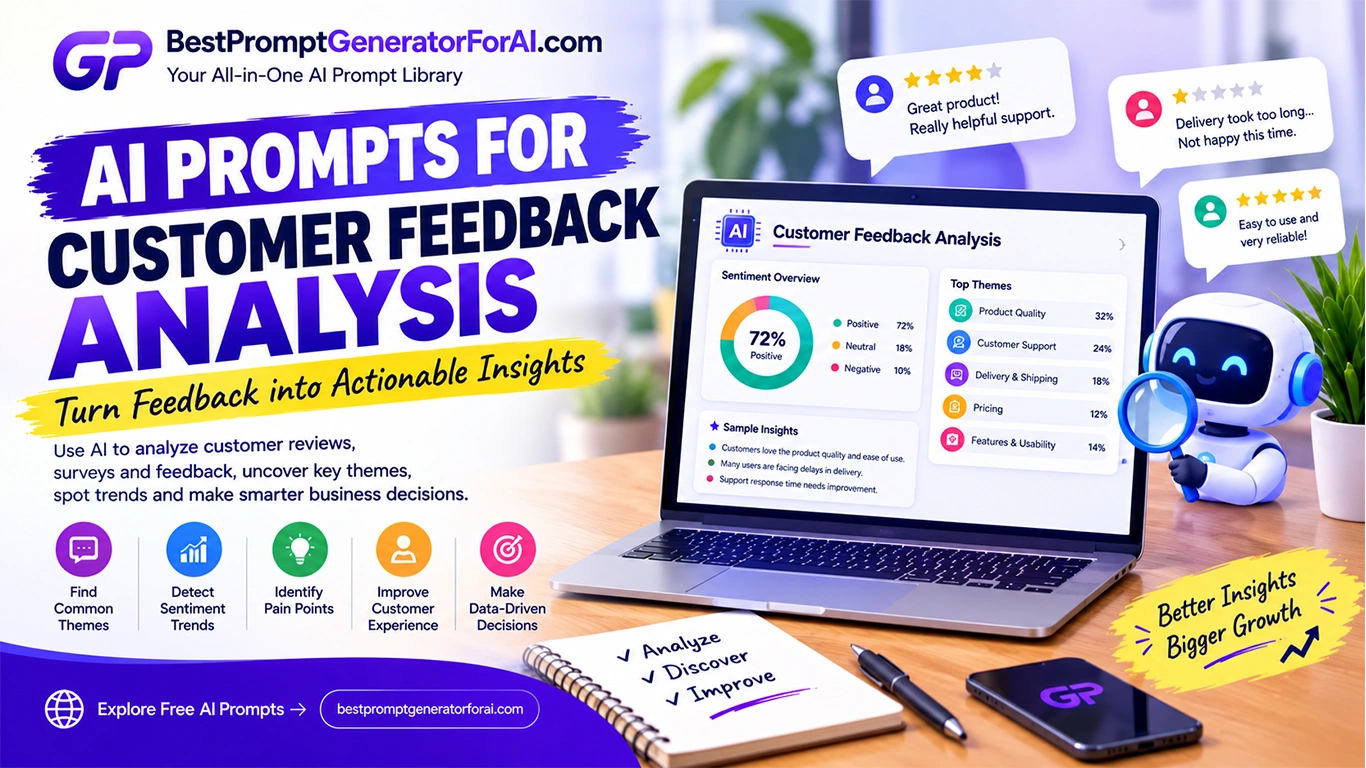
Customer feedback contains valuable information about what customers like, dislike, need, and expect from a product or service. However, reviewing hundreds of reviews, surveys, support messages, and comments manually can be time-consuming.
With the right AI prompts for customer feedback analysis, businesses can quickly identify trends, customer needs, pain points, sentiment, complaints, feature requests, and actionable improvements.
This guide provides practical customer feedback analysis prompts that you can use to analyze customer feedback with AI and turn unstructured responses into useful customer feedback insights.
Customer feedback analysis is the process of reviewing customer comments, reviews, surveys, support conversations, and other responses to discover useful patterns.
AI customer feedback analysis can organize large amounts of information into themes such as positive experiences, negative experiences, product issues, customer complaints, feature requests, and service improvements.
Fill the form and click "Generate Prompt"
Your professional AI prompt will appear here
✓ Prompt generated successfully!
Copy and paste this into ChatGPT, Claude, or any AI model to get expert results.
AI can identify repeated complaints and problems that appear across multiple customer responses.
Customer sentiment analysis helps businesses understand whether customers feel positive, negative, or neutral about their experiences.
AI can identify common requests, expectations, missing features, and areas where customers want better experiences.
Instead of manually reviewing every response, teams can use AI to summarize and organize large amounts of feedback quickly.
Effective analysis does more than summarize comments. It helps businesses decide which problems should be solved first.
Clearly explain whether you want to identify sentiment, complaints, customer needs, product issues, themes, or feature requests.
Include relevant information about your product, audience, industry, or feedback source so the AI can provide more useful results.
Ask for a table, summary, categorized list, priority ranking, or action plan depending on how you intend to use the results.
For better results from different AI tasks, learn how effective prompt engineering improves AI responses.
Prompt: Analyze the following customer feedback and identify the main positive themes, negative themes, recurring complaints, customer needs, feature requests, and improvement opportunities. Summarize the most important findings and provide three actionable recommendations.
Prompt: Analyze the following customer responses and classify each one as positive, negative, or neutral. Explain the main reason for each sentiment and provide an overall summary of customer sentiment.
Prompt: Review these customer comments and identify the most common pain points. Group similar problems together and explain their frequency, customer impact, possible causes, and recommended solutions.
Prompt: Analyze this product feedback and identify the features customers like, features they dislike, usability problems, missing functionality, and frequently requested improvements. Rank the opportunities according to customer impact.
Prompt: Extract all product and feature requests from the customer feedback. Combine similar requests, explain the customer problem behind each request, and rank them by frequency and importance.
Prompt: Analyze these customer complaints and group them into categories. For each category, identify the frequency, likely cause, customer impact, severity, and recommended action.
Prompt: Identify the recurring themes in this customer feedback. Combine comments that describe similar issues and explain what each major theme means for the business.
Prompt: Create a concise executive summary of this customer feedback. Include the strongest positive themes, biggest customer concerns, important trends, requested improvements, and recommended next steps.
Prompt: Prioritize the problems found in this customer feedback based on frequency, customer impact, urgency, and business value. Classify each issue as high, medium, or low priority.
Prompt: Turn the following customer feedback into an action plan. Identify each major problem, supporting customer insight, recommended solution, priority, expected customer benefit, and suggested success metric.
Prompt: Analyze these customer reviews and identify sentiment, recurring topics, positive experiences, complaints, product issues, feature requests, and important improvement opportunities.
Customer support conversations can reveal repeated questions, confusing processes, product problems, and service issues. AI can organize this information so support and product teams can identify recurring problems more easily.
Use these AI prompts for customer support teams and feedback analysis to create more targeted support workflows.
Prompt: Analyze the following customer support conversations and identify common questions, recurring problems, product issues, communication problems, and opportunities for self-service. Rank the findings according to frequency and customer impact.
Gather customer reviews, survey responses, support tickets, emails, interviews, and other feedback into one organized source.
Decide whether your goal is to understand customer sentiment, find pain points, discover feature requests, or identify broader trends.
Select a prompt that matches your objective and provide enough context for the AI to understand the feedback.
Check important findings against the original customer comments. Human review is especially important when feedback contains sarcasm, unclear wording, or industry-specific language.
Use the findings to improve products, services, customer support, onboarding, messaging, or other parts of the customer experience.
A reusable customer feedback analysis template can make regular analysis faster and more consistent.
Customer Feedback: [Paste feedback here]
Customer Segment: [Enter customer group]
Analysis Goal: [Enter the main objective]
Instructions: Identify positive themes, negative themes, customer pain points, sentiment, feature requests, recurring complaints, and important trends. Provide evidence for major findings and finish with prioritized recommendations.
This format can be adapted for surveys, reviews, support conversations, product feedback, and customer interviews.
Specific prompts usually produce more useful results than broad instructions such as “analyze this feedback.”
Request examples from the original feedback so your team can understand why an insight was identified.
Using the same categories over time makes it easier to compare customer feedback and identify changes.
Ask AI to distinguish between what customers directly said and what it inferred from their comments.
AI can speed up analysis, but important business decisions should still include human judgment.
To improve your prompts further, avoid these common AI prompt mistakes that affect output quality.
Problems mentioned by many customers may deserve immediate attention, particularly when they affect satisfaction or retention.
Positive feedback can reveal the product features, services, or experiences that customers appreciate most.
Repeated suggestions and complaints can help product teams decide which improvements could have the greatest customer impact.
Regular customer feedback analysis can show whether satisfaction, complaints, and customer needs are changing after product or service improvements.
Customer feedback can also reveal the language customers naturally use when describing their problems, expectations, and desired outcomes.
Identify frequently used words and phrases that describe customer problems and desired results.
Analyze positive comments to discover which product benefits customers value most.
Feedback can reveal concerns about pricing, features, usability, service quality, or competitors.
Marketing teams can use these findings alongside AI prompt templates for marketing workflows.
Unclear instructions can produce broad results that are difficult to apply to real business decisions.
The same comment may have different meanings for different customer groups, products, or industries.
Negative feedback is important, but positive feedback can reveal the strengths your business should protect and expand.
AI-generated insights should be checked before they become major product, marketing, or customer experience decisions.
To show what the generator above produces, we filled it in with a realistic scenario and copied the result exactly as the tool returned it. Nothing below was edited by hand.
Act as an expert customer feedback analyst.

Analyze the following customer feedback.

Product or service: Subscription snack box

Customer feedback
"Delivery was fast but the box arrived dented." "Love the flavors, but the app keeps logging me out." "Support replied in two hours and fixed my order." "The price went up again, though the quality is still good."

Analysis type
Pain Point Analysis

Customer type
Existing Customers

Business goal
Decide which two problems to fix first

Please analyze the feedback according to the selected analysis type.

Identify the most important patterns, customer needs, concerns, and actionable insights.

If analyzing sentiment, classify the feedback as positive, negative, or neutral and explain the reasons.

If analyzing pain points or complaints, identify the recurring problems, their frequency, customer impact, possible causes, and recommended solutions.

If analyzing feature requests, group similar requests and explain which improvements appear most valuable.

If analyzing themes, identify the major recurring themes and explain what they mean for the business.

If analyzing product feedback, identify strengths, weaknesses, usability issues, missing features, and improvement opportunities.

Present the final results as
Action Plan

Prioritize findings according to
Balanced

Base your analysis only on the provided customer feedback. Do not invent customer opinions or information that is not supported by the feedback.
Good for finding patterns in feedback you already have. The prompt tells the AI to base its analysis only on the pasted comments, which reduces invented opinions. The four comments above are sample text written for this example, not real customers. Keep personal details out of any feedback you paste, and check the counts and themes the AI reports against your own data.
They are instructions that tell an AI tool how to review customer feedback and identify sentiment, themes, complaints, customer needs, and improvement opportunities.
Yes. AI can organize reviews by sentiment, topic, complaint, feature request, and recurring customer concerns.
Yes. AI can group similar complaints and identify recurring problems, their potential causes, and their customer impact.
Customer sentiment analysis determines whether feedback expresses a positive, negative, or neutral opinion and helps explain the reasons behind that opinion.
Yes. AI can extract feature requests, combine similar suggestions, and help teams prioritize them according to customer demand.
No. AI can make analysis faster, but human review is important for validating significant findings and understanding context.
AI can make customer feedback analysis faster, more organized, and easier to scale. With well-written prompts, businesses can identify customer sentiment, recurring pain points, product opportunities, feature requests, and actionable customer feedback insights.
The best results come from combining clear prompts, relevant customer information, structured analysis, and human judgment. Start with a specific goal, choose the right customer feedback analysis prompt, review the findings, and turn the most valuable insights into measurable improvements.
If you need to select the right AI solution for a particular analysis task, this guide explains how to choose the right AI model for your task.

About the author
Best Prompt Generator for AI Team
Best Prompt Generator for AI Team is the small team behind bestpromptgeneratorforai.com, based in Rajkot, Gujarat, India. We build free tools that turn a rough idea into a clear, structured prompt for ChatGPT, Claude, Gemini, Midjourney and other AI tools, and we publish practical guides and prompt examples for creators, marketers and everyday users. Every tool and article is written and reviewed by our team before it is published. Questions or corrections: info@bestpromptgeneratorforai.com. Our tools are free to use, with an optional Pro plan for higher monthly limits.
Enter a subject and AI will instantly build the best form for you — up to 10 smart fields.
Searching best fields for your subject…
These fields were crafted specifically for your prompt type.
Generating your optimised prompt…