Configuration
Generated Prompt
Fill the form and click "Generate Prompt"
Your professional AI prompt will appear here
The healthcare sector is evolving rapidly, and artificial intelligence (AI) is becoming increasingly useful in medical and administrative workflows. Doctors and healthcare professionals often manage patient communication, clinical documentation, medical research, education, reports, and many other time-consuming tasks.
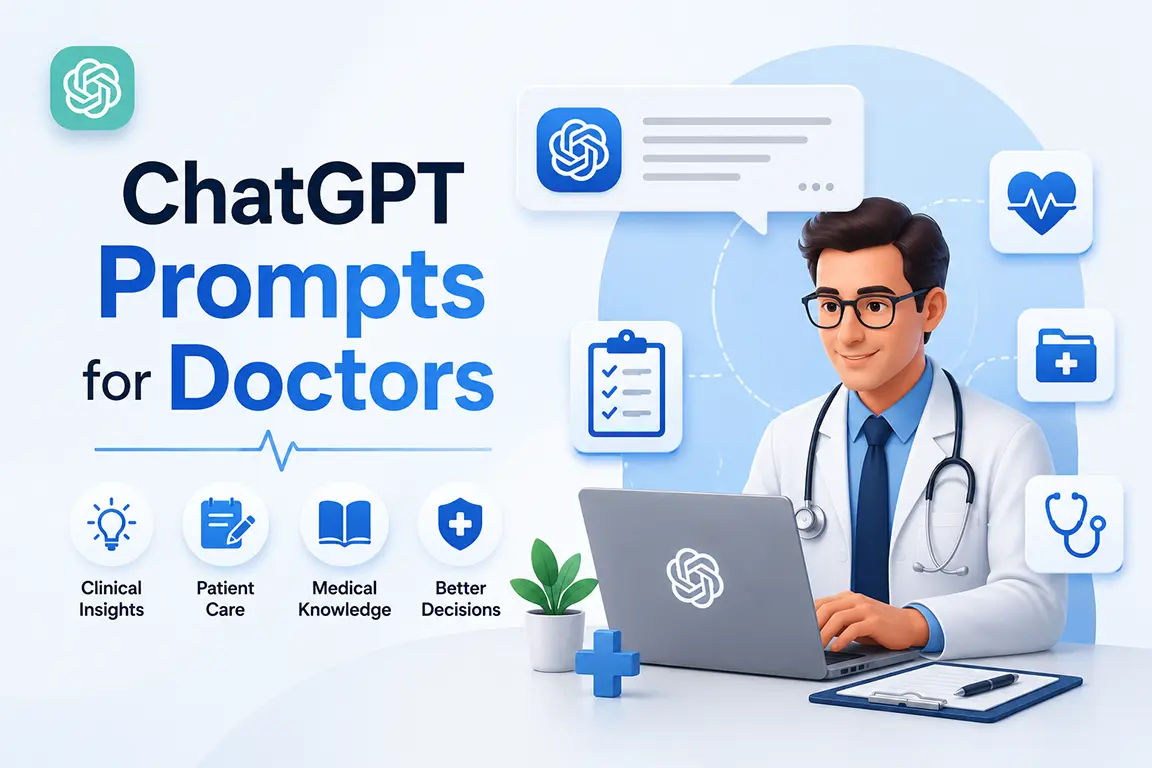
This is where ChatGPT prompts for doctors can help. Well-written prompts allow doctors to give ChatGPT clear instructions and receive more structured, relevant, and useful responses for tasks such as patient education, medical documentation, research summaries, communication, and healthcare content creation.
However, ChatGPT should be used as an assistive tool rather than a replacement for professional medical judgment. Medical information generated by AI should always be reviewed and verified by a qualified healthcare professional before it is used for patient care or clinical decision-making.
In this guide, you’ll learn how ChatGPT prompts for doctors can be used in different healthcare workflows, along with practical AI prompts that doctors can adapt for their daily work.
What Is ChatGPT and Why Is It Useful for Doctors?
ChatGPT is an AI language model that can understand instructions and generate human-like text. When doctors provide clear context and specific instructions, ChatGPT can help organize information, draft content, summarize material, and improve communication.
The quality of the response depends heavily on the quality of the prompt. A vague instruction may produce a generic response, while a detailed prompt can provide a much more useful output.
Doctors who are new to AI can start with an AI prompt generator for beginners to learn how to create structured prompts.
Why Are ChatGPT Prompts for Doctors Important?
Healthcare professionals work with large amounts of information every day. From clinical notes and research papers to patient instructions and administrative communication, many tasks require considerable time.
Using carefully designed ChatGPT prompts for doctors can help structure these tasks and make AI responses more consistent.
Some potential applications include:
- Creating patient education materials
- Summarizing medical research
- Drafting non-sensitive clinical documentation
- Simplifying complex medical information
- Creating healthcare educational content
- Organizing administrative information
- Preparing teaching materials
- Improving patient communication
- Structuring healthcare-related content
- Supporting medical research workflows
How Can Doctors Use ChatGPT?
There are many ways doctors can use ChatGPT as an assistant for writing, organization, education, and information processing.
Below are some practical applications of ChatGPT prompts for doctors.
1. Create Patient Education Materials
Doctors frequently need to explain medical conditions, procedures, medications, and general health information in language patients can understand.
Instead of writing every explanation from scratch, doctors can use ChatGPT to create a first draft and then review it for medical accuracy.
Example prompt:
Act as a medical education writing assistant. Explain [medical condition] in simple language for a general patient audience. Include what the condition means, common symptoms, general treatment approaches, lifestyle considerations, and when a patient should contact a healthcare professional. Avoid making a diagnosis or giving personalized medical advice.
This type of AI prompt for doctors can help create easy-to-understand educational material while allowing the doctor to make the final clinical review.
2. Write Medical Reports and Clinical Notes
Documentation is an important part of healthcare, but preparing and organizing notes can be time-consuming.
With an appropriate workflow and approved tools, ChatGPT can help structure non-identifiable information into a clearer format.
Example prompt:
Organize the following non-identifiable clinical information into a professional medical note. Use sections for patient history, relevant findings, assessment information, plan, and follow-up. Do not invent missing information. Clearly identify information that requires professional review.
AI-assisted clinical documentation can help improve organization and readability, but doctors should carefully verify every generated detail before using it in an official record.
3. Organize Differential Diagnosis Ideas for Professional Review
AI can also be used to organize potential possibilities based on information supplied by a healthcare professional.
For example:
Based only on the following clinical information, organize possible differential considerations for professional review. For each possibility, list supporting and opposing features and identify what additional information may be relevant. Do not provide a definitive diagnosis or treatment recommendation.
This approach uses ChatGPT medical prompts as an information-organizing aid rather than allowing AI to independently diagnose a patient.
4. Summarize Research Papers and Medical Studies
Doctors and researchers need to keep up with a large amount of medical literature.
ChatGPT can help summarize a research paper or provided study text into a more structured format.
Example prompt:
Summarize this medical research paper for a healthcare professional. Organize the summary into research objective, methodology, population, key findings, limitations, and clinical relevance. Do not introduce information that is not included in the source.
This can make initial research review faster. Doctors should still read the original publication when making clinical, academic, or research decisions.
For doctors using AI regularly, structured medical research prompts can make literature-review workflows more consistent.
5. Understand Clinical Guidelines
Medical guidelines can contain extensive information and technical language.
Doctors can use AI to summarize a guideline they provide, making it easier to identify major recommendations.
Example prompt:
Summarize the following clinical guideline for a healthcare professional. Highlight the major recommendations, patient considerations, evidence limitations, and important exceptions. Use only the information provided and recommend checking the latest official guideline before applying it to patient care.
This is one of the useful applications of ChatGPT for healthcare professionals, but current official sources should always be checked because clinical guidelines can change.
6. Write Healthcare Blogs and SEO Content
Doctors, clinics, hospitals, and healthcare organizations often publish educational content online.
ChatGPT can help generate article outlines, headings, FAQs, topic ideas, and first drafts. Doctors can then review the content and add their professional expertise.
For SEO-focused healthcare writing, you can also use AI prompts for SEO blog writing to create more structured content.
Example prompt:
Create an SEO-friendly outline for a healthcare article about [topic]. Include an introduction, clear H2 and H3 headings, commonly asked questions, medically responsible explanations, and a conclusion. Avoid unsupported medical claims and do not provide personalized medical advice.
Healthcare content should prioritize accuracy, usefulness, credibility, and professional review rather than simply inserting keywords.
7. Explain Medications in Simple Language
Doctors may need to explain general medication information in patient-friendly language.
Example prompt:
Explain the general purpose of [medication] in simple language for a patient. Include its commonly documented uses, general precautions, commonly reported side effects, and situations where the patient should contact a healthcare professional. Do not provide individualized dosage instructions. Keep the explanation easy to understand and suitable for professional review.
This type of ChatGPT prompt for doctors can help create a starting point for patient education.
Any medication-related information should be checked against reliable and current medical references before being given to a patient.
8. Support Hospital Management and Administrative Tasks
Healthcare organizations also have many administrative responsibilities.
AI can assist with tasks such as:
- Drafting internal announcements
- Creating meeting summaries
- Organizing workflows
- Preparing checklists
- Drafting staff communication
- Creating standard operating procedure outlines
- Structuring administrative reports
Example prompt:
Create a professional checklist for [hospital or clinic administrative process]. Organize the checklist into preparation, execution, documentation, quality review, and follow-up. Keep the language concise and identify areas that require organization-specific policies.
These uses can save time without requiring AI to make clinical decisions.
9. Support Medical Education and Study
Doctors, residents, medical students, and healthcare educators can use AI to create educational material.
For example, ChatGPT can help generate:
- Practice questions
- Case-study discussion prompts
- Study summaries
- Flashcards
- Educational outlines
- Explanation of complex concepts
- Teaching scenarios
Example prompt:
Create 10 educational questions about [medical topic] for a healthcare learner. Include answers and brief explanations. Focus on understanding the underlying concepts rather than memorization. Base the material only on the information provided.
You can also explore AI prompts for personalized learning plans when creating structured learning workflows.
10. Improve Patient Communication
Clear communication is essential in healthcare.
Doctors can use ChatGPT to draft or simplify general patient communication, such as appointment instructions, follow-up messages, educational notices, or explanations of medical terminology.
Example prompt:
Rewrite the following healthcare message in a clear, respectful, and easy-to-understand tone for a general patient audience. Keep the medical meaning unchanged, remove unnecessary technical language, and do not add new medical recommendations.
This can make communication easier to understand while allowing the healthcare professional to review the final message.
Benefits of ChatGPT Prompts for Doctors
Using structured ChatGPT prompts for doctors can provide several workflow benefits when AI is used appropriately.
Save Time
AI can help create first drafts, summaries, outlines, checklists, and educational materials more quickly.
Improve Organization
Detailed prompts can encourage AI to structure information into headings, tables, bullet points, or other useful formats.
Simplify Medical Communication
Doctors can use AI to turn complex terminology into easier-to-understand explanations for educational purposes.
Support Research
AI can help organize information from provided research materials and identify key sections that deserve closer review.
Assist With Content Creation
Healthcare professionals and organizations can use AI to create initial drafts for blogs, educational resources, newsletters, and other content.
Improve Prompt Consistency
Reusable medical AI prompts can create repeatable workflows for common writing and organization tasks.
10+ Effective ChatGPT Prompts for Doctors
Here are practical ChatGPT prompts for doctors that can be adapted for different healthcare workflows.
Prompt 1: Patient Education
Explain [medical topic] in simple language for a patient. Cover the basic meaning, commonly discussed symptoms, general management approaches, and when professional medical attention may be necessary. Avoid personalized diagnosis or treatment recommendations.
Prompt 2: Clinical Note Organization
Organize the following non-identifiable clinical information into a professional note with sections for history, findings, assessment information, plan, and follow-up. Do not invent information that is not provided.
Prompt 3: Research Summary
Summarize the following medical study for a healthcare professional. Include the objective, methodology, participants, key findings, limitations, and relevance. Use only information contained in the source material.
Prompt 4: Medical Study Questions
Create 10 study questions about [medical subject]. Include an answer and a concise explanation for each question. Focus on concepts that healthcare learners should understand.
Prompt 5: Patient-Friendly Rewrite
Rewrite this medical explanation in simple, patient-friendly language. Preserve the original meaning, avoid unnecessary medical terminology, and do not add new medical claims.
Prompt 6: Guideline Summary
Summarize this clinical guideline into key recommendations, important considerations, exceptions, and limitations. Use only the provided guideline and remind the reader to verify the latest official version.
Prompt 7: Medical Blog Outline
Create a detailed outline for a healthcare article about [topic]. Include an introduction, H2 and H3 headings, relevant questions, evidence-focused sections, and a conclusion. Avoid unsupported claims and personalized medical advice.
Prompt 8: Medication Education
Create a patient-friendly educational explanation of [medication]. Include its general purpose, commonly documented uses, common side effects, precautions, and when professional advice may be appropriate. Do not provide personalized dosage instructions.
Prompt 9: Administrative Checklist
Create a step-by-step administrative checklist for [healthcare process]. Include preparation, execution, documentation, review, and follow-up steps. Do not assume policies that were not provided.
Prompt 10: Differential Considerations
Organize possible differential considerations based on the information below for review by a qualified healthcare professional. Explain what information may support or weaken each possibility. Do not provide a definitive diagnosis.
Prompt 11: Medical Content Review
Review the following healthcare article for unsupported claims, unclear explanations, excessive jargon, and potentially misleading statements. Identify areas that require verification by a qualified healthcare professional.
How to Write Better ChatGPT Prompts for Doctors
The quality of an AI response depends significantly on how the instruction is written.
A useful healthcare prompt should clearly explain:
- Role – Tell ChatGPT what role it should perform.
- Task – Clearly describe what you want it to produce.
- Context – Provide relevant background information.
- Audience – Explain whether the content is for doctors, healthcare students, patients, or the general public.
- Format – Specify whether you want bullets, paragraphs, tables, summaries, or another structure.
- Limitations – Tell the AI what it must avoid.
- Verification – Ask it not to invent information and identify content requiring professional review.
For more detailed prompt-writing techniques, see this prompt engineering guide.
Example of a Structured Medical Prompt
Instead of writing:
Explain diabetes.
A more structured instruction would be:
Act as a medical education writing assistant. Explain diabetes for a general adult audience. Define the condition, describe commonly discussed risk factors and symptoms, explain general management approaches, and include questions a patient may want to discuss with a healthcare professional. Use clear language, avoid personalized medical advice, and do not invent statistics or clinical recommendations.
The second prompt gives the AI much more context and direction.
How Long Should a Medical Prompt Be?
There is no single ideal length for ChatGPT prompts for doctors.
A good prompt should contain enough information to define the task without adding unnecessary instructions.
For simple tasks, one or two sentences may be enough. More complex healthcare workflows may require information about the audience, source material, output format, limitations, and verification requirements.
Learn more about how long a prompt should be to create clearer AI instructions.
How to Use ChatGPT Responsibly in Healthcare
AI can be useful in healthcare, but doctors should use it carefully.
Protect Patient Privacy
Do not enter personally identifiable, confidential, or sensitive patient information into an AI system unless the system and workflow are specifically approved for that use and comply with applicable privacy requirements.
Whenever possible, use appropriately anonymized or de-identified information.
Verify Medical Information
AI-generated responses can contain incorrect, incomplete, outdated, or misleading information.
Doctors should verify important medical information using appropriate current clinical references and official sources.
Maintain Human Oversight
AI should support healthcare professionals rather than replace professional judgment.
A doctor should review AI-generated documentation, patient education, research summaries, and other healthcare content before it is used.
Avoid Using AI as an Independent Diagnostic Tool
ChatGPT can help organize information and generate differential considerations, but it should not independently diagnose a patient.
Clinical decisions require qualified professional assessment and appropriate medical evidence.
Review Patient-Facing Content
Any content intended for patients should be reviewed carefully to ensure it is accurate, understandable, appropriate, and consistent with the healthcare professional’s advice.
Using ChatGPT Prompts for Medical SEO
Doctors, clinics, hospitals, and healthcare websites can also use AI for content marketing and SEO.
For example, healthcare professionals can create prompts for:
- Medical blog outlines
- Healthcare keyword research
- Patient-focused FAQs
- Article title ideas
- Meta descriptions
- Healthcare content briefs
- Topic clusters
- Internal linking ideas
- Content updates
- Search-intent analysis
For more information, explore SEO-friendly articles with AI and learn how AI can support the content creation process.
Example Medical SEO Prompt
Act as an SEO content strategist for a healthcare website. Create a content brief for the keyword “[keyword].” Identify the likely search intent, relevant secondary topics, useful H2 and H3 headings, FAQs, and important information that should be covered. Prioritize accurate, helpful, user-focused content and avoid unsupported medical claims.
AI can help organize the SEO process, but healthcare content should be reviewed for factual accuracy and credibility before publication.
Advanced Use Cases for ChatGPT in Healthcare
Beyond basic writing tasks, ChatGPT for doctors can support more advanced information workflows when used within an appropriate and verified process.
Clinical Documentation Templates
Doctors can create reusable templates for common documentation tasks.
Medical Education Content
Healthcare educators can develop lesson outlines, discussion questions, and practice exercises.
Research Organization
Researchers can use AI to organize provided research information and create structured summaries.
Patient Communication Workflows
Clinics can create drafts for appointment instructions, general educational materials, and follow-up communication.
Healthcare Content Strategy
Medical practices can develop topic ideas, content calendars, FAQs, and educational resources with AI assistance.
The key is to use AI as a supporting productivity tool, while qualified professionals remain responsible for medical accuracy and final decisions.
Frequently Asked Questions
What are ChatGPT prompts for doctors?
ChatGPT prompts for doctors are specific instructions designed to help healthcare professionals use ChatGPT for tasks such as documentation, patient education, research summaries, medical content creation, communication, and education.
Can doctors use ChatGPT for medical documentation?
Doctors may use AI to assist with drafting or organizing documentation when the workflow is approved and privacy requirements are satisfied. Every AI-generated note should be reviewed carefully by the responsible healthcare professional.
Can ChatGPT diagnose patients?
ChatGPT should not be treated as an independent diagnostic system. Doctors can use AI to organize information or explore differential considerations, but diagnosis requires professional clinical assessment and appropriate medical evidence.
How can doctors create better AI prompts?
Doctors can create better prompts by specifying the role, task, context, audience, desired format, limitations, and verification requirements. Detailed prompts generally provide more useful and consistent results.
Can ChatGPT help doctors write patient education content?
Yes. ChatGPT prompts for doctors can be used to create drafts of patient education materials in simpler language. However, the final content should be reviewed by a qualified healthcare professional before being provided to patients.
Can doctors use ChatGPT for medical research?
ChatGPT can assist with summarizing or organizing research material that has been provided to it. Doctors and researchers should verify important information against the original publication and current authoritative sources.
Can ChatGPT help with healthcare SEO?
Yes. Doctors, clinics, hospitals, and healthcare marketers can use AI to create content outlines, FAQs, topic ideas, keyword-focused briefs, and draft articles. Healthcare content should always be reviewed for accuracy and credibility.
Are ChatGPT prompts safe for patient information?
Doctors should avoid entering identifiable or confidential patient information unless the specific AI system and workflow are approved for that use and meet applicable privacy and organizational requirements.
What are some useful AI prompts for healthcare professionals?
Useful AI prompts for doctors and healthcare professionals include prompts for patient education, research summaries, documentation organization, medical education, guideline summaries, communication, healthcare content, and administrative tasks.
Conclusion
ChatGPT prompts for doctors can make many writing, education, research, communication, and administrative workflows more efficient. From creating patient-friendly explanations and organizing documentation to summarizing research and developing healthcare content, AI can act as a useful productivity assistant.
The most important factor is how the technology is used. Doctors should provide clear instructions, protect patient privacy, verify AI-generated information, and maintain professional oversight throughout the process.
By combining effective ChatGPT prompts for doctors with professional expertise and responsible AI practices, healthcare professionals can explore the benefits of AI while keeping accuracy, privacy, and patient safety at the center of their workflow.