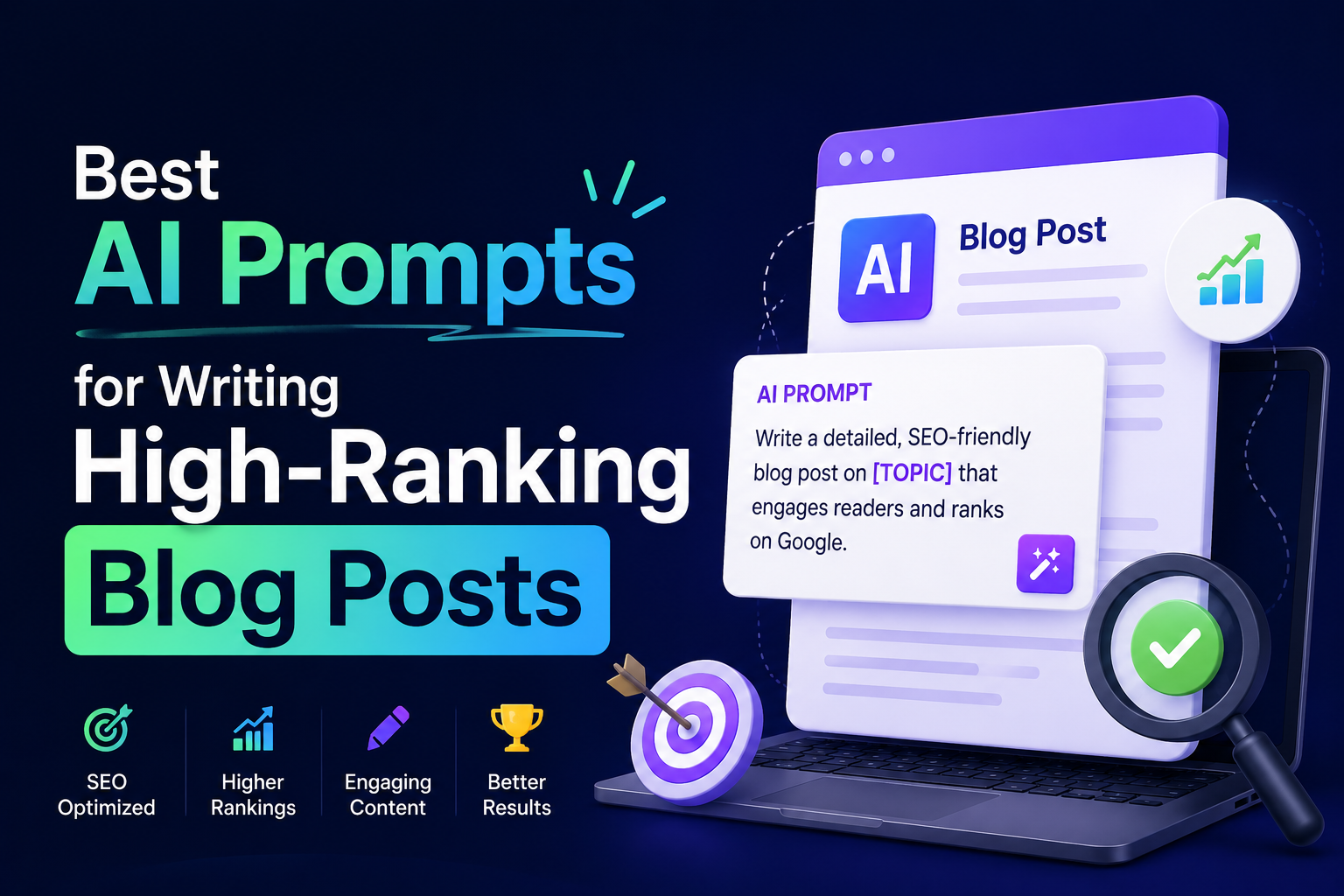
AI prompts help content creators develop SEO-friendly blog posts by generating topic ideas, creating structured outlines, optimizing keywords, improving readability, and aligning content with search intent. With the right AI prompts, marketers can save time while creating useful, well-structured content that has a better opportunity to perform well in search results.
Introduction: How to Write High-Ranking Blog Posts with AI?
In today’s digital age, simply writing a blog post is not enough. The goal for businesses, bloggers, and content creators is to create useful content that satisfies readers and is easy for search engines to understand.
Strong writing alone does not guarantee search visibility. Proper keyword research, SEO strategy, content planning, search intent, internal linking, readability, and accurate information are also important parts of creating an effective blog post.
This is where Artificial Intelligence (AI) can become a useful content creation assistant. By using well-structured AI prompts, you can generate topic ideas, develop outlines, explore related keywords, improve content structure, and identify areas that need optimization.
AI prompts for blog writing have become increasingly useful for content writers and marketers. Instead of asking AI to simply “write a blog,” detailed prompts can provide clear instructions about the audience, topic, search intent, keywords, structure, tone, and content requirements.
For a more structured approach, you can create stronger SEO blog content with practical AI prompts and use those prompts as part of your content workflow.
In this guide, we will learn how to use AI prompts to plan, write, optimize, and improve blog posts for search and readers.

Why Are AI Prompts Necessary for High-Ranking Blog Posts?
Thousands of new blog posts are published online every day. In this competitive environment, publishing an article is only one part of the process. Content also needs to provide useful information, satisfy search intent, follow a clear structure, and offer a good reading experience.
AI prompts for writing high-ranking blog posts can help writers and marketers organize the content creation process. With the right instructions, AI can assist with keyword research, blog outlines, SEO-friendly headings, content ideas, search intent analysis, and content improvement.
However, AI should be treated as an assistant rather than a replacement for human expertise. Every AI-generated draft should be reviewed, fact-checked, edited, and improved before publication.
What Should High-Ranking Blog Content Include?
- Useful and informative information: Readers should be able to find clear answers and practical solutions to their questions.
- Natural SEO optimization: Relevant keywords, descriptive headings, internal links, title tags, and meta descriptions should support the topic naturally.
- Clear search intent: The article should address the reason behind the user’s search instead of focusing only on keywords.
- Simple and readable language: Clear sentences, logical sections, and useful formatting make content easier to understand.
- Original value: Examples, practical experience, expert insights, data, and useful explanations can make an article more valuable to readers.
What Is AI Content Creation?
AI content creation is the process of using Artificial Intelligence tools to assist with creating different types of content. AI can help generate blog ideas, outlines, social media posts, emails, advertisements, video scripts, product descriptions, and other marketing materials.
AI content creation can make repetitive writing tasks more efficient. It can also help content teams brainstorm topics, organize information, improve drafts, and identify opportunities for optimization.
What Can Be Created with AI Content Creation?
- Blog Content: Creating blog ideas, outlines, articles, and SEO-focused content drafts.
- Social Media Content: Creating post ideas, captions, content calendars, and engagement-focused copy.
- Marketing Copy: Writing advertisements, landing page copy, email campaigns, and promotional content.
- Video Content: Creating video scripts, outlines, hooks, and content ideas.
- Product Descriptions: Creating informative and persuasive product descriptions for e-commerce businesses.
The Role of AI in SEO-Friendly Blog Writing
SEO-friendly blog writing means creating content that is useful, readable, well organized, and relevant to what people are searching for. Effective SEO content uses relevant keywords naturally while focusing primarily on the needs and questions of the audience.
AI can support SEO-friendly blog writing by helping writers research topics, understand search intent, organize content, identify keyword opportunities, and improve drafts. The final article should still be reviewed by a human to maintain accuracy, originality, expertise, and a natural writing style.
1. Help With Keyword Research
AI can help identify primary keywords, related search terms, long-tail variations, questions, and topical concepts associated with a subject. These suggestions can give writers a starting point for building a comprehensive content plan.
For deeper keyword planning, you can find relevant SEO keywords using practical AI prompt workflows before creating your article outline.
2. Creating a Blog Outline
AI can generate a logical blog structure based on the main topic, target audience, and search intent. It can suggest H2 and H3 sections, questions to answer, supporting topics, and potential content gaps.
A strong outline helps prevent unnecessary repetition and gives the writer a clear direction before drafting the article.
3. SEO-Friendly Content Creation
AI can assist with creating an initial content draft using simple language, relevant terminology, logical headings, and useful explanations. However, AI-generated text should be edited to add originality, expertise, examples, and accurate information.
For additional writing support, you can use practical AI prompts for writing SEO-focused blog content throughout your drafting process.
4. Content Optimization
AI can review existing content and suggest improvements to titles, headings, keyword usage, readability, content structure, internal linking opportunities, and meta descriptions.
These recommendations should be treated as suggestions rather than automatic SEO rules. Human review is still important because optimization should always support the reader and the purpose of the article.
AI Tools for Content Writers
Many AI tools can assist content writers with brainstorming, drafting, editing, research, and optimization. Different tools are useful for different stages of the content workflow.
- ChatGPT
- Jasper AI
- Copy.ai
- Grammarly AI
- Surfer SEO
The best tool depends on the task, content requirements, workflow, budget, and level of human editing involved.
How to Write a High-Ranking Blog Using AI?
Step 1: Choose the Right Topic
Choose a topic that solves a real problem or answers an important question for your target audience. Before writing, consider what readers want to learn, what information they need, and what type of content best satisfies their search intent.
Step 2: Do Keyword Research
Identify the primary keyword along with relevant secondary keywords, long-tail keywords, related questions, and supporting topics. Avoid choosing keywords simply because they have high search volume. Relevance to the article and audience should remain the priority.
Step 3: Create an Outline With AI
Give AI clear instructions about your topic, audience, search intent, keywords, content format, and required sections. Ask it to create a logical outline with useful H2 and H3 headings.
Step 4: Write Useful Content With AI Assistance
Use AI to create a first draft or expand individual sections, but add your own expertise, examples, observations, and accurate information. Human editing helps make the article more natural, useful, and trustworthy.
Step 5: Optimize the Article for SEO
After drafting the article, review its SEO elements and overall usefulness. Check the following areas:
- Use the primary keyword naturally.
- Include relevant secondary and related keywords where appropriate.
- Use descriptive H2 and H3 headings.
- Add relevant internal links.
- Write a useful SEO title and meta description.
- Improve readability and content structure.
- Check that the article satisfies the intended search intent.
- Review factual claims before publishing.
SEO Optimization Tips for AI-Generated Content
AI can make content creation more efficient, but publishing an AI-generated draft without review can result in generic, inaccurate, repetitive, or poorly targeted content. Proper editing and optimization are essential.
Add a Human Touch
Improve AI-generated content with your own experience, examples, expertise, opinions where appropriate, and original explanations. Human input can make the content more useful and distinctive.
Avoid Keyword Stuffing
Use keywords naturally rather than repeatedly inserting the same phrase. Excessive keyword repetition can make an article difficult to read and can weaken the overall quality of the content.
Provide Valuable Information
Focus on answering the reader’s questions completely. Include practical examples, clear explanations, relevant steps, and useful details instead of adding text simply to increase word count.
Keep Important Content Updated
Review articles periodically when information, statistics, tools, examples, or recommendations change. Updating outdated information can help maintain usefulness and accuracy over time.
Add Relevant Images and Visual Content
Relevant images, screenshots, charts, diagrams, and examples can make complex information easier to understand and improve the overall reading experience. Visuals should support the topic rather than being added only for decoration.
Common AI Writing Mistakes
Not Doing Manual Editing
Publishing AI-generated content without reviewing it can lead to factual errors, awkward language, repetitive explanations, or content that does not match the intended audience.
Overusing Keywords
Keywords are useful for helping search engines understand a topic, but excessive repetition can make content unnatural. Focus on relevance and readability instead.
Ignoring Search Intent
Creating content around keywords alone is not enough. The article should understand what users actually want when they search for the topic and provide an appropriate answer.
Lack of Human Expertise
AI can generate general information, but human knowledge and experience can provide context, practical examples, original insights, and more useful recommendations.
Not Checking Facts
AI can sometimes generate inaccurate, incomplete, or outdated information. Always verify important facts, statistics, claims, product details, and other information before publication.
How to Create an AI Content Strategy?
An effective AI content strategy is more than generating articles quickly. It should connect AI-assisted content creation with audience needs, keyword research, search intent, content goals, quality standards, and human review.
1. Define Your Content Goals
Determine whether your content strategy is focused on organic search visibility, educating customers, generating leads, supporting sales, building authority, or another specific objective.
2. Identify Your Target Audience
Understand who you are writing for, what problems they face, what questions they ask, and what information they need before making a decision.
3. Build a Keyword and Topic Framework
Create topic clusters around your main subject and identify primary keywords, secondary keywords, related questions, and supporting topics. This gives AI clearer instructions and helps create a more organized content plan.
4. Create Reusable AI Prompt Workflows
Develop prompts for different stages such as topic research, keyword analysis, outlining, drafting, editing, SEO optimization, and content updating. Reusable prompts can make the content workflow more consistent.
5. Add Human Review and Quality Control
Every AI-assisted article should go through human review. Check accuracy, originality, search intent, tone, structure, examples, internal links, and overall usefulness before publishing.
You can also build a stronger AI content marketing strategy with workflows to organize AI-assisted content production more effectively.
6. Measure and Improve Content Performance
Monitor relevant content metrics and review which topics, formats, and sections perform well. Use these insights to improve future content rather than relying only on AI-generated recommendations.
FAQs
1. What is a high-ranking blog?
A high-ranking blog is a blog post that performs strongly in search engine results for relevant search queries. It generally provides useful information, satisfies search intent, uses clear structure, and follows sound SEO practices.
2. How can AI prompts help create a high-ranking blog?
AI prompts can help generate topic ideas, keyword suggestions, blog outlines, headings, content drafts, optimization suggestions, and questions related to search intent. Human review and editing are still necessary to ensure the final content is accurate and valuable.
3. What are the key elements of a high-ranking blog?
Important elements include relevant topic targeting, keyword research, useful and original information, clear headings, strong search-intent alignment, internal links, readable formatting, optimized metadata, and a positive user experience.
4. Why is keyword research important for a high-ranking blog?
Keyword research helps identify the topics, phrases, questions, and problems people are searching for. It gives content creators useful direction for planning articles that are relevant to their intended audience.
5. Can AI write content for a high-ranking blog?
Yes, AI can assist with topic ideas, outlines, research, and draft content for a blog post. However, AI-generated content should be reviewed, fact-checked, edited, and enhanced with human expertise before publication.
6. Should AI-generated blog content be edited before publishing?
Yes. Human editing is important for checking factual accuracy, improving readability, removing repetitive content, adding original insights, matching the brand voice, and ensuring that the article genuinely satisfies the reader’s needs.
7. Can AI-generated content guarantee higher Google rankings?
No. AI-generated content cannot guarantee higher rankings. AI can support research, writing, and optimization, but search performance depends on many factors, including relevance, quality, competition, technical SEO, authority, and user experience.
Conclusion
AI prompts for writing high-ranking blog posts can help content writers and marketers make many parts of the content workflow more efficient. AI can assist with topic research, keyword ideas, content outlines, drafting, SEO optimization, readability, and content improvement.
However, using AI does not automatically make a blog post rank well. Search performance depends on factors such as content quality, relevance, search intent, competition, website authority, technical SEO, internal linking, and the overall user experience.
The most effective approach is to combine AI assistance with human expertise, original insights, careful fact-checking, thoughtful SEO optimization, and ongoing content improvement. When AI is used as a strategic assistant rather than a replacement for human judgment, it can help create more useful and search-focused blog content efficiently.