Written by Best Prompt Generator for AI Team
Reviewed by our team before publishing — learn more about us


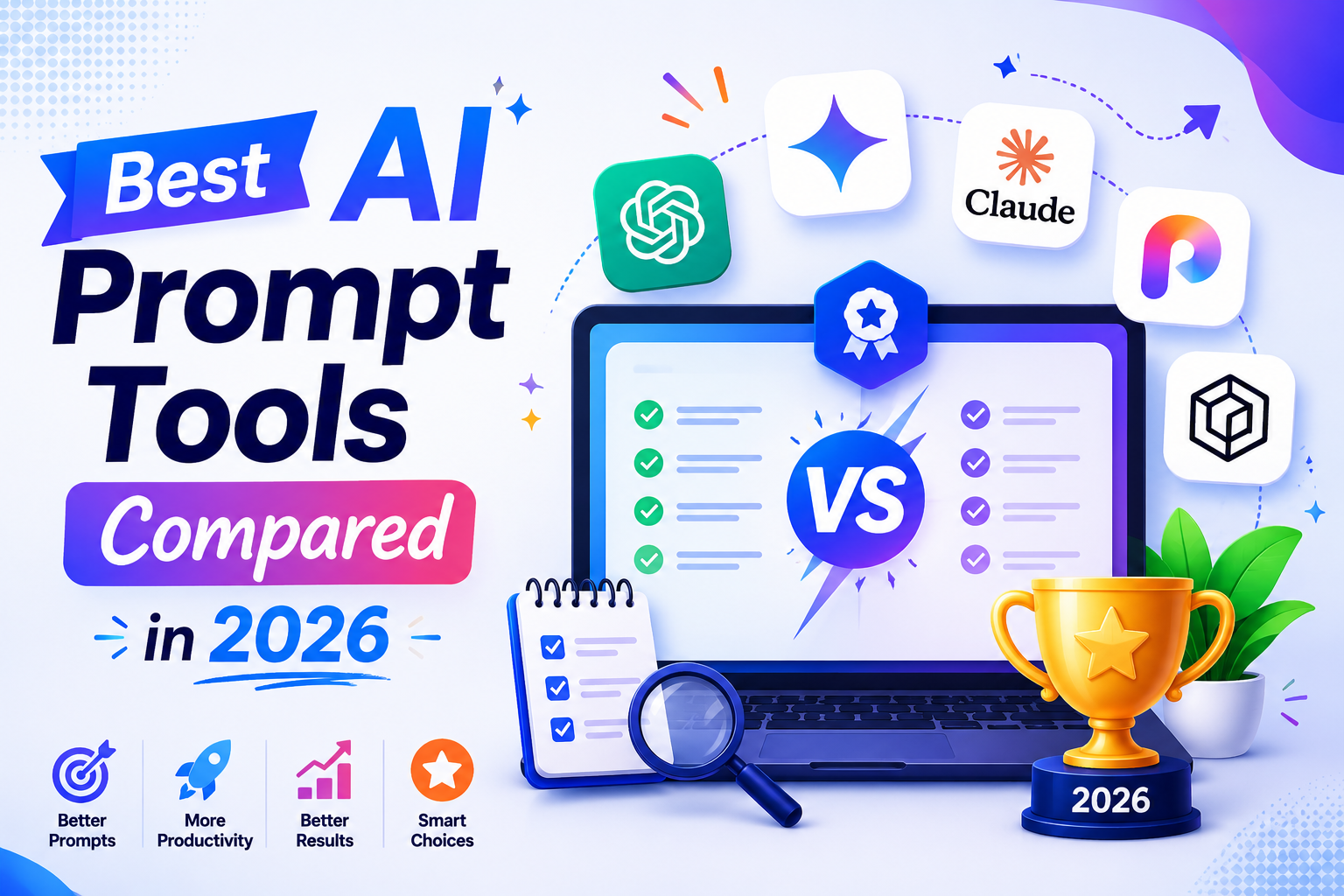
AI prompt tools compared in 2026 show how different platforms can vary in prompt optimization, usability, features, flexibility, and supported AI workflows. By comparing AI prompt tools, users can identify solutions that fit their needs for content creation, SEO, marketing, coding, research, and other AI-powered tasks.
AI tools are now part of everyday workflows for content creators, marketers, bloggers, developers, businesses, and professionals. However, getting useful results from an AI system often depends on how clearly the task is explained. This is why AI prompt tools have become increasingly useful.
AI prompt tools can help users create, improve, organize, or discover prompts instead of writing every instruction from scratch. Some platforms focus on prompt optimization, while others provide prompt libraries, communities, templates, or specialized workflows.
In this guide, we will compare popular AI prompt tools in 2026, examine their key features, discuss their strengths and limitations, explain who they may be suitable for, and show what factors you should consider before choosing a prompt tool.
AI prompt tools are software platforms or services that help users create, improve, organize, discover, or manage prompts for artificial intelligence systems. A prompt is the instruction or input given to an AI model to explain what you want it to do.
In simple terms, AI prompt tools help users create clearer instructions so AI systems can better understand the requested task.

These tools can support different tasks, including:
The right prompt tool depends on the user’s goal, preferred AI model, workflow, experience level, and required features.
AI prompt tools can make it easier to create structured instructions and develop repeatable AI workflows. Instead of experimenting with vague instructions, users can use templates, optimization features, or prompt libraries to create more specific inputs.
A detailed prompt gives an AI system more useful context about the requested task. For example, a prompt such as “Write an SEO-friendly fitness blog for beginners in 1,000 words using a helpful and conversational tone” provides more direction than simply asking, “Write a fitness blog.”
AI prompt tools can help users create prompts for blog posts, social media content, video scripts, product descriptions, email campaigns, and other content tasks.
Reusable prompts and templates can reduce the need to write similar instructions repeatedly. This is especially useful for marketers, content teams, agencies, and businesses with recurring AI workflows.
AI prompt tools can help users develop instructions for keyword research, content planning, SEO writing, social media campaigns, email marketing, and other digital marketing activities. For SEO-focused content workflows, use practical AI prompts for improving SEO content workflows.
Prompt tools can also help users create structured instructions for coding, data analysis, brainstorming, research, customer support, business planning, and other professional tasks.
There are many AI prompt platforms available, and they are not all designed for the same purpose. Some focus on prompt optimization, some provide ready-made prompt libraries, and others help users discover or purchase prompts.
The following comparison focuses on the main purpose, features, strengths, and suitable use cases of several well-known prompt platforms and tool categories.
PromptPerfect is a prompt optimization platform designed to help users improve prompts before using them with AI models. Its purpose is to make prompts more structured and effective for different types of AI tasks.
FlowGPT is a community-focused platform where users can discover and share AI prompts. Its prompt library approach can be useful for people looking for examples and ideas for different AI tasks.
PromptBase is a marketplace for AI prompts where users can discover, purchase, and sell prompts for different AI applications. It is particularly relevant for users interested in specialized or commercially created prompt resources.
AIPRM is a prompt library and productivity extension associated with ChatGPT workflows. It provides access to collections of pre-built prompts that can help users with content creation, SEO, marketing, and other common tasks.
ChatGPT prompt builder tools are designed to help users create more structured instructions for ChatGPT and similar AI systems. These tools may guide users through elements such as context, role, task, constraints, examples, and output format.
Different AI prompt tools can be suitable for different users. Instead of choosing a tool simply because it is popular, consider what you actually need from the platform.
| Tool or Platform | Best For | Difficulty | Main Purpose |
|---|---|---|---|
| PromptPerfect | Prompt optimization | Easy | Improving prompts |
| FlowGPT | Content creators | Easy | Discovering shared prompts |
| PromptBase | Prompt buyers and creators | Medium | Prompt marketplace |
| AIPRM | SEO and marketing users | Medium | Ready-made prompt library |
| Prompt Builder Tools | General users | Easy | Creating structured prompts |
Beginners may prefer tools that provide templates, guided prompt creation, or ready-made examples. These features can make it easier to understand how effective prompts are structured.
Content creators can benefit from prompt libraries and content-focused prompt tools that provide ideas for blogs, social media posts, scripts, product descriptions, and other content formats.
SEO professionals may prefer tools that provide structured prompts for keyword research, content planning, search intent analysis, and SEO-focused writing.
Advanced users may prefer prompt optimization tools or flexible prompt-building platforms that allow them to create complex workflows and customize instructions for specific AI models.
Choosing the right AI prompt tool requires more than looking at its number of templates. Consider how the platform fits your workflow, AI models, experience level, and content requirements.
A good prompt tool should be easy to understand and use. Beginners may benefit from guided interfaces, while advanced users may want more control over prompt structure.
Look for tools that help create clear, specific, and context-rich prompts rather than simply generating longer instructions.
Some prompt tools are designed around particular AI platforms, while others support multiple models. Before choosing a tool, check whether it works with the AI systems you regularly use.
If you are unsure which AI model fits a particular task, compare AI models to choose the right tool for tasks.
Reusable templates and prompt libraries can be valuable for users who regularly perform similar tasks. They can reduce repetitive work and provide starting points for new workflows.
Advanced users may need tools that allow them to customize roles, context, instructions, constraints, examples, and output formats.
Compare the available features, usage limits, free options, and paid plans before selecting a tool. A free tool may be sufficient for occasional use, while teams with larger workflows may require more advanced capabilities.
AI prompt tools can support a wide range of professional and creative activities. Their usefulness depends on the quality of the prompt, the AI model being used, and the complexity of the task.
Content creators can use prompt tools to develop article outlines, introductions, content ideas, summaries, and other writing tasks. For more search-focused workflows, explore AI prompts designed for creating high-ranking blog content.
Marketers can create prompts for advertising concepts, email campaigns, landing pages, audience research, campaign planning, and social media content.
SEO professionals can use structured prompts for keyword research, search-intent analysis, content briefs, on-page optimization, and content development.
Creators can use prompts for video ideas, scripts, titles, descriptions, hooks, and content planning.
Developers can use prompts to explain programming problems, generate code examples, troubleshoot errors, document code, and explore possible technical solutions.
Businesses can use AI prompt tools for brainstorming, research, customer communication, planning, internal documentation, and repetitive administrative workflows.
There are many AI prompt platforms, but each one can offer a different approach to prompt creation and management. Comparing them helps users identify the features that are most relevant to their specific needs.
A content creator may need a prompt library, while an advanced AI user may prefer prompt optimization and customization features.
The right tool can reduce repetitive prompt-writing tasks and make frequently used AI workflows easier to repeat.
Prompt libraries and marketplaces can provide ideas that users may not have considered when creating prompts from scratch.
Comparing tools allows users to evaluate free plans, paid features, usage limits, and overall value before committing to a platform.
AI prompt tools can be useful, but users can also create effective prompts manually by following a clear structure.
Tell the AI what role it should take, such as SEO writer, marketing strategist, coding assistant, teacher, or research assistant.
Include the background information the AI needs to understand the task properly.
Use direct instructions and specify exactly what you want the AI to produce.
Include requirements such as word count, tone, audience, formatting, language, or information that should be avoided.
Tell the AI whether you want a table, list, paragraph, JSON output, outline, email, article, or another format.
For a deeper understanding of structured prompting, discover how to build clearer and more effective AI prompts.
AI prompt tools are continuing to evolve as AI models become more capable and users expect more efficient workflows. Prompt platforms are increasingly focused on helping users create structured instructions, reuse successful prompts, and connect prompting with broader AI workflows.
Voice interfaces can make it easier for users to describe tasks without manually typing long instructions.
Prompt optimization features can help users refine instructions by identifying missing context, unclear wording, or structural improvements.
Support for multiple languages can make AI prompting more accessible to users and businesses working across different markets.
AI systems can suggest additional context, instructions, examples, or output requirements based on the user’s initial request.
Future prompt workflows may increasingly combine prompt creation with real-time suggestions, editing, and output evaluation.
Comparing AI prompt tools in 2026 shows that there is no single platform that is ideal for every user or every task. Different tools focus on different areas, including prompt optimization, prompt libraries, prompt marketplaces, structured prompt creation, and AI productivity workflows.
PromptPerfect can be useful for prompt optimization, FlowGPT for discovering community prompts, PromptBase for prompt marketplace resources, AIPRM for ready-made prompt collections, and prompt builder tools for creating structured instructions.
The best choice depends on your goals, preferred AI models, experience level, budget, and the type of work you want to accomplish. Before selecting a platform, compare its features, usability, customization options, model compatibility, and pricing.
For users who want to make everyday AI workflows more efficient, find practical ChatGPT prompts for saving valuable work time and adapt reusable instructions to your own tasks.
Extra ready-to-use prompts you can copy and adapt. Replace anything in [brackets] with your own details.
Manual prompting can be useful when users understand the AI model well and need precise control over the instructions. Experienced users may prefer writing prompts themselves for specialized or highly specific workflows.
An AI prompt generator can be useful when users are beginners, need help structuring ideas, or frequently create similar prompts. It can also provide a useful starting point when the user knows what they want but does not know how to communicate it effectively to an AI system.
You can use an AI Prompt Generator to save time, organize your ideas, create reusable prompts, and get help structuring instructions for AI tools. It can be especially useful for beginners who are still learning how to write effective prompts.
AI prompt tools are platforms or software that help users create, improve, organize, discover, or manage prompts for AI systems. They can provide prompt templates, optimization features, libraries, or guided prompt-building workflows.
There is no single best AI prompt tool for every user. The right choice depends on your requirements. Prompt optimization tools may suit users who want to improve existing prompts, while prompt libraries or marketplaces may be better for users looking for ready-made examples.
Consider ease of use, prompt quality, AI model compatibility, available templates, customization options, pricing, usage limits, and how well the tool fits your workflow.
Yes. AI prompt tools can help SEO professionals create structured prompts for keyword research, content planning, search-intent analysis, content briefs, and SEO-focused writing. However, AI output should be reviewed for accuracy, relevance, originality, and usefulness.
AI prompt tools can save time by providing reusable prompts, templates, optimization features, and prompt libraries. The amount of time saved depends on the user’s workflow and how frequently similar AI tasks are performed.
Yes. Beginners can use prompt libraries, templates, and guided prompt builders to learn how effective AI instructions are structured. These resources can provide useful starting points before users learn to create more advanced prompts themselves.
Yes. You can create effective prompts manually by clearly defining the role, context, task, requirements, constraints, examples, and desired output format. Specialized prompt tools are helpful but are not required for effective prompting.

About the author
Best Prompt Generator for AI Team
Best Prompt Generator for AI Team is the small team behind bestpromptgeneratorforai.com, based in Rajkot, Gujarat, India. We build free tools that turn a rough idea into a clear, structured prompt for ChatGPT, Claude, Gemini, Midjourney and other AI tools, and we publish practical guides and prompt examples for creators, marketers and everyday users. Every tool and article is written and reviewed by our team before it is published. Questions or corrections: info@bestpromptgeneratorforai.com. Our tools are free to use, with an optional Pro plan for higher monthly limits.