Most people want to learn a new skill, but creating a realistic learning plan can be difficult. You may know what you want to learn but not know where to start, what to study first, how much time to spend each day, or how to measure your progress.
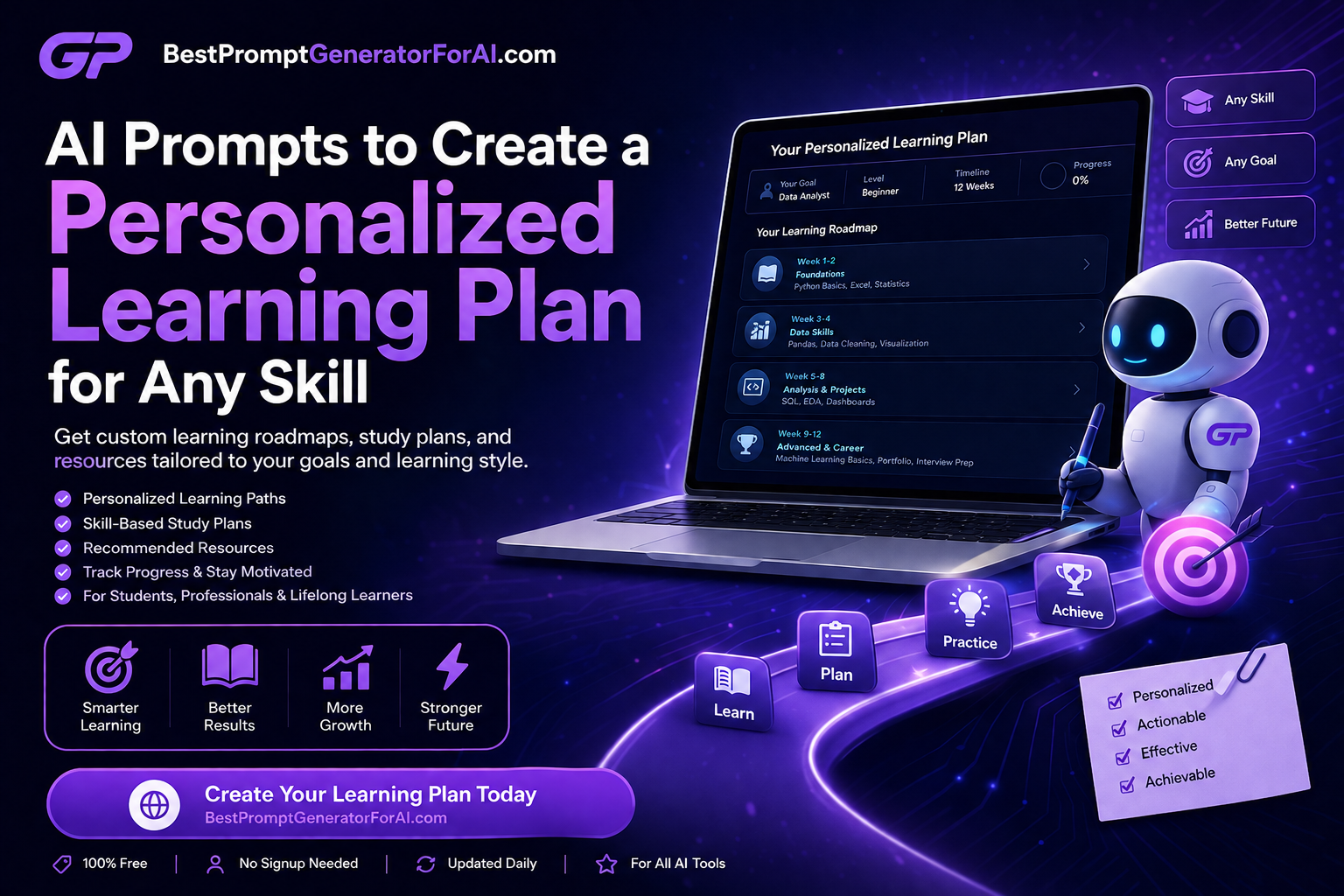
This is where AI prompts to create a personalized learning plan can help. Instead of following the same generic course or study schedule as everyone else, you can use AI to create a learning roadmap based on your skill level, available time, learning goal, and preferred study style.
Whether you want to learn coding, digital marketing, SEO, design, a language, or another professional skill, AI can help you organize the learning process into clear and manageable steps.
If you are wondering how to build a learning plan with AI for any skill, the key is to give the AI enough information about your current level, goal, available time, and expected result.
What Is an AI Personalized Learning Plan?
An AI personalized learning plan is a customized roadmap created with the help of an AI tool. Instead of giving the AI a simple instruction such as “teach me coding,” you provide details about your current knowledge, available study time, target skill, and final goal.
The AI can then organize the learning process into different stages.
A personalized learning plan may include:
- Skills and topics to learn
- Beginner-to-advanced learning stages
- Daily or weekly study schedules
- Practice activities
- Projects and assignments
- Progress checkpoints
- Revision sessions
- Recommended resource types
- Milestones and deadlines
For example, someone who has only 30 minutes per day should receive a different plan from someone who can study for three hours every day.
This makes AI useful for self-directed learning, career development, personal growth, and professional upskilling.
Why Use AI to Create a Personalized Learning Plan?
Traditional learning plans are often created for a general audience. They may not consider your experience, schedule, learning preferences, or specific goals.
AI allows you to create a more personalized approach.
1. Create a Learning Roadmap Quickly
Instead of spending hours researching what to learn first, you can ask AI to organize the topics into a logical sequence.
2. Learn According to Your Schedule
If you only have a few hours each week, AI can create a realistic plan that fits your schedule.
3. Start at the Right Skill Level
You can tell AI whether you are a beginner, intermediate learner, or advanced professional so the plan does not waste time on topics you already understand.
4. Set Clear Learning Goals
AI can structure your learning around a specific outcome, such as getting a new job, completing a project, passing an exam, or developing a professional skill.
5. Adjust the Plan as You Progress
Your learning plan does not need to remain fixed. You can ask AI to modify the roadmap when you learn faster, fall behind, or have less time available.
If you are new to writing effective AI instructions, you can also read our guide on how to write perfect AI prompts.
How to Build a Learning Plan With AI for Any Skill
If you want to know how to build a learning plan with AI for any skill, start by giving the AI five important pieces of information:
- Skill: What do you want to learn?
- Current level: Are you a beginner, intermediate, or advanced learner?
- Available time: How many hours can you study each day or week?
- Learning goal: What do you want to achieve?
- Timeframe: When do you want to reach your goal?
The more specific your information is, the more useful the learning plan can become.
Example AI Prompt
Act as an expert learning coach and curriculum designer. Create a personalized learning plan for [skill]. My current level is [beginner/intermediate/advanced]. I can study for [number] hours per week. My goal is [specific goal], and I want to achieve it within [timeframe]. Break the plan into logical learning stages. Include weekly topics, practice activities, milestones, revision sessions, and a method for tracking my progress. Make the plan realistic for my available time.
This type of prompt gives the AI enough context to create a structured roadmap instead of a generic list of topics.
Self-Taught Learning Plan AI Prompt
People who learn independently often struggle with deciding what to study next. A self-taught learning plan AI prompt can help organize independent learning without requiring a traditional classroom or fixed curriculum.
Try this prompt:
Act as a personal learning coach. I am a self-taught learner who wants to learn [skill]. My current knowledge is [describe your level]. I can dedicate [hours] per week to learning. Create a step-by-step self-taught learning plan that starts with the fundamentals and gradually moves toward advanced topics. Include practical exercises, projects, revision tasks, milestones, and ways to test my knowledge after each stage.
This approach is useful for people learning programming, marketing, SEO, graphic design, writing, business, languages, and many other skills.
For students who want to combine AI with their studies, you can also explore AI tools to study smarter and faster.
Learning Plan Prompt for Busy Professionals
Busy professionals often know what they want to learn but cannot follow a traditional course schedule.
A learning plan prompt for busy professionals should tell AI exactly how much time is realistically available.
For example:
Act as a productivity-focused learning coach. Create a learning plan for a busy professional who wants to learn [skill]. I can study for only [30 minutes/1 hour] on weekdays and [number] hours on weekends. Create a realistic weekly schedule with short learning sessions, practice activities, review sessions, and monthly milestones. Avoid unrealistic workloads and prioritize the most important topics first.
This prompt helps prevent one of the biggest learning problems: creating a plan that looks good but is impossible to follow.
A realistic plan with 30 minutes of focused learning each day can be more useful than a demanding schedule that gets abandoned after one week.
AI Prompt to Learn Coding on a Schedule
Coding is a good example of a skill that benefits from structured learning. Beginners often try to learn too many programming concepts at once.
An AI prompt to learn coding on a schedule can divide programming into manageable stages.
Act as an experienced programming instructor and learning coach. Create a coding learning plan for me to learn [Python/JavaScript/HTML/CSS/etc.]. I am currently a [beginner/intermediate] learner and can study for [X] minutes per day, [X] days per week. Create a [8-week/12-week] schedule that covers the most important concepts in the correct order. Include coding exercises, mini projects, weekly reviews, and checkpoints. Make each session realistic for my available time.
You can make this prompt even more specific by adding your final goal.
For example, if your goal is to build websites, ask the AI to prioritize HTML, CSS, JavaScript, responsive design, and practical website projects.
AI Prompt to Build a 90-Day Learning Plan
A 90-day period is long enough to develop a meaningful skill while still giving you a clear deadline.
An AI prompt to build a 90-day learning plan can divide your goal into three major stages:
- Days 1–30: Learn the fundamentals
- Days 31–60: Build practical knowledge
- Days 61–90: Apply the skill through projects and advanced practice
90-Day Learning Plan Prompt
Act as an expert learning strategist. Create a 90-day learning plan for [skill]. My current level is [level], and my final goal is [goal]. I can dedicate [hours] per week. Divide the plan into three 30-day phases. For each phase, provide the key topics, weekly objectives, practical exercises, milestones, and a progress-check method. Include revision time and adjust the workload so the plan is realistic and sustainable.
You can also ask AI to convert the 90-day roadmap into a daily schedule after the main plan has been created.
AI Learning Roadmap for a New Job Skill
Learning a skill for a career change requires a slightly different approach. You do not necessarily need to learn everything about a subject. Instead, you should focus on the knowledge and practical abilities required for your target role.
An AI learning roadmap for a new job skill can help you identify the most important skills first.
Try this prompt:
Act as a career learning advisor. I want to develop the skills needed for a new job as a [job title]. My current experience includes [experience]. Create an AI learning roadmap for a new job skill that identifies the essential technical and practical skills I should learn. Organize the roadmap into beginner, intermediate, and job-ready stages. Include practical projects, portfolio ideas, skill checkpoints, and a realistic timeline. Prioritize the skills that will have the greatest impact on becoming job-ready.
This approach is especially useful when you are changing careers or adding a new skill to your existing professional background.
How to Create a Weekly Study Schedule With AI
Once AI creates your overall roadmap, you can turn it into a practical weekly schedule.
Use this prompt:
Act as a productivity coach. Convert my learning roadmap into a weekly study schedule. I have [X] hours available each week. My preferred study sessions are [30 minutes/1 hour]. Include learning sessions, practical exercises, revision, and one weekly progress review. Make sure the schedule is realistic and does not overload me.
A good weekly schedule should include both learning and practice.
Simply reading or watching educational content is not enough for most skills. Practical application helps you understand whether you can actually use what you have learned.
How to Use AI to Track Your Learning Progress
Creating a plan is only the first step. You also need to review your progress regularly.
You can ask AI:
Act as my learning coach. Here is my current learning plan: [paste plan]. Here is what I completed this week: [details]. Identify what I completed successfully, where I am falling behind, what I should review, and what I should focus on next week. Adjust my remaining schedule if necessary without increasing my workload too much.
This helps turn a static learning plan into an adaptable system.
Common Mistakes When Creating an AI Learning Plan
Being Too General
A prompt such as “create a plan to learn marketing” may produce a broad response.
Instead, specify the exact skill and desired outcome.
Creating an Unrealistic Schedule
Do not tell AI that you can study 20 hours per week if you realistically have only three hours.
Use your actual available time.
Trying to Learn Everything
A learning plan should prioritize the most useful topics instead of attempting to cover an entire field.
Not Including Practical Projects
Projects help you turn theoretical knowledge into practical skills.
Never Updating Your Plan
Your schedule may change. Your learning speed may also change. Review your plan regularly and ask AI to adjust it.
Focusing Only on AI-Generated Answers
AI can help organize learning, but you should still practice, verify important information, use reliable resources, and apply what you learn.
Best AI Prompt Structure for Personalized Learning
A strong learning prompt can follow this simple structure:
Role + Skill + Current Level + Available Time + Goal + Deadline + Learning Format + Practice + Milestones
For example:
Act as an expert learning coach. Create a personalized learning plan for [skill]. I am currently at [level]. I can study for [hours] per week. My goal is [goal], and I want to achieve it within [timeframe]. Organize the plan into weekly stages with learning topics, practical exercises, projects, revision sessions, milestones, and progress checks. Keep the workload realistic and adjust the plan according to my progress.
This structure can be reused for almost any skill.
Make Personalized Learning Easier With AI
If you frequently create prompts for different learning goals, you do not need to write the entire instruction from scratch every time.
You can use an AI prompt generator to turn your basic learning idea into a more structured prompt. This can be particularly useful when you are still learning how to communicate your requirements clearly to AI.
You can also learn more about how long an AI prompt should be to understand how much detail you should include.
For online educators and course creators, structured prompts can also help with lesson planning, course organization, and educational content. Explore these ChatGPT prompts for online course creators for additional ideas.
FAQ
What are AI prompts to create a personalized learning plan?
AI prompts to create a personalized learning plan are detailed instructions that tell an AI tool to build a learning roadmap based on your skill level, available time, learning goal, and desired timeframe.
Can AI create a learning plan for any skill?
Yes. You can use a well-structured prompt for many skills, including coding, marketing, SEO, writing, design, business, languages, and other professional or personal interests.
How often should I update my AI learning plan?
Reviewing your plan every one or two weeks is a practical approach. You can update it sooner if your schedule or learning goals change.
Can AI create a 90-day learning plan?
Yes. You can specifically ask AI to divide your goal into three 30-day phases with weekly objectives, practice activities, milestones, and progress checks.
Can AI help me learn a new job skill?
Yes. AI can help organize the skills needed for a target role into a learning roadmap. For career-related learning, combine the roadmap with practical projects and real-world practice.
Is AI suitable for self-taught learners?
Yes. AI can help self-taught learners organize topics, create schedules, generate practice activities, and adjust the roadmap as their knowledge improves.
Conclusion
Creating a personalized learning plan does not have to be complicated. With the right instructions, AI can help you turn a broad goal into a clear roadmap with manageable steps, practical exercises, milestones, and deadlines.
Whether you need a self-taught learning plan AI prompt, a learning plan prompt for busy professionals, an AI prompt to learn coding on a schedule, or an AI prompt to build a 90-day learning plan, the most important thing is to provide AI with enough information about your current situation and desired outcome.
The same approach can also create an AI learning roadmap for a new job skill and help you stay organized throughout your learning journey.
The goal is not simply to generate a plan with AI. The goal is to create a realistic learning system that you can actually follow, measure, and improve over time.