Configuration
Generated Prompt
Fill the form and click "Generate Prompt"
Your professional AI prompt will appear here
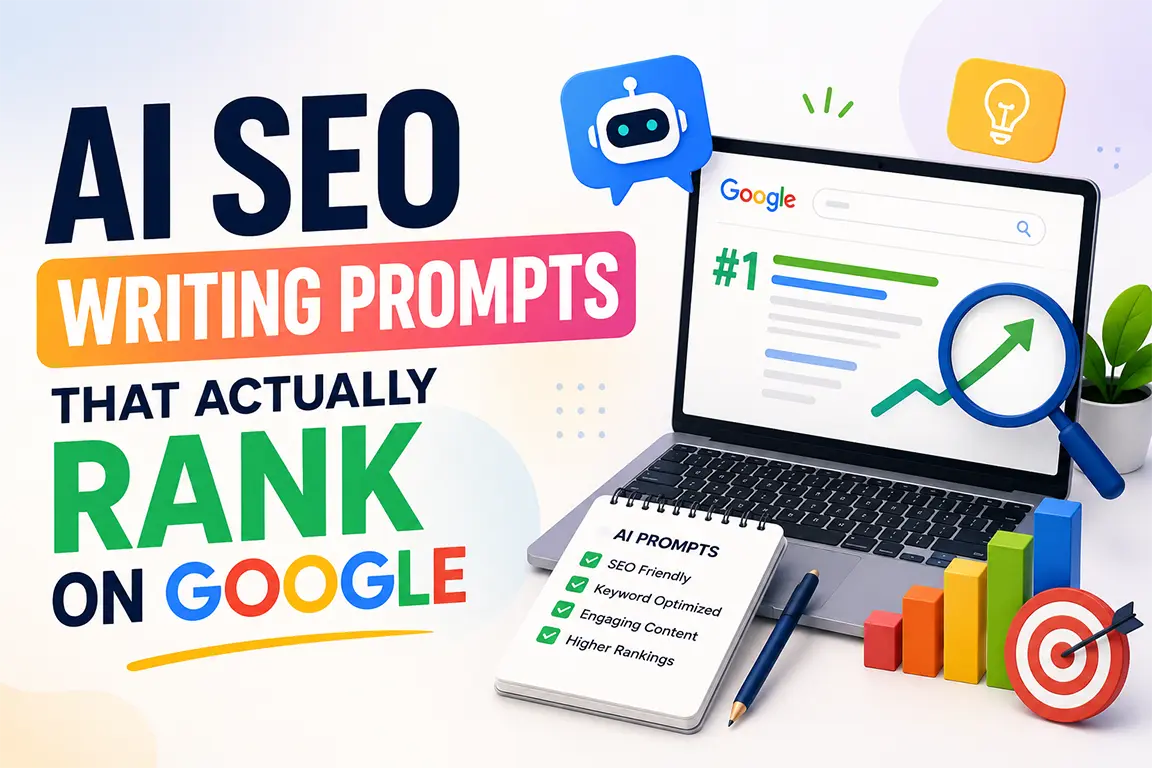
AI SEO writing prompts are specific instructions given to AI tools—such as ChatGPT, Gemini, or Claude—to generate SEO-friendly content capable of ranking on Google. By providing the right prompt, AI can produce high-quality articles that incorporate appropriate keyword usage, H1–H3 headings, simple language, FAQs, and a proper SEO structure.
In today’s landscape, simply generating content using AI is not enough. If the prompt is not right, the content may lack quality, SEO optimization, and alignment with user intent. Therefore, the proper use of AI SEO writing prompts is crucial.
In this article, you will learn what AI SEO writing prompts are, how they aid in Google rankings, how to craft effective prompts, and how to utilize ready-made SEO prompt templates that you can simply copy and paste.
What are AI SEO writing prompts?
AI SEO writing prompts are clear and detailed instructions that you provide to an AI tool so that it can generate SEO-optimized content.
Simply put:
A “prompt” is an instruction given to AI, and an “SEO prompt” is an instruction that helps create content optimized for Google.
For example, if you simply write:
“Write a blog post about weight loss.”
The AI will generate a generic article.
But if you write:
“Write a 2000-word SEO-friendly blog on Weight Loss. Include H2 and H3 headings, focus keyword naturally, FAQ section, conclusion, meta title, and meta description.”
Why are AI Prompts important for SEO?
Google always prefers content that answers readers’ questions correctly, is written in simple language, and is well-organized.
Using the right AI SEO Writing Prompts gives you the following benefits:
1. SEO-Friendly Structure: AI creates articles with appropriate headings (H1, H2, H3), paragraphs, and lists, making them easy to read.
2. Time Savings: While writing a single article can take hours, a first draft can be prepared in a very short time using the right prompt.
Complete Guide to Website SEO Analysis and Optimization
3. Natural use of keywords: AI naturally incorporates the main keyword and related keywords into the article. It also helps avoid keyword stuffing.
4. Easy-to-read content: Good prompts guide the AI to write using simple language, short paragraphs, and clear explanations.
5. Opportunity to gain more organic traffic: Content created with SEO best practices is more likely to be indexed by Google and rank higher in search results, helping your website attract more organic traffic over time.
What makes a good AI SEO writing prompt?
If you want to generate an SEO-friendly article using ChatGPT, Gemini, Claude, or any other AI tool, simply providing a generic prompt like “Write an SEO article on Digital Marketing” will not yield excellent results.
A good AI SEO writing prompt should always be clear, detailed, and goal-oriented. The more relevant information you provide in the prompt, the higher the quality of content the AI will produce—ensuring it is both search engine optimized and user-friendly.
Key elements that should be included in every AI SEO writing prompt
1. Topic
First, clearly specify the topic on which the AI needs to write the article.
Examples:
- Digital Marketing
- WhatsApp Marketing
- AI Tools for Business
- SEO Tips for Beginners
If the topic is clear, the AI will generate content in the right direction.
2. Primary Keyword
Make sure to include the keyword for which you want to rank on Google in the prompt.
- Example: Primary Keyword: AI SEO Writing
The AI will naturally incorporate this keyword throughout the article to strengthen SEO.
3. Secondary Keywords
A single keyword is not enough. Add related keywords as well.
Examples:
- AI Content Writing
- SEO Content
- ChatGPT SEO
- Content Optimization
- AI Blogging
These keywords make the article more comprehensive.
4. Search Intent
Let the AI know what the user wants to find.
Search intent can be of four types:
- Informational (seeking information)
- Commercial (exploring options)
- Transactional (making a purchase)
- Navigational (visiting a specific website)
Example:
- Target Search Intent: Informational
5. Target Audience
It is crucial to specify who the article is intended for.
Examples:
- Beginners
- Bloggers
- Students
- Business Owners
- Digital Marketers
- Freelancers
AI selects the language, examples, and method of explanation based on the audience.
6. Content Goal
What is the main purpose of this article?
Examples:
- Educating people
- Generating leads
- Selling a product
- Increasing website traffic
- Increasing brand awareness
Content becomes more effective when there is a clear goal.
7. Language
Specify the language you want to write in.
Example:
- Gujarati
- English
- Hindi
8. Tone of Voice
What should the tone of the article be?
Examples:
- Professional
- Friendly
- Conversational
- Educational
- Persuasive
- Authoritative
The right tone keeps the reader more engaged.
9. Internal Linking Suggestions
Ask the AI to suggest internal links for related topics.
Example:
- Suggested Internal Links:
What is SEO?
Keyword Research Guide
On-Page SEO Checklist
10. External References
Ask for references to reliable sources where necessary.
Examples:
- Google Search Central
- Google Analytics
- HubSpot
- Moz
- Ahrefs
1. SEO-Friendly Blog Post Prompt
“Write an SEO-friendly blog post of over 2,000 words using the main keyword [Your Keyword]. Include a compelling introduction, H2 and H3 headings, related keywords, simple language, FAQs, a conclusion, and natural keyword placement to ensure it is useful for both Google and readers.”
2. Blog Outline Prompt
“Create an SEO-optimized blog outline for the keyword [Your Keyword]. Include H2 and H3 headings, brief descriptions for each section, and a content structure aligned with Google search intent.”
3. SEO Introduction Prompt
“Write an engaging introduction for the keyword [Your Keyword] that immediately answers the user’s search intent in the opening paragraph. Ensure the introduction is clear, concise, informative, and encourages readers to continue reading.”
Explore our in-depth article on this topic
4. Keyword Optimization Prompt
“Naturally incorporate the main keyword [Your Keyword] into this article. Avoid keyword stuffing and use relevant LSI keywords to make the article more SEO-friendly and easy to read.”
5. Meta Title and Meta Description Prompt
“Write an SEO Meta Title (under 60 characters) and an engaging Meta Description (under 160 characters) for the keyword [Your Keyword]. Place the main keyword at the beginning of both and use effective words to maximize CTR.”
Explore Related Content for Better Understanding
6. FAQ Section Prompt
“Prepare at least 10 common questions related to the keyword [Your Keyword] along with clear, simple, and SEO-friendly answers. Ensure each answer provides useful information to readers and is written in simple.”
7. Google Featured Snippet Prompt
“Create a brief response of 50–70 words for the keyword [Your Keyword] that immediately answers the user’s question. Incorporate the primary keyword naturally, write in clear and reader-friendly language, and structure the content to improve its chances of appearing as a Google Featured Snippet.”
8. Complete SEO Content Prompt
“Create a complete SEO-optimized article for the keyword [Your Keyword]. Include a Meta Title, Meta Description, Introduction, H2-H3 headings, bullet points, examples, FAQs, a conclusion, and natural keyword placement. The language should be simple, entirely human-written, and optimized for Google ranking.”
For more in-depth information, check out our related blog
9. EEAT SEO Prompt (Bonus)
“Write an article for the keyword [Your Keyword] that adheres to Google’s E-E-A-T (Experience, Expertise, Authoritativeness, and Trustworthiness) principles. Include reliable information, real-life examples, simple language, and useful advice for readers to ensure the content is trustworthy and SEO-friendly.”
10. Content Improvement Prompt
“Conduct an SEO audit of this article and provide detailed suggestions to improve the heading structure, keyword density, readability, user experience, and content quality.”
FAQ’s
1. What are AI SEO writing prompts?
AI SEO writing prompts are specific instructions given to tools like ChatGPT, Gemini, or other AI platforms to generate content that is SEO-friendly and capable of ranking well on Google.
2. What is the main benefit of AI SEO writing prompts?
Using the right AI SEO writing prompt enables the AI to produce high-quality, keyword-optimized content written in simple language that aligns with search intent. It saves time and helps improve SEO performance.
3. Can AI-generated content rank on Google?
Yes. If the content is useful, original, well-structured, and optimized for SEO, AI-generated content can rank well on Google. Instead of relying solely on AI, it is essential to incorporate human editing and fact-checking.
4. How do you write a good AI SEO writing prompt?
A good prompt should include clear instructions regarding the topic, focus keyword, target audience, word count, tone of voice, content structure, and SEO requirements. The clearer the prompt, the better the result will be.
5. Which AI tools are best for AI SEO writing?
ChatGPT, Google Gemini, Claude, Microsoft Copilot, and other modern AI writing tools are useful for creating SEO-friendly content. All these tools can deliver better results when provided with the right prompts.
Conclusion
If you want to create high-quality content that ranks on Google in a short amount of time, AI SEO writing prompts can be a highly effective tool for you. A well-crafted prompt provides clear guidance to the AI, enabling it to generate content that is SEO-friendly, useful to readers, and aligned with search intent.