Written by Best Prompt Generator for AI Team
Reviewed by our team before publishing — learn more about us


Written by Best Prompt Generator for AI Team
Reviewed by our team before publishing — learn more about us
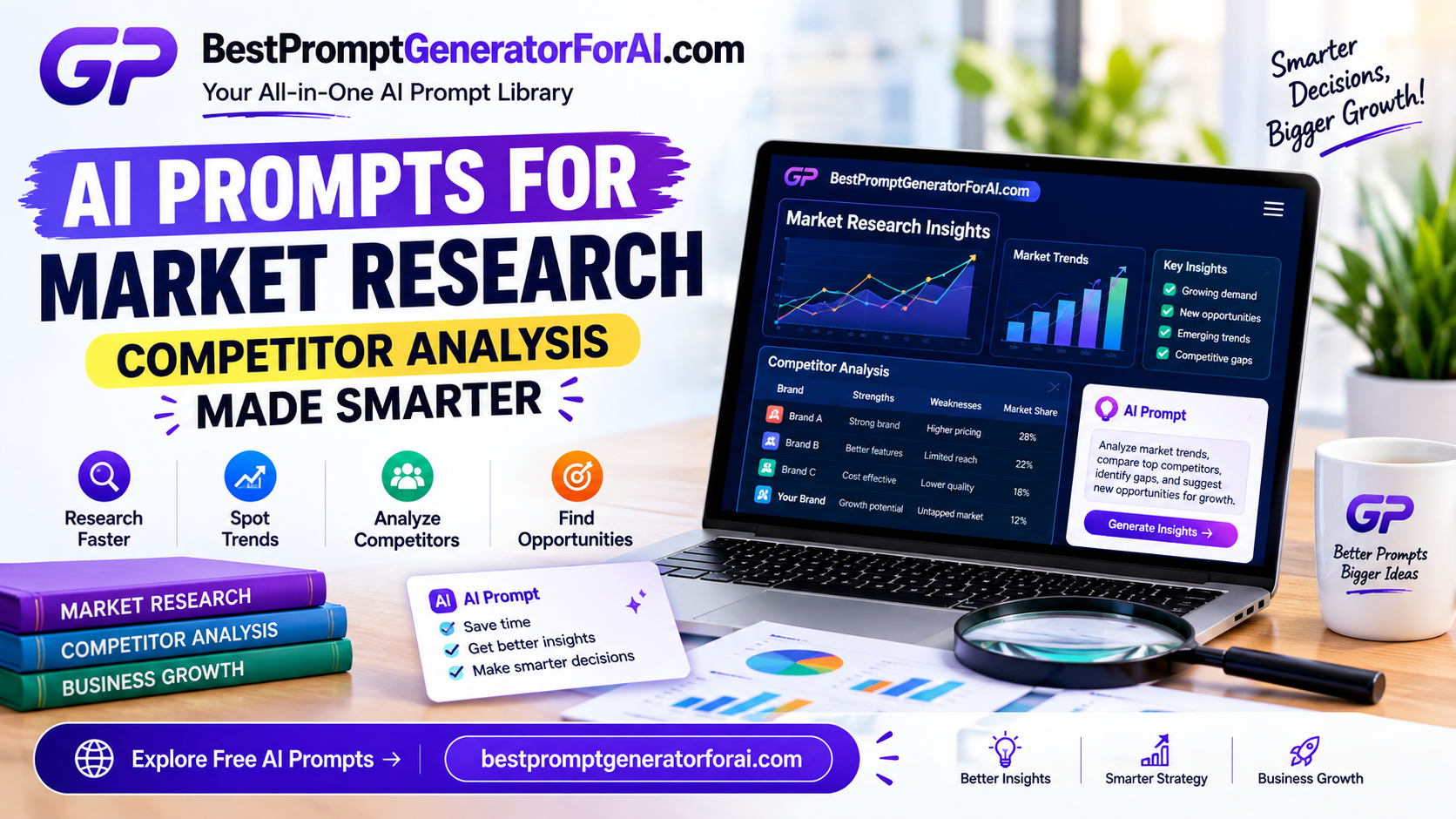
Market research and competitor analysis are essential for understanding customers, identifying business opportunities, tracking industry changes, and making better decisions. However, traditional research can take hours or even days when you need to collect information, organize findings, compare competitors, and identify useful patterns.
AI can make this process much faster when you provide it with clear and structured instructions. With the right AI prompts for market research, you can ask AI tools to analyze customer needs, explore market trends, identify competitors, compare products, discover positioning opportunities, and organize research findings.
Similarly, AI prompts for competitor analysis can help you examine competitor strengths, weaknesses, pricing, marketing strategies, target audiences, content approaches, and unique selling propositions. Instead of starting every research task from scratch, you can use reusable prompts to guide AI toward more useful and actionable results.
This guide explains how to create and use AI prompts for market research and competitor analysis, along with practical prompt examples for marketers, entrepreneurs, startups, business owners, and researchers.
Fill the form and click "Generate Prompt"
Your professional AI prompt will appear here
✓ Prompt generated successfully!
Copy and paste this into ChatGPT, Claude, or any AI model to get expert results.
AI prompts for market research are specific instructions given to an artificial intelligence tool to help collect, organize, analyze, or interpret market-related information. A well-written prompt gives the AI clear context, explains the research objective, identifies the target audience, and defines the type of output you need.
For example, instead of asking an AI tool, “Analyze this market,” you can provide a detailed instruction such as:
“Analyze the online fitness software market for small businesses. Identify major customer problems, emerging trends, common pricing models, target customer segments, and potential gaps that a new SaaS product could address. Present the findings in a structured table.”
The second prompt provides much more direction. This allows the AI to produce a structured response that is easier to review and use for business planning.
AI output depends heavily on the quality and context of your instructions. Vague prompts often produce broad answers that may not be useful for decision-making. Specific prompts can produce more organized insights because they define what the AI should investigate and how the results should be presented.
Good market research prompts can help you:
Competitor analysis involves studying businesses that offer similar products or services. The goal is to understand how competitors attract customers, position their products, price their offers, create content, and differentiate themselves.
AI can help structure this process by turning your research requirements into repeatable analysis tasks. You can ask AI to create competitor comparison frameworks, identify differences between businesses, summarize publicly available information, and generate questions that help uncover competitive opportunities.
AI prompts can be used to examine several competitor factors, including:
For example, a competitor analysis prompt could ask an AI tool to compare five businesses based on product features, pricing, customer segments, positioning, marketing channels, and potential weaknesses.
For marketers who also need stronger keyword research workflows, these AI prompts for keyword research can improve search-focused market analysis.
One of the biggest advantages of AI-assisted research is speed. Instead of manually organizing every research question, you can create reusable prompts that guide the AI through a consistent process.
This is especially useful when you need to analyze multiple customer segments, products, competitors, or market categories.
AI can organize research into tables, bullet points, categories, summaries, and comparison frameworks. You can specify the exact format you want in your prompt.
For example, you can ask for a table containing competitor name, target audience, product strengths, weaknesses, pricing model, marketing approach, and differentiation.
Sometimes the biggest challenge is knowing what questions to ask. AI can help generate additional research questions based on your industry, audience, product, or business goal.
This can help researchers move beyond obvious questions and explore customer behavior, objections, purchasing factors, and unmet needs.
Instead of analyzing competitors individually, you can create a standardized prompt that evaluates multiple businesses using the same criteria. This makes comparisons easier and can reveal patterns that may not be obvious when reviewing companies separately.
Market research should ultimately help you make better decisions. AI-generated analysis can help organize information into useful insights for product development, marketing, positioning, content strategy, and customer targeting.
For entrepreneurs exploring opportunities alongside research, these AI prompts for generating winning business ideas can reveal new opportunities.
Prompt:
“Analyze the current trends in the [industry] market. Identify the most important emerging trends, changes in customer behavior, new technologies, growing product categories, and potential opportunities. Explain why each trend matters and provide practical recommendations for a business entering this market.”
Prompt:
“Act as a market research strategist. Analyze the target audience for [product/service]. Identify their main problems, goals, frustrations, purchasing motivations, objections, preferred features, and decision-making factors. Organize the findings into customer needs, pain points, motivations, and opportunities.”
Prompt:
“Analyze the [industry] market and identify potential gaps that existing businesses are not addressing effectively. Consider customer complaints, underserved audiences, missing features, pricing issues, service limitations, and changing customer expectations. Provide five potential opportunities and explain why each could be valuable.”
Prompt:
“Divide the [industry] market into meaningful customer segments. For each segment, explain demographics, needs, purchasing behavior, common problems, preferred solutions, price sensitivity, and marketing messages that are likely to appeal to them. Rank the segments by potential business value.”
Prompt:
“Evaluate potential demand for [product] among [target audience]. Identify the problems the product solves, reasons customers may purchase it, potential objections, competing solutions, and factors that could influence adoption. Summarize the findings and recommend the strongest positioning approach.”
Prompt:
“Compare [Competitor A], [Competitor B], [Competitor C], and [Competitor D] in the [industry] market. Evaluate their products, pricing, target customers, key features, positioning, strengths, weaknesses, marketing messages, and unique selling propositions. Present the comparison in a clear table and identify the biggest competitive opportunities.”
Prompt:
“Analyze the strengths and weaknesses of [competitor]. Evaluate its product offering, pricing, customer experience, brand positioning, marketing strategy, content, and customer value proposition. Identify areas where another business could create a stronger or more differentiated offer.”
Prompt:
“Analyze the pricing strategy of [competitor or competitor group]. Identify pricing tiers, product packages, discounts, free plans, premium features, and perceived value. Explain how the pricing compares with alternatives and recommend possible pricing opportunities for a new competitor.”
Prompt:
“Analyze the content strategy of [competitor]. Identify the main topics they publish, content formats they use, audience problems they address, search-focused topics, promotional themes, and potential content gaps. Recommend content opportunities that could help a competing business provide more useful information.”
Prompt:
“Analyze how [competitor] positions its brand in the [industry]. Identify its primary audience, core message, unique value proposition, key benefits, differentiators, and customer promises. Compare this positioning with three major competitors and recommend opportunities for stronger differentiation.”
Startups can combine these research workflows with the AI prompts designed specifically for startup founders and business planning.
Understanding customers is one of the most important parts of market research. AI prompts can help you organize customer research around specific questions rather than simply asking for a generic audience description.
Prompt:
“Identify the top 15 pain points experienced by [target audience] when trying to solve [specific problem]. Categorize each pain point as functional, financial, emotional, or practical. Explain the likely cause of each problem and suggest opportunities for a product or service to address it.”
Prompt:
“Analyze how [target audience] typically evaluates and purchases [product/service]. Identify the most important factors influencing their decision, common objections, information they search for before buying, trusted sources, and reasons they may choose one provider over another.”
Prompt:
“Create three detailed customer personas for [business/product]. Include goals, problems, motivations, objections, purchasing behavior, preferred communication channels, decision factors, and common questions. Explain how the marketing strategy should differ for each persona.”
Competitor research becomes more valuable when it leads to actionable opportunities. Instead of simply asking AI to summarize competitors, ask it to identify differences, weaknesses, underserved audiences, and areas where your business could provide additional value.
Prompt:
“Review the available information about [competitors]. Identify customer needs that appear underserved, product features that are missing or poorly addressed, audience segments receiving limited attention, and recurring complaints. Create a prioritized list of competitive gaps and explain how a new business could address each gap.”
Prompt:
“Based on the following competitor information, identify five ways [business] could differentiate itself. Consider product features, customer experience, pricing, positioning, content, service, specialization, and convenience. For each recommendation, explain the customer benefit and potential competitive advantage.”
When building more advanced workflows, learning structured prompting techniques can help you create more consistent research instructions through this prompt engineering guide for creating better AI instructions.
Start by explaining exactly what you want to discover. Your goal could be identifying market trends, understanding customers, comparing competitors, evaluating demand, or finding product opportunities.
A clear goal prevents the AI from producing a broad response that does not address your actual research objective.
Give the AI enough background information about your business, industry, product, audience, and market. Context helps make the prompt more specific and relevant.
Market research becomes much more useful when the target audience is clearly defined. Include information such as customer type, business size, location, industry, experience level, or purchasing needs when relevant.
Ask for a table, list, comparison, summary, ranking, or framework depending on your research objective. Output instructions make large amounts of information easier to review.
Do not stop at “analyze this market.” Ask the AI to identify what the findings mean and what actions a business could take based on those findings.
AI-generated research should not automatically be treated as verified market data. Ask the AI to distinguish assumptions, estimates, and information that requires external verification.
Different AI models can perform differently depending on the complexity of the task, the amount of context required, and the type of output you need. For simple brainstorming, a fast general-purpose model may be enough. More complex research workflows may benefit from models designed for deeper analysis or larger context windows.
Before starting an important research project, it is useful to understand how model capabilities match different tasks. This guide to choosing the right AI model for your task can improve prompt workflows.
If you are comparing AI models, use the same prompt and input information whenever possible. This creates a more consistent basis for evaluating response quality.
Do not evaluate models only by response length. Consider accuracy, relevance, structure, useful insights, clarity, consistency, and how easily the output can be turned into a business decision.
A prompt such as “Tell me about my competitors” is too broad. Include the industry, competitors, research criteria, target audience, and expected output.
AI can organize and analyze information, but your own customer interviews, surveys, analytics, reviews, and verified market data can provide valuable context. Combine AI assistance with reliable source material whenever possible.
AI output can contain assumptions or inaccurate information. Important business decisions should be checked against reliable sources and current market evidence.
A massive prompt covering customers, competitors, pricing, trends, products, content, and marketing may produce an unfocused response. Break complex research into smaller stages and then combine the findings.
Markets change constantly. Competitor pricing, product features, customer preferences, and marketing strategies can change over time. Repeat important research periodically instead of relying on an old analysis.
Begin with one clear business question. For example, you might want to understand whether a particular customer segment has an unmet need.
Describe the industry, geographic market, customer type, product category, and relevant business conditions. This gives the AI useful context.
Use prompts to identify customer needs, pain points, buying factors, objections, and desired outcomes.
Create a standardized competitor framework covering products, pricing, positioning, marketing, audience, strengths, weaknesses, and differentiation.
Compare customer needs with current competitor offerings. Look for underserved problems, missing features, weak experiences, and overlooked audiences.
Ask AI to turn the research findings into potential product, positioning, content, or marketing opportunities.
Check important conclusions against reliable market data, customer feedback, competitor websites, surveys, industry reports, and other trustworthy sources before making major decisions.
To show what the generator above produces, we filled it in with a realistic scenario and copied the result exactly as the tool returned it. Nothing below was edited by hand.
Act as an expert market research and competitive intelligence strategist.

Analyze the market for

Business: GreenLeaf Meal Kits
Industry: Meal-kit delivery
Product/Service: Plant-based weekly meal kits
Target Audience: Busy professionals in urban areas
Market/Location: United Kingdom
Research Goal: Competitor Positioning
Key Customer Problem: Healthy meals take too long to plan and cook
Additional Context: Pre-launch, planning mid-range pricing.

Conduct a detailed market research and competitor analysis focused specifically on this business.

Analyze

1. Market overview and current landscape
2. Target audience needs, motivations, and pain points
3. Key customer problems and existing solutions
4. Important market trends and emerging opportunities
5. Major competitors and alternative solutions
6. Competitor products, pricing, features, positioning, strengths, and weaknesses
7. Competitive gaps and underserved customer needs
8. Potential market opportunities
9. Possible competitive advantages for the business
10. Recommended positioning and value proposition
11. Marketing and content opportunities
12. Potential market risks and competitive threats

Present the findings using clear headings, bullet points, and comparison tables where useful.

Prioritize practical insights over generic advice. Clearly distinguish verified information from assumptions. Do not invent statistics, competitor information, customer data, or market facts.

Finish with
- A 5–7 point executive summary
- 5 strongest competitive opportunities
- 5 actionable recommendations
- A prioritized 30-day action plan

Use the additional context below whenever relevant:

Pre-launch, planning mid-range pricing.
Good for scoping research before you spend time on it. The business, market, location and a single research goal are set, and the template tells the AI to separate verified information from assumptions and not to invent statistics. Unless your AI tool can search the web, it cannot see competitors' current prices, so verify every competitor claim on their own websites. The meal-kit business in this example is fictional.
The best AI prompts clearly define the research goal, target audience, industry, questions, and desired output. Useful prompts can focus on market trends, customer pain points, market segmentation, product demand, pricing, and competitive gaps.
Yes, ChatGPT can help structure competitor research, compare business information, identify potential strengths and weaknesses, generate research questions, and organize findings. Important information should still be independently verified before making business decisions.
AI prompts provide a repeatable framework for evaluating competitors. They can instruct an AI tool to compare products, pricing, positioning, audiences, marketing strategies, customer problems, and potential opportunities using consistent criteria.
Start with your research objective and provide context about your industry, product, target audience, and market. Then define the specific information you want and tell the AI how to organize the results.
AI can help identify potential market gaps by comparing customer needs, competitor offerings, product features, pricing, and recurring problems. These opportunities should be validated using real customer feedback and reliable market evidence.
AI-generated results can be useful for organizing and exploring information, but they should not automatically be considered verified facts. Important claims, statistics, competitor information, and market conclusions should be checked against reliable sources.
Include competitor names, industry, target audience, products or services, pricing, positioning, features, marketing channels, strengths, weaknesses, and the specific comparison criteria you want the AI to evaluate.
Yes. Small businesses can use AI prompts to research customer needs, explore competitors, identify market opportunities, develop customer personas, analyze positioning, and organize research without creating every research framework manually.
AI can make market research and competitor analysis faster, more organized, and easier to repeat. The quality of your results largely depends on the quality of your instructions. Instead of using short and generic questions, provide clear context, define your research objective, identify your audience, specify the analysis criteria, and explain how you want the results presented.
The most effective approach is to treat AI as a research assistant rather than a replacement for real market validation. Use AI to organize ideas, generate research questions, compare information, identify patterns, and develop possible opportunities. Then verify important findings using reliable evidence.
By combining structured AI prompts for market research with competitor analysis, customer research, and proper validation, businesses can create a repeatable research workflow that supports smarter marketing, product development, positioning, and strategic decisions.

About the author
Best Prompt Generator for AI Team
Best Prompt Generator for AI Team is the small team behind bestpromptgeneratorforai.com, based in Rajkot, Gujarat, India. We build free tools that turn a rough idea into a clear, structured prompt for ChatGPT, Claude, Gemini, Midjourney and other AI tools, and we publish practical guides and prompt examples for creators, marketers and everyday users. Every tool and article is written and reviewed by our team before it is published. Questions or corrections: info@bestpromptgeneratorforai.com. Our tools are free to use, with an optional Pro plan for higher monthly limits.
Enter a subject and AI will instantly build the best form for you — up to 10 smart fields.
Searching best fields for your subject…
These fields were crafted specifically for your prompt type.
Generating your optimised prompt…