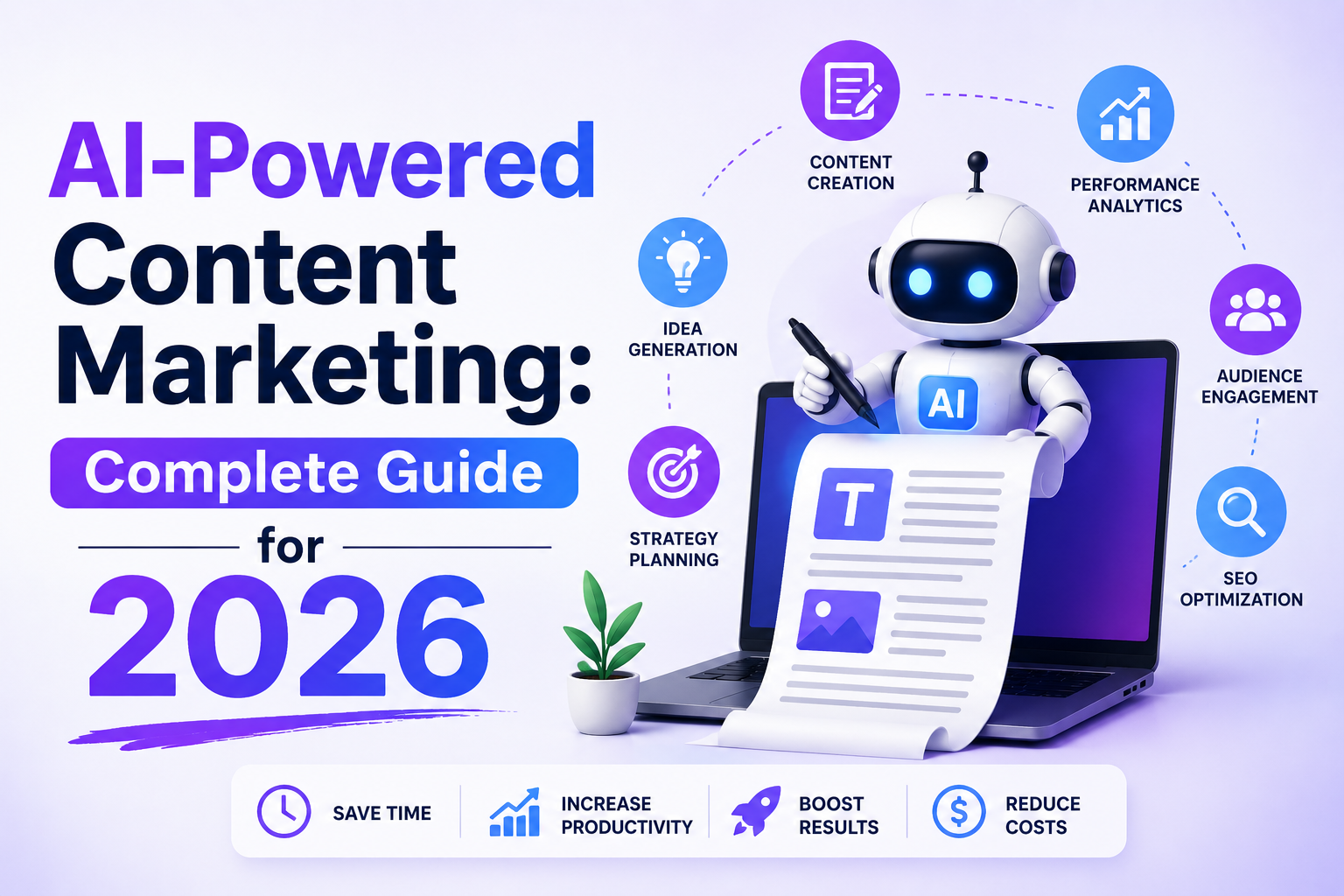
AI-Powered Content Marketing uses Artificial Intelligence to create, optimize, analyze, personalize, and distribute content more efficiently. It helps businesses understand their audiences, organize content workflows, and use data insights to create more relevant marketing experiences.
What Is AI-Powered Content Marketing?
The world of digital marketing is constantly changing. In 2026, AI-Powered Content Marketing has become an important approach for businesses that want to create, optimize, analyze, and distribute content more efficiently.
With the help of Artificial Intelligence (AI), marketers can brainstorm content ideas, analyze audience needs, develop content outlines, improve existing content, and identify opportunities for better engagement.
Traditional content marketing often requires significant time and manual effort. AI can assist with repetitive tasks and help marketing teams organize different stages of the content workflow more efficiently.

AI can assist with various types of marketing content, including:
- Blog articles: AI can help generate topic ideas, outlines, drafts, and content improvements.
- Social media content: AI can assist with post ideas, captions, content calendars, and engagement-focused copy.
- SEO research: AI can help identify relevant keywords, search topics, and related questions.
- Customer analysis: AI can analyze available data to help marketers understand customer interests and behavior.
- Email marketing: AI can help create email ideas, subject lines, campaign copy, and personalized messaging.
- Personalized content: AI can help adapt marketing messages for different audience segments.
Simply put, AI can support marketers by making content workflows more organized, data-driven, and efficient while allowing humans to remain responsible for strategy, accuracy, and creativity.
Why Is AI Content Marketing Important in 2026?
People are exposed to a large amount of digital content every day. Because of this competition, businesses need to create content that is useful, relevant, easy to understand, and aligned with audience needs.
AI content marketing can support this process by helping businesses research topics, create content, analyze performance, and improve future campaigns.
1. Faster Content Creation
AI tools can help marketers generate ideas, outlines, drafts, social media content, emails, and other marketing materials more quickly. This can reduce repetitive manual work and give teams more time for strategy and creative tasks.
2. Better Customer Insights
AI can analyze available customer data, search behavior, engagement patterns, and content performance. These insights can help marketers understand what topics and messages may be more relevant to their audiences.
3. Support for SEO
AI can assist with keyword research, content structure, search intent analysis, readability, and content optimization. These capabilities can support an SEO-focused content workflow when combined with human review and a strong overall SEO strategy.
4. Personalized Marketing
Different customers may have different needs and interests. AI can help marketers organize audience segments and create variations of content or messaging that are more relevant to different groups.
5. More Efficient Content Workflows
AI can connect several stages of content production, including research, ideation, drafting, optimization, and performance analysis. This can make content operations more consistent and easier to manage.
How Does AI Content Marketing Work?
AI-Powered Content Marketing generally works through a combination of research, content creation, optimization, personalization, and performance analysis. AI assists marketers at different stages while humans provide strategic direction and quality control.
1. Content Research and Data Analysis
AI can help analyze audience needs, search topics, keywords, trends, and available marketing data. This information can help marketers decide which topics and content formats are worth exploring.
For example, AI can help identify common questions and related search topics around a subject such as “AI Content Marketing.”
2. Content Ideation and Content Creation
AI can generate ideas for blogs, social media posts, emails, advertisements, videos, and other content formats. It can also create initial drafts that marketers can review and improve.
For example, a marketing agency can use AI to brainstorm a 30-day social media content calendar and then refine the ideas based on its clients’ audiences and goals.
3. Content Optimization and Personalization
AI can assist with improving content structure, keyword placement, readability, messaging, and audience relevance. It can also help create different versions of content for specific audience segments.
For example, a business could create different marketing messages for new visitors, existing customers, and returning buyers.
4. Performance Tracking and Improvement
AI can help analyze metrics such as traffic, engagement, clicks, conversions, and content performance. Marketers can use these insights to identify successful content and improve future campaigns.
For example, if a particular blog consistently attracts relevant visitors, marketers can analyze its topic and structure and develop related content around the same audience need.
For marketers looking to improve their content workflow, use practical AI prompts for writing SEO-focused blog content and combine them with human editing and SEO review.
AI Technology and Tools for Content Marketing
Different AI tools can support different stages of content marketing. Some focus on writing, while others assist with SEO, analytics, personalization, images, videos, or workflow automation.
AI Writing Tools
AI writing tools can help generate blog ideas, outlines, social media posts, emails, marketing copy, and other written content. They are most effective when marketers provide clear instructions and review the generated content.
SEO AI Tools
SEO-focused AI tools can assist with keyword research, content optimization, search intent analysis, topic discovery, and content performance evaluation.
AI Analytics Tools
AI analytics tools can help marketers analyze customer behavior, website traffic, engagement, conversions, and other performance data to identify useful patterns.
AI Content Personalization Tools
AI can help marketers organize audience segments and adapt content or messaging according to available customer information and behavior.
AI Image and Video Tools
AI image and video tools can help marketing teams develop visual concepts, creative assets, video ideas, and other supporting content for digital campaigns.
Marketing teams can also discover practical AI prompts for digital marketing campaigns to support different content and marketing tasks.
The Difference Between AI and Human Content Creation
AI can simplify many parts of content creation, but human creativity, expertise, judgment, and experience remain important. AI is most useful when it supports human decision-making rather than completely replacing it.
| AI Content | Human Content |
|---|---|
| Helps create content more quickly | Adds experience, emotion, context, and personal perspective |
| Can analyze patterns and available data | Provides original ideas and strategic judgment |
| Helps reduce repetitive content tasks | Builds stronger relationships and authentic audience connections |
| Can generate multiple content variations | Chooses the most appropriate message for the audience and brand |
The strongest approach combines AI efficiency with human expertise, creativity, fact-checking, and strategic decision-making.
Benefits of AI-Powered Content Marketing
1. Time Saving
AI can automate or assist with repetitive marketing tasks such as brainstorming, outlining, drafting, summarizing, and content repurposing. This can give marketing teams more time to focus on strategy and creative work.
2. Better Content Quality
AI can provide suggestions for structure, readability, topic coverage, and content improvement. Human editing is still necessary to ensure that the final content is accurate, useful, original, and aligned with the brand.
3. Reduced Repetitive Work
AI can handle repetitive content tasks at scale, which may help businesses manage larger content workflows without manually completing every basic task.
4. Greater Customer Engagement
More relevant and personalized content can help businesses communicate more effectively with their audiences. AI can assist marketers in understanding audience patterns and creating appropriate content variations.
5. Better Content Planning
AI can help identify content ideas, related topics, audience questions, and potential content gaps. This can make it easier to create organized content calendars and topic clusters.
Businesses can also build a stronger AI content marketing strategy with practical workflows for planning and producing content more efficiently.
Importance of SEO in AI Content Marketing
SEO remains an important part of content marketing because useful content needs to be discoverable by the audiences searching for it. AI can support several SEO tasks, but it should be combined with human judgment and a broader SEO strategy.
Keyword Research
AI can help discover primary keywords, secondary keywords, long-tail phrases, related questions, and topic variations. These suggestions can help marketers build a more comprehensive content plan.
Content Optimization
AI can review content structure, headings, keyword usage, readability, and topical coverage. Marketers can use these recommendations to identify areas for improvement.
Search Intent Analysis
AI can help categorize search intent and identify the types of questions or information users may expect from a particular search query.
Competitor and Topic Analysis
AI can assist with analyzing available competitor content and identifying commonly covered topics. Human review is important when deciding which gaps are genuinely valuable to address.
Content Performance Tracking
AI can help analyze traffic, engagement, conversions, and other content metrics. These insights can help marketers decide which content should be updated, expanded, repurposed, or used as inspiration for new topics.
For SEO-focused content planning, you can find relevant SEO keywords using practical AI prompt workflows before creating new content.
Challenges of AI Content Marketing
Although AI can provide significant assistance, businesses should understand its limitations before making it a central part of their content workflow.
1. Maintaining Originality
AI-generated content can become generic when prompts lack context or when businesses publish drafts without adding their own expertise. Human insights, examples, experience, and original perspectives are important for creating distinctive content.
2. Fact Checking
AI can sometimes generate incorrect or outdated information. Important claims, statistics, product details, and other factual information should be verified before publication.
3. Maintaining the Human Touch
Content should communicate naturally with its intended audience. Human review helps ensure that AI-assisted content reflects the brand voice, audience expectations, emotions, and real-world context.
4. Avoiding Over-Automation
Automating every part of content production can lead to repetitive or low-value content. AI should support a thoughtful workflow rather than replace strategic decisions.
AI Content Marketing Best Practices for 2026
Use AI as an Assistant
Use AI to support research, brainstorming, drafting, editing, and analysis while keeping humans responsible for strategy, accuracy, and final publishing decisions.
Create Original and Useful Content
Focus on solving real audience problems instead of creating content simply to increase publishing frequency. Add original information, examples, practical advice, and relevant expertise.
Put Customer Needs First
Content should be created around the needs and questions of the target audience. AI-generated content should never become more important than the people it is designed to serve.
Use Relevant Keywords Naturally
Include relevant keywords where they make sense, but avoid keyword stuffing. Search-focused content should remain natural and easy for readers to understand.
Review Content Regularly
Monitor content performance and update articles when information becomes outdated or when new audience needs emerge. Regular content reviews can help maintain accuracy and usefulness.
Develop Clear AI Prompt Workflows
Use specific prompts that explain the topic, audience, goal, tone, content format, keywords, and required output. Clear instructions can produce more useful AI-assisted results.
The Future of AI-Powered Content Marketing
AI is likely to become an increasingly important part of digital content marketing. As AI systems become more capable, marketers will be able to use them for more advanced research, personalization, content analysis, automation, and workflow support.
Better Understanding of User Behavior
AI can increasingly help marketers analyze audience interactions and identify patterns that may inform future content decisions.
More Personalized Content
AI can help businesses create content variations that are more relevant to different customer segments, channels, and stages of the customer journey.
Easier Marketing Automation
AI can assist with repetitive marketing workflows, content repurposing, scheduling support, analysis, and other operational tasks.
Stronger Human-AI Collaboration
The future of content marketing is likely to involve collaboration between AI systems and human marketers. AI can provide speed and analytical assistance, while humans contribute creativity, expertise, judgment, and strategic direction.
FAQs
1. What is AI-Powered Content Marketing?
AI-Powered Content Marketing is the use of Artificial Intelligence to assist with content research, ideation, creation, optimization, personalization, analysis, and other marketing activities. It helps businesses make content workflows more efficient while keeping human strategy and review involved.
2. How does AI-Powered Content Marketing work?
AI-Powered Content Marketing can involve several stages, including audience research, topic discovery, content creation, SEO optimization, personalization, performance analysis, and content improvement. AI assists with these tasks while marketers provide strategy and quality control.
3. What are the benefits of AI-Powered Content Marketing?
AI-Powered Content Marketing can help businesses save time, reduce repetitive work, generate content ideas, support SEO, improve content planning, analyze performance, and create more personalized marketing experiences.
4. Can AI-Powered Content Marketing improve SEO performance?
AI can support SEO by helping with keyword research, search intent analysis, content structure, readability, and optimization. However, AI does not guarantee higher rankings because search performance depends on many factors, including relevance, content quality, competition, technical SEO, authority, and user experience.
5. Which businesses can benefit from AI-Powered Content Marketing?
Businesses of different sizes and industries can use AI-Powered Content Marketing. Startups, e-commerce businesses, agencies, publishers, service providers, SaaS companies, and larger organizations can use AI to support content research, production, optimization, and analysis.
6. Should businesses publish AI-generated content without editing?
No. AI-generated content should be reviewed and edited before publication. Human review helps verify facts, improve originality, add expertise, maintain brand voice, remove repetitive information, and ensure that the content genuinely helps the intended audience.
7. Can AI replace human content marketers?
AI can automate and assist with many content marketing tasks, but human marketers remain important for strategy, creativity, expertise, judgment, audience understanding, fact-checking, and final content decisions.
Conclusion
AI-Powered Content Marketing has become an important approach for businesses looking to improve how they research, create, optimize, personalize, and analyze marketing content in 2026.
AI can help with content ideas, keyword research, SEO optimization, content creation, personalization, performance analysis, and repetitive marketing tasks. However, relying on AI alone is not a complete content marketing strategy.
The most effective approach combines AI technology with human creativity, industry knowledge, accurate research, strategic planning, and careful editing. When used responsibly, AI can help marketing teams build more efficient workflows and create content that is more relevant and useful to their audiences.