Prompt engineering is the practice of designing clear instructions that help AI models generate accurate, useful, and consistent responses. It combines communication, critical thinking, and experimentation to obtain better results from modern large language models (LLMs). This guide covers fundamentals, advanced techniques, major prompting frameworks, examples for leading AI assistants, common mistakes, and best practices for beginners through experts.
Artificial intelligence has transformed how we write, code, research, market products, analyze data, and solve everyday problems. But here’s something many users discover quickly:
The same AI can produce either an average answer or an outstanding one depending on how you ask the question.
That difference is called prompt engineering.
Whether you’re using ChatGPT, Gemini, or Claude, your prompts determine the quality of the response more than the model alone. Recent guidance from AI developers increasingly emphasizes providing clear context, explicit goals, desired output formats, and constraints rather than relying on vague requests.
Instead of asking:
Write me a blog.
Ask:
Write a 2,000-word SEO blog targeting beginner digital marketers. Use H2 and H3 headings, include practical examples, maintain a conversational tone, optimize for featured snippets, and finish with FAQs.
The second prompt gives the AI enough direction to produce a more useful result.
This guide explains how to write prompts that consistently work across ChatGPT, Gemini, and Claude, while also showing where each model tends to excel.
What Is Prompt Engineering?
Prompt engineering is the process of designing clear, structured instructions that help AI generate more accurate, relevant, and useful responses.
Think of AI as a highly capable assistant.
If you say:
Help me.
The assistant has very little to work with.
If you say:
Help me create a six-month content marketing plan for a SaaS startup targeting HR managers, including monthly themes, SEO keywords, LinkedIn content ideas, KPIs, and publishing frequency.
The AI has enough context to produce a focused, high-value answer.
Prompt engineering isn’t about using “magic words.” It’s about communicating your intent clearly and supplying the information the model needs to complete the task well.
Why Prompt Engineering Matters More Than Ever
Modern AI models are powerful, but they don’t read your mind.
They infer what you want from the instructions you provide.
Good prompts help you:
- Save time by reducing revisions
- Get more accurate answers
- Generate higher-quality content
- Produce structured outputs
- Improve consistency
- Reduce hallucinations
- Create reusable workflows
Organizations increasingly treat prompt design as a practical workplace skill rather than a niche specialty because it improves productivity across writing, coding, research, and business tasks.
Create your perfect prompt in seconds. Click here, complete the form, and get a ready-to-use AI prompt instantly.
AI Social Media Caption & Content Generator
AI Prompts for Accountants and Bookkeepers
AI Prompt Generator for YouTube Videos, Scripts & Ideas
AI Prompt Generator for Marketing | Boost Campaigns with Smart AI Prompts
AI Prompt Generator for Business | Create Powerful AI Prompts Instantly
ChatGPT vs Gemini vs Claude: Understanding Their Strengths
Although all three models can perform many of the same tasks, they often shine in different areas.
| Feature | ChatGPT | Claude | Gemini |
|---|---|---|---|
| Creative Writing | ⭐⭐⭐⭐⭐ | ⭐⭐⭐⭐⭐ | ⭐⭐⭐⭐ |
| Coding | ⭐⭐⭐⭐⭐ | ⭐⭐⭐⭐ | ⭐⭐⭐⭐ |
| Long Documents | ⭐⭐⭐⭐ | ⭐⭐⭐⭐⭐ | ⭐⭐⭐⭐ |
| Research Assistance | ⭐⭐⭐⭐ | ⭐⭐⭐⭐ | ⭐⭐⭐⭐⭐ |
| Brainstorming | ⭐⭐⭐⭐⭐ | ⭐⭐⭐⭐⭐ | ⭐⭐⭐⭐ |
| Structured Output | ⭐⭐⭐⭐⭐ | ⭐⭐⭐⭐ | ⭐⭐⭐⭐ |
| Google Workspace Integration | ⭐⭐⭐ | ⭐⭐⭐ | ⭐⭐⭐⭐⭐ |
Independent comparisons consistently find differences in emphasis rather than absolute capability. ChatGPT is often praised for structured instruction-following, Claude for nuanced writing and long-form reasoning, and Gemini for research workflows and Google ecosystem integration.
The Biggest Mistake Beginners Make
Most users write prompts that are far too short.
For example:
Write about SEO.
The AI must guess:
- Who is the audience?
- How long should it be?
- Beginner or expert?
- Formal or conversational?
- Should examples be included?
- Should it be optimized for search?
Those assumptions often lead to generic content.
Instead, provide enough detail to reduce ambiguity.
The Anatomy of a High-Quality Prompt
A reliable prompt usually contains these building blocks:
1. Goal
State exactly what you want.
Example:
Create a beginner-friendly tutorial on email marketing.
2. Context
Explain the background.
Example:
The audience consists of small business owners with no previous marketing experience.
3. Role
Assign a role when it genuinely helps.
Example:
Act as an experienced content strategist.
4. Output Format
Specify how the answer should be organized.
Example:
- Introduction
- Step-by-step guide
- Table
- FAQ
- Checklist
5. Constraints
Set boundaries.
Examples:
- Maximum 2,000 words
- Use simple English
- Avoid jargon
- Include examples
- Use markdown headings
A Universal Prompt Formula
One practical structure that works well across major AI models is:
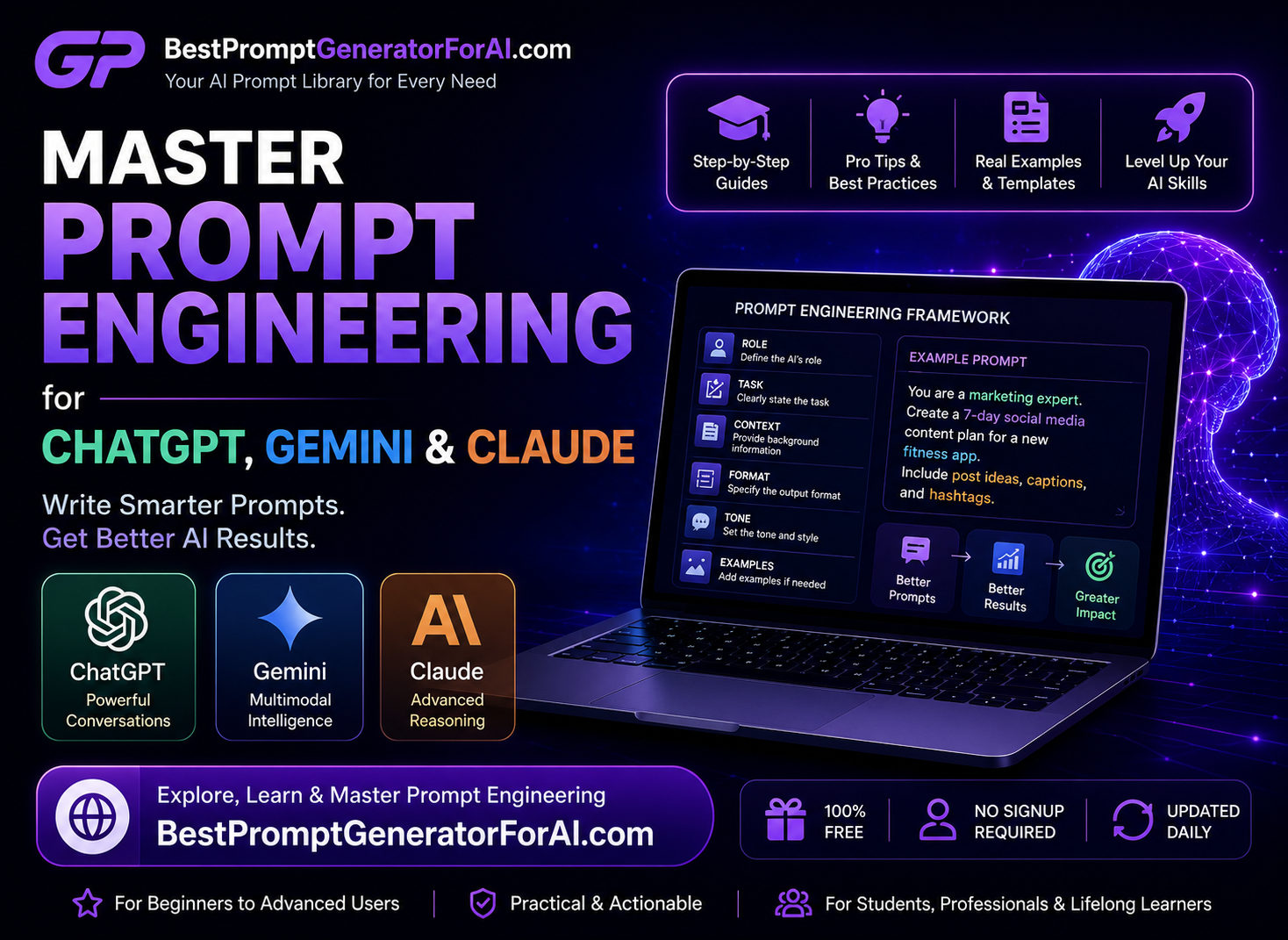
Role + Goal + Context + Requirements + Output Format + Constraints
Example:
Act as an SEO expert.
Write a 2,500-word article explaining local SEO.
The audience is small business owners.
Include examples, statistics where appropriate, FAQs, and a comparison table.
Use H2 and H3 headings.
Maintain a conversational tone.
This type of structured prompt generally produces more consistent results than a brief, open-ended request.
Why Context Beats Clever Tricks
Many people search for secret prompt hacks.
In reality, the biggest improvement often comes from giving the model enough context.
Compare these prompts:
Prompt A
Write Facebook ads.
Prompt B
Write five Facebook ads for an online fitness coaching business targeting busy professionals aged 30–45. Highlight convenience, personalized coaching, and flexible scheduling. Each ad should include a headline, primary text, and CTA.
Prompt B provides the information needed to create tailored outputs instead of generic copy.
Advanced Prompt Engineering Frameworks That Actually Work
you learned the fundamentals of prompt engineering and why structured prompts consistently outperform vague instructions. Now it’s time to explore proven frameworks that professionals use to get better results from ChatGPT, Gemini, and Claude.
These frameworks aren’t “prompt hacks.” They’re structured ways to communicate with AI so it understands your goals, audience, constraints, and desired output. Guidance from AI providers increasingly emphasizes clarity, context, examples, and iterative refinement rather than relying on special keywords.
1. The CRAFT Framework
CRAFT is one of the most practical prompt structures because it covers the essential information an AI model needs.
| Element | Meaning |
|---|---|
| C | Context |
| R | Role |
| A | Action |
| F | Format |
| T | Tone |
Example Prompt
Context:
I’m launching an online course about email marketing.Role:
Act as a senior digital marketing strategist.Action:
Create a landing page that explains the course benefits and encourages signups.Format:
Use H2 headings, bullet points, testimonials, and a CTA section.Tone:
Professional, persuasive, and easy to understand.
Why It Works
Each instruction serves a clear purpose:
- Context explains the situation.
- Role shapes the model’s perspective.
- Action defines the task.
- Format creates consistency.
- Tone aligns the writing style with your audience.
Best for: Blog writing, sales copy, emails, landing pages, and content marketing.
2. The COSTAR Framework
COSTAR is ideal for business writing because it emphasizes outcomes and audience.
| Element | Meaning |
|---|---|
| Context | Background information |
| Objective | Desired result |
| Style | Writing style |
| Tone | Voice |
| Audience | Target reader |
| Response | Output format |
Example
Context:
Our SaaS startup helps restaurants manage reservations.Objective:
Generate five blog topics that attract restaurant owners.Style:
SEO-focused and educational.Tone:
Friendly and authoritative.Audience:
Restaurant owners and managers.Response:
Provide a table with titles, search intent, and target keywords.
Why It Works
Instead of focusing only on what to create, COSTAR emphasizes who it’s for and what outcome you want, which often leads to more focused responses.
Prompt Engineering Tips for Each AI Model
While the same core principles apply across models, slight adjustments can improve results.
| Model | What It Responds Well To | Best Practices |
|---|---|---|
| ChatGPT | Structured instructions, formatting, creative tasks | Specify output format, constraints, and audience clearly. |
| Claude | Long documents, nuanced writing, document analysis | Provide detailed context and allow room for thoughtful explanations. |
| Gemini | Research assistance, multimodal tasks, Google ecosystem workflows | Be explicit about goals and ask for organized summaries or comparisons. |
These differences are tendencies rather than strict rules. Testing your prompts on multiple models can reveal which one best suits a particular task.
Common Prompt Engineering Mistakes
Avoid these frequent pitfalls:
- Being too vague or generic.
- Omitting the target audience.
- Forgetting to specify the desired output format.
- Trying to accomplish unrelated tasks in a single prompt.
- Not providing relevant context.
- Skipping refinement after the first response.
- Expecting identical outputs across different AI models.
Frequently Asked Questions (FAQs)
1. What is prompt engineering?
Prompt engineering is the practice of writing clear, structured instructions that help AI models like ChatGPT, Gemini, and Claude generate more accurate, relevant, and useful responses.
2. Do I need technical skills to learn prompt engineering?
No. Anyone can learn prompt engineering. While developers may use advanced techniques, marketers, content creators, educators, and business professionals can achieve excellent results using straightforward prompting frameworks.
3. Which AI model is best for prompt engineering?
There isn’t a single “best” model. ChatGPT is known for structured outputs and versatility, Claude excels at long-form writing and document analysis, and Gemini integrates well with Google’s ecosystem and research workflows. The right choice depends on your use case.
4. Can the same prompt work across ChatGPT, Gemini, and Claude?
Yes. Most well-structured prompts work across all three models. However, slight adjustments in wording, context, or formatting may improve results depending on the platform.
5. How can I improve the quality of AI responses?
Provide clear objectives, sufficient context, define the target audience, specify the desired output format, include constraints, and refine the response through follow-up prompts instead of starting over.
6. What are the biggest prompt engineering mistakes?
Common mistakes include writing vague prompts, omitting important context, asking multiple unrelated questions at once, failing to specify the desired format, and publishing AI-generated content without reviewing it.
7. Is prompt engineering important for SEO content?
Absolutely. Well-crafted prompts help generate content with logical structure, clear headings, relevant keywords, FAQs, and user-focused answers that support modern SEO and AI search optimization strategies.
8. What is the difference between SEO, GEO, and LLMO?
SEO (Search Engine Optimization): Optimizes content for traditional search engines.
GEO (Generative Engine Optimization): Structures content so AI-powered search systems can summarize and cite it effectively.
LLMO (Large Language Model Optimization): Improves clarity, factual organization, and readability for AI assistants and language models.
9. Should I trust AI-generated answers without checking them?
No. AI can make mistakes or present outdated information. Always verify important facts, especially for medical, legal, financial, or technical topics, and add your own expertise before publishing.
10. Where can I find high-quality prompt templates?
You can build your own library using the frameworks discussed in this guide or explore dedicated prompt resources and tools. For a growing collection of AI prompt templates, generators, and practical guides, visit Best Prompt Generator for AI.
Conclusion
Prompt engineering is the key to getting better results from ChatGPT, Gemini, Claude, and other AI tools. By providing clear instructions, relevant context, defined goals, and the desired output format, you can generate more accurate, useful, and high-quality responses. As AI continues to evolve, learning how to communicate effectively with these models will become an essential digital skill for content creators, marketers, developers, businesses, and students alike. Keep experimenting, refine your prompts based on the results, and combine AI capabilities with your own expertise to create content and solutions that deliver real value.