Written by Best Prompt Generator for AI Team
Reviewed by our team before publishing — learn more about us


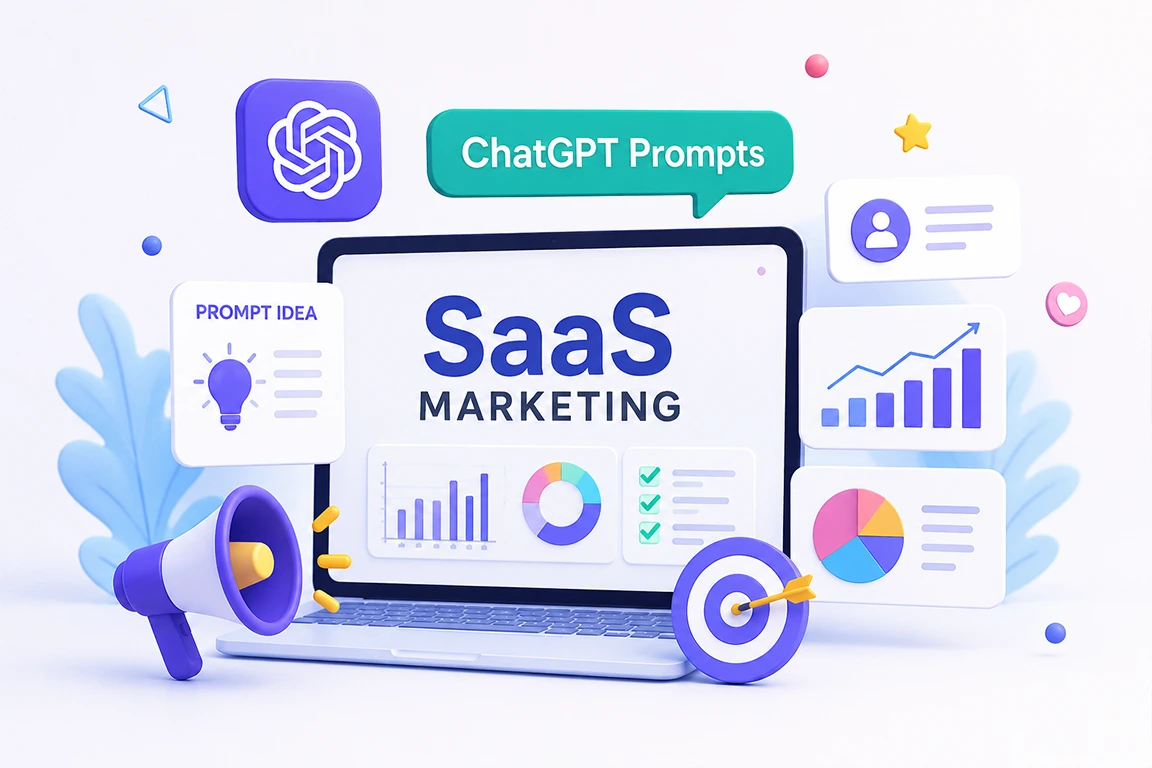
SaaS companies compete to attract users, generate qualified leads, increase conversions, and retain customers, and AI tools like ChatGPT can act as marketing assistants for that work. By using the right ChatGPT prompts for SaaS marketing, businesses can streamline tasks such as content creation, lead generation, SEO, email marketing, social media management, and customer retention while saving time.
For SaaS businesses, effective marketing requires more than simply promoting software features. Companies need to communicate their value proposition clearly, understand their target audience, create useful content, nurture leads, and continuously improve the customer journey. AI prompts can support many of these activities when combined with human strategy and review.
Fill the form and click "Generate Prompt"
Your professional AI prompt will appear here
SaaS marketing refers to the process of promoting and acquiring customers for Software as a Service (SaaS) products or online applications. SaaS companies make their software available over the internet, so customers generally do not need to purchase and install traditional software. Instead, they access the product through a subscription, which may be billed monthly or annually.
Simply put, the primary goal of SaaS marketing is to reach the right customers, explain the value of the software, encourage prospects to start a free trial or request a demo, convert them into paying customers, and retain them over the long term.
SaaS Marketing = A marketing strategy for acquiring and retaining software customers.
For example, if a company offers CRM software, accounting software, HR software, an AI platform, project management software, or another subscription-based application, the process of promoting and selling that product is SaaS marketing.
Thousands of SaaS products are available today, creating intense competition across almost every software category. Simply building a useful product is not enough. SaaS companies must make their products discoverable, communicate their value, build trust, and provide compelling reasons for potential customers to choose them.
A well-planned SaaS marketing strategy can help businesses generate qualified leads, increase product awareness, improve conversions, reduce customer acquisition challenges, and build stronger relationships with users.
| Traditional Marketing | SaaS Marketing |
|---|---|
| Product may be sold once | Usually subscription-based |
| Limited post-sale relationship | Continuous customer engagement is important |
| Repeat purchases may be less frequent | Monthly or annual renewals are important |
| Often focused on one-time revenue | Recurring revenue such as MRR and ARR is important |
| Customer lifecycle may be shorter | Acquisition, activation, retention, and expansion all matter |
The following AI prompts for SaaS marketing can help with positioning, research, content creation, email campaigns, social media, advertising, SEO, product demos, and lead generation. Customize each prompt with information about your product, audience, competitors, and marketing goals.
1. SaaS Product Positioning Prompt
Prompt: “I want to create a strong positioning statement for my SaaS product. Analyze the target audience, their main problems, our unique value proposition, important product benefits, and key differences from competitors. Create a clear positioning statement that explains why our ideal customers should consider this product.”
2. SaaS Market Research Prompt
Prompt: “Create a detailed market research framework for my SaaS product. Analyze the target customer segments, common customer pain points, industry trends, major competitors, pricing models, product positioning, and potential market opportunities. Present the findings in a structured format that can help guide our marketing strategy.”
3. SaaS Blog Content Writing Prompt
Prompt: “Create an SEO-friendly blog article for my SaaS business about [topic]. Identify the search intent, suggest relevant keywords, create an engaging outline, explain the topic clearly, include practical examples, and naturally connect the topic with the benefits and use cases of our software without making the article overly promotional.”
For a stronger organic content strategy, create SEO-focused blog content for your SaaS audience around the problems and questions your potential customers search for.
4. SaaS Email Marketing Prompt
Prompt: “Create an email marketing campaign for my SaaS product. Include a welcome email, product onboarding email, educational email, customer success email, promotional email, and follow-up email. Make each message useful, concise, personalized, and focused on moving the reader toward the appropriate next step.”
5. SaaS Landing Page Copy Prompt
Prompt: “Write high-converting landing page copy for my SaaS product. Create an attention-grabbing headline, supporting subheadline, customer pain points, product benefits, important features, social proof placeholders, objections and responses, frequently asked questions, and a strong call to action. Keep the messaging focused on customer outcomes rather than only product features.”
6. SaaS Social Media Marketing Prompt
Prompt: “Create a 30-day social media content plan for my SaaS company. Include educational posts, product tips, industry insights, customer-focused content, product use cases, engagement questions, and promotional posts for LinkedIn, Instagram, and X. Provide a suggested format and call to action for each post.”
You can also find useful AI prompts for creating engaging social content and adapt them to your SaaS brand and target audience.
7. SaaS Paid Ads Copy Prompt
Prompt: “Create persuasive advertising copy for Google Ads and social media advertising for my SaaS product. Focus on the target audience’s biggest challenges, explain how the software solves those problems, highlight the most important benefits, address a common objection, and include a clear call to action that encourages qualified prospects to click or start a free trial.”
8. SaaS SEO Strategy Prompt
Prompt: “Develop a complete SEO strategy for my SaaS website. Include keyword research ideas, search intent analysis, topic clusters, on-page SEO recommendations, internal linking opportunities, content ideas, technical SEO considerations, and a long-term content plan designed to attract relevant organic traffic and potential customers.”
9. SaaS Product Demo Script Prompt
Prompt: “Create a professional product demo video script for my SaaS application. Start by identifying the target customer’s problem, introduce the software as a solution, demonstrate the most valuable features step by step, explain real-world use cases, highlight customer benefits, and finish with a clear call to action.”
10. SaaS Lead Generation Prompt
Prompt: “Create a lead generation strategy for my SaaS business using content marketing, lead magnets, free trials, landing pages, webinars, paid advertising, and email funnels. Identify the ideal customer profile, suggest lead-generation offers, explain how each lead should be nurtured, and recommend metrics for measuring campaign performance.”
1. Rapid Content Creation:
AI can help marketing teams create first drafts of blog posts, social media content, landing pages, email campaigns, product messaging, and other marketing assets more quickly. This allows teams to spend more time on strategy, editing, research, and optimization.
2. More Efficient SEO Planning:
AI can assist with keyword research ideas, search intent analysis, content structures, topic clusters, FAQs, and metadata. Marketers can use these outputs as starting points while validating important SEO decisions with reliable research and current search data.
3. Better Lead Generation:
AI can help marketers brainstorm lead magnets, audience segments, landing page ideas, qualification questions, outreach messages, and nurturing campaigns. This can make the lead-generation process more organized and scalable.
4. High-Quality Ad Copy Ideas:
AI can generate different versions of advertising headlines, descriptions, hooks, value propositions, and calls to action. Marketing teams can test these variations and refine them based on actual campaign performance.
5. Email Marketing Ideas:
AI can help create personalized email sequences for onboarding, product education, abandoned trials, promotions, renewals, and customer engagement. Marketers can then adjust the messages based on customer behavior and campaign data.
6. Customer Retention Support:
AI can help identify customer communication opportunities, develop onboarding content, brainstorm retention campaigns, and create educational resources. These activities can support stronger customer engagement and help SaaS teams improve the overall customer experience.
SaaS products operate in highly competitive markets where customers can often compare multiple solutions before making a purchasing decision. Because subscription businesses depend on recurring customer relationships, marketing must support the entire customer journey rather than focusing only on the initial sale.
The quality of an AI-generated response depends heavily on the information included in the prompt. Generic instructions often produce generic marketing content. For stronger results, give ChatGPT enough context about your SaaS product and the specific task.
To improve your overall prompting approach, learn how to create clearer and more effective AI prompts for different marketing tasks and workflows.
Content marketing is one of the most useful applications of AI for SaaS companies. A single customer problem can become multiple pieces of content, including a detailed blog post, social media posts, email content, video topics, FAQs, and downloadable resources.
AI can also help marketing teams develop topic clusters and content calendars around different stages of the buyer journey. However, SaaS content should provide genuine value instead of simply promoting the product in every article.
For a broader content strategy, discover AI strategies for building stronger SaaS content marketing and adapt those ideas to your company’s goals.
One of the biggest advantages of using AI for SaaS marketing is reducing repetitive work. Instead of beginning every campaign from a blank page, marketers can use well-designed prompts to create initial drafts, messaging options, research frameworks, content outlines, and campaign ideas.
This does not mean AI should replace marketing strategy. Human marketers still need to understand customers, validate information, make strategic decisions, review outputs, and analyze campaign performance.
AI works best when it supports experienced marketers rather than operating without direction. Combining customer insights, business goals, marketing data, and effective prompts can produce more useful and relevant results.
Although ChatGPT can accelerate marketing workflows, every AI-generated output should be reviewed before publication. AI may produce inaccurate product claims, outdated information, unsupported statistics, or messaging that does not match your brand.
Marketing teams should verify important facts, pricing information, product capabilities, customer claims, and industry-specific information. They should also avoid entering confidential customer information, private business data, passwords, or other sensitive information into AI tools.
The goal should be to use AI as a productivity and ideation tool while keeping human judgment at the center of the marketing process.
To show what the generator above produces, we filled it in with a realistic scenario and copied the result exactly as the tool returned it. Nothing below was edited by hand.
You are an expert SaaS growth marketing strategist.

Develop a comprehensive marketing strategy for a SaaS product (type: B2B) targeting Small business owners who manage client projects. The strategy should address the audience's primary challenges, including Low trial-to-paid conversion and unclear onboarding, while focusing on achieving the following business objectives: More free-trial activations and lower churn.

Your strategy should include the following sections:

1. Target Audience Analysis
 - Describe the target audience in detail.
 - Identify their motivations, behaviors, purchasing triggers, and decision-making process.
 - Explain how the product solves their specific pain points.

2. Value Proposition & Positioning
 - Create a compelling value proposition tailored to the audience.
 - Differentiate the product from competitors using these competitor insights (if provided).
 - Align messaging with the existing brand identity (if provided).

3. Marketing Channel Strategy
 - Recommend the most effective marketing channels based on Email Marketing.
 - Explain why each channel is suitable.
 - Suggest campaign ideas, content formats, and customer acquisition tactics for each channel.

4. Content & Messaging Strategy
 - Develop key messaging that resonates with the target audience.
 - Recommend content themes, campaign ideas, and calls-to-action.
 - Ensure consistency with the existing branding guidelines.

5. Competitive Analysis
 - Analyze the strengths and weaknesses of the competitors named above (if provided).
 - Identify opportunities to outperform competitors through positioning, pricing, features, or marketing.

6. Budget Allocation
 - Create a recommended marketing budget distribution based on this budget (if provided).
 - Explain how resources should be allocated across channels for maximum ROI.

7. Implementation Roadmap
 - Develop a phased execution plan covering the timeframe of Medium-term (3-6 months).
 - Include milestones, priorities, and expected outcomes for each phase.

8. KPIs & Success Metrics
 - Recommend measurable KPIs such as website traffic, lead generation, conversion rate, CAC, LTV, MRR growth, customer retention, and ROI.
 - Explain how success should be measured and optimized.

9. Additional Considerations
 - Incorporate any special requirements, constraints, industry trends, regulatory considerations, or business context (if provided): The product is a project management tool and the marketing team has three people.

Deliver the response in a professional, well-structured format using clear headings, tables where appropriate, actionable recommendations, and prioritized next steps. Focus on creating a practical, data-driven marketing strategy that helps achieve More free-trial activations and lower churn while maximizing growth and marketing efficiency.
Good for a planning document when you know your audience, pain points and goal but have not yet mapped channels and timing. The three optional fields (branding, competitors and budget) were left blank on purpose: the tool still returns a complete prompt, and filling them in makes the strategy more specific. Treat the AI's strategy as a starting point to check against your own data.
ChatGPT prompts for SaaS marketing are instructions that help marketers use ChatGPT for specific SaaS-related tasks. They can be used to generate blog ideas, landing page copy, email campaigns, advertising concepts, social media content, SEO strategies, lead-generation ideas, and other marketing materials.
Yes. ChatGPT can be useful for content creation, marketing brainstorming, SEO planning, email campaigns, social media posts, customer communication, product messaging, and other marketing activities. However, AI-generated content should be reviewed and customized before publication.
Well-designed prompts can help generate keyword ideas, search-intent frameworks, content outlines, FAQs, meta descriptions, topic clusters, and SEO content drafts. These outputs can support an SEO workflow, but marketers should validate keywords, search demand, competition, and important SEO decisions independently.
Useful prompts include those for SaaS blog writing, product positioning, landing pages, email marketing, social media campaigns, paid advertising, lead generation, customer onboarding, product demos, SEO planning, and customer retention.
It is better to review and edit AI-generated content before publishing it. Marketing teams should verify factual claims, add original insights, include accurate product information, match the company’s brand voice, and ensure the final content provides genuine value to its intended audience.
ChatGPT can help brainstorm lead magnets, landing page copy, email sequences, outreach messages, audience segments, qualification questions, and campaign ideas. However, actual lead generation depends on factors such as audience targeting, offer quality, distribution, traffic, conversion optimization, and campaign execution.
AI can reduce the time required for repetitive writing and brainstorming tasks. Marketers can use it to create first drafts, campaign variations, content outlines, email sequences, social posts, and research frameworks, allowing more time for strategy, analysis, and optimization.
In today’s competitive software market, AI can become a valuable part of a modern SaaS marketing workflow. The right ChatGPT prompts for SaaS marketing can help teams develop content, plan SEO strategies, generate leads, write emails, create advertisements, develop social media campaigns, and improve customer communication.
However, prompts alone do not guarantee marketing success. SaaS companies still need a clear value proposition, a strong understanding of their target customers, reliable data, effective positioning, and consistent execution.
Use ChatGPT to accelerate repetitive tasks, generate ideas, and create useful first drafts. Then combine AI-generated outputs with your own expertise, customer insights, and performance data to create marketing campaigns that genuinely support SaaS growth.

About the author
Best Prompt Generator for AI Team
Best Prompt Generator for AI Team is the small team behind bestpromptgeneratorforai.com, based in Rajkot, Gujarat, India. We build free tools that turn a rough idea into a clear, structured prompt for ChatGPT, Claude, Gemini, Midjourney and other AI tools, and we publish practical guides and prompt examples for creators, marketers and everyday users. Every tool and article is written and reviewed by our team before it is published. Questions or corrections: info@bestpromptgeneratorforai.com. Our tools are free to use, with an optional Pro plan for higher monthly limits.