Written by Best Prompt Generator for AI Team
Reviewed by our team before publishing — learn more about us


Written by Best Prompt Generator for AI Team
Reviewed by our team before publishing — learn more about us
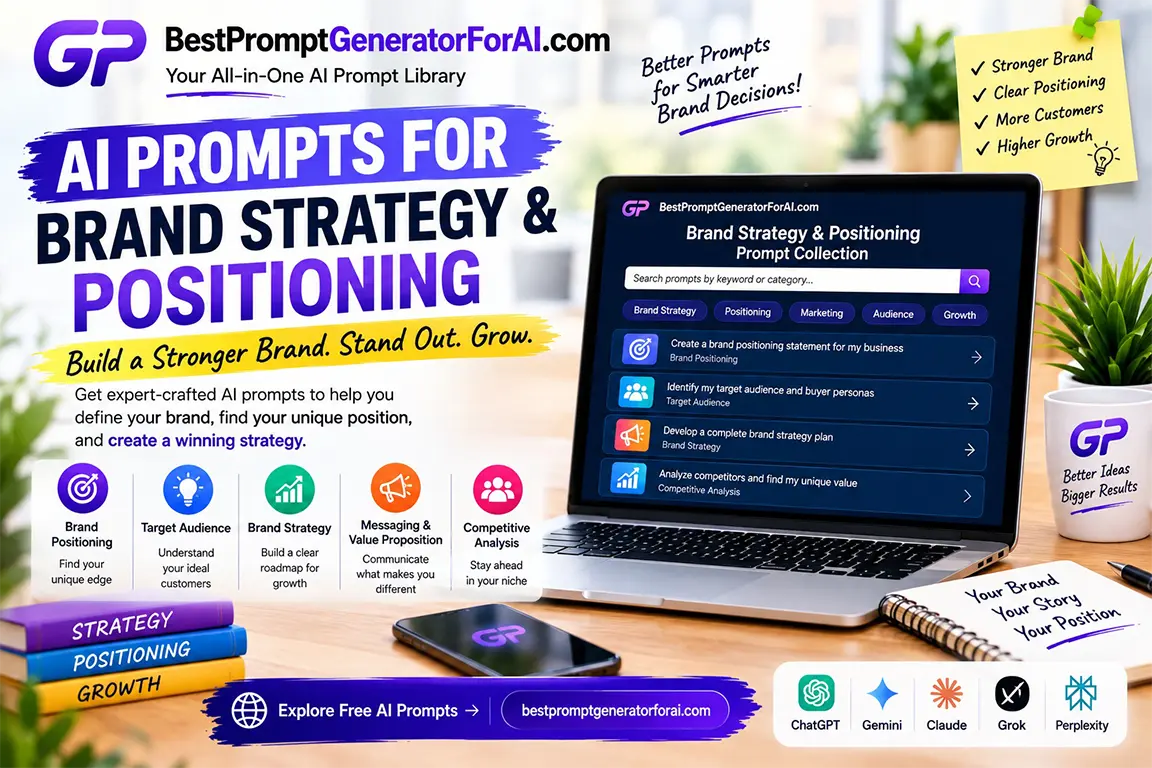
Building a strong brand requires more than a memorable name or attractive logo. A successful brand needs clear positioning, a defined target audience, consistent messaging, and a strong reason for customers to choose it.
AI prompts for brand strategy can help marketers, entrepreneurs, and business owners develop positioning ideas, understand customers, analyze competitors, create messaging, and build a stronger brand identity. Instead of asking AI generic questions, structured prompts provide the context needed to generate more useful strategic recommendations.
Whether you are launching a new business, repositioning an existing company, or developing a personal brand, AI can help make the planning process faster and more organized.
AI prompts for brand strategy are detailed instructions that guide AI tools through specific branding tasks. They can help with audience research, brand positioning, differentiation, messaging, brand personality, value propositions, and strategic planning.
A strong prompt explains your business, target audience, customer problem, competitors, goals, and unique advantages. Understanding how effective prompt engineering improves AI results can help you create more useful branding prompts.
Fill the form and click "Generate Prompt"
Your professional AI prompt will appear here
✓ Prompt generated successfully!
Copy and paste this into ChatGPT, Claude, or any AI model to get expert results.
AI can quickly generate different positioning concepts, value propositions, messaging ideas, and brand directions for comparison.
Detailed prompts can help explore customer needs, pain points, motivations, objections, and buying behavior.
AI can organize competitor information and highlight potential opportunities for differentiation.
Reusable prompts can help maintain consistent positioning and brand voice across websites, social media, emails, advertisements, and other channels.
Instead of starting every branding task from scratch, teams can create reusable prompts containing their core business information.
Include your business name, industry, products or services, location, business model, and current growth stage.
Describe your ideal customers, including their needs, challenges, interests, motivations, and purchasing behavior.
Explain the main problem your audience wants to solve. Strong positioning connects an important customer problem with a valuable solution.
Provide information about major competitors and explain how they position their products or services.
Include your expertise, features, technology, service, pricing, experience, or other factors that differentiate your business.
Describe how you want your brand to sound and feel, such as professional, friendly, innovative, premium, practical, or trustworthy.
Replace the placeholders with your own business information before using these prompts.
Prompt: Act as an experienced brand strategist. Analyze {business_name}, {industry}, {target_audience}, {product_or_service}, competitors, customer problems, and business goals. Create a brand strategy covering purpose, mission, vision, values, positioning, differentiation, personality, messaging, and growth opportunities.
Prompt: Create three positioning statements for {business_name}. We serve {target_audience}, provide {product_or_service}, solve {customer_problem}, and differentiate ourselves through {unique_advantage}. Explain the strategic difference between each option.
Prompt: Define the ideal target audience for {business_name}. Analyze demographics, motivations, goals, pain points, objections, buying behavior, and reasons customers choose one brand over another.
Prompt: Identify the most important problems experienced by customers who need {product_or_service}. Categorize them into functional, emotional, financial, and strategic pain points.
Prompt: Analyze {business_name} and its competitors. Identify five opportunities to differentiate the brand through customer benefits, expertise, service, innovation, experience, pricing, or positioning.
Prompt: Analyze {competitor_1}, {competitor_2}, and {competitor_3}. Compare their audiences, value propositions, messaging, strengths, weaknesses, and positioning. Identify market gaps for {business_name}.
When validating market demand, you can also use structured AI prompts for deeper keyword research.
Prompt: Create five unique value propositions for {business_name}. Consider our target audience, customer problem, benefits, competitors, and unique strengths. Keep each proposition specific and customer-focused.
Prompt: Develop three mission statements for {business_name}. Our purpose is {brand_purpose}, our audience is {target_audience}, and we help customers achieve {customer_outcome}.
Prompt: Create three long-term brand vision statements based on our industry, target audience, purpose, and future business goals.
Prompt: Recommend five to seven core brand values for {business_name}. Explain how each value should influence products, customer experience, marketing, and business decisions.
Prompt: Define the ideal personality for {business_name}. Recommend personality traits, communication characteristics, words to use, and words to avoid.
Prompt: Create a brand voice guide covering tone, vocabulary, sentence style, emotional characteristics, communication principles, and phrases to avoid.
Prompt: Build a messaging framework including the main brand message, supporting messages, customer pain points, value propositions, differentiators, benefits, proof points, and calls to action.
Prompt: Create an authentic brand story using {company_background}, {customer_problem}, {solution}, {mission}, and {unique_advantage}. Make it customer-focused and suitable for a website.
Prompt: Generate 20 tagline ideas for {business_name}. Make them memorable, customer-focused, relevant to our positioning, and free from generic marketing clichés.
Prompt: Identify the five most important perceptions {business_name} should build among its target customers. Explain how marketing can reinforce each perception.
Prompt: Develop a rebranding strategy for {business_name}. Explain what should remain, what should change, and how the new positioning should differ from the current strategy.
Prompt: Identify gaps between how {business_name} wants to be perceived and how customers may currently perceive it. Recommend practical improvements.
Prompt: Analyze the market for {product_or_service} in {market_location}. Identify customer segments, competitors, trends, underserved needs, and positioning opportunities.
Prompt: Create a content strategy that reinforces {business_name}’s brand positioning. Define content pillars, audience needs, messaging themes, topics, formats, and calls to action that consistently communicate the brand’s unique value.
Once your positioning is established, turn your brand strategy into repeatable marketing workflows for consistent campaign execution.
Prompt: Develop a campaign that communicates our brand positioning. Include the target audience, positioning message, customer problem, key differentiator, creative direction, channels, content ideas, offer, CTA, and measurement criteria.
Prompt: Review these brand messages for inconsistencies in positioning, tone, value proposition, audience focus, and personality. Recommend specific improvements.
Prompt: Create a personal brand positioning strategy for {person_name}. Consider expertise, experience, audience, strengths, competitors, goals, differentiation, and content opportunities.
Prompt: Develop a positioning strategy for {product_name}. Analyze features, benefits, audience, customer problems, competitors, alternatives, pricing, and unique advantages.
Prompt: Audit the brand strategy for {business_name}. Review audience, positioning, value proposition, differentiation, messaging, brand voice, benefits, and competitive landscape. Identify the five highest-priority improvements.
Explain what your company does, who it serves, what problem it solves, and what makes it different.
Specify whether you want a table, framework, positioning statements, recommendations, or step-by-step strategy.
Request several positioning and messaging options so you can compare different strategic directions.
Competitor information helps AI understand your market and identify opportunities for differentiation.
Ask AI to identify weaknesses, assumptions, risks, and potential customer objections instead of providing only positive recommendations.
Review the first response, provide additional context, and ask AI to improve the strategy based on your feedback.
Document your business model, products, services, industry, customers, and goals.
Define customer needs, problems, motivations, objections, and desired outcomes.
Identify competing brands and examine their positioning, messaging, strengths, and weaknesses.
Determine what your business can credibly do differently or better for customers.
Use AI to develop several possible positioning directions based on your research.
Compare each option for clarity, relevance, uniqueness, credibility, and customer value.
Turn the selected positioning into core messages, benefits, proof points, and communication guidelines.
Use the positioning across your website, social media, advertisements, emails, products, and sales materials.
Generic prompts often produce generic recommendations. Include specific business and customer information.
Use AI as a strategic assistant and validate important market, competitor, and customer information independently.
Clear positioning requires a defined audience rather than trying to appeal to every possible customer.
Competitor research should reveal opportunities for differentiation, not encourage you to copy another brand.
Strong branding requires customer relevance, credibility, differentiation, and strategic consistency—not just creative slogans.
AI can generate useful hypotheses, but customer interviews, reviews, surveys, and real business data remain important.
AI can generate many branding ideas quickly for comparison and refinement.
Complex branding information can be organized into practical frameworks.
Reusable prompts can help teams maintain consistent positioning and brand voice.
AI can help organize information so teams can spend more time evaluating insights.
Small businesses can use AI prompts to explore branding ideas without starting every task from scratch.
Startup teams can also use AI prompts for faster founder-led strategic planning when developing an early brand direction.
AI prompting does not have to replace traditional brand strategy. It can complement research, workshops, customer interviews, competitor analysis, and strategic consulting by helping teams brainstorm, organize information, and explore alternative positioning options.
The strongest approach combines AI-assisted ideation with real customer evidence, market research, business knowledge, and human strategic judgment.
Replace placeholders with specific information about your company and customers.
Tell AI whether you need a brand strategist, marketing consultant, customer researcher, or positioning specialist.
Clearly explain who the brand is trying to reach and what those customers need.
Tell AI what to avoid, including clichés, generic language, unsupported claims, or competitor-like positioning.
Request practical next steps instead of asking only for general analysis.
After developing your positioning, apply consistent brand messaging across social media to strengthen recognition across customer touchpoints.
To show what the generator above produces, we filled it in with a realistic scenario and copied the result exactly as the tool returned it. Nothing below was edited by hand.
You are an expert brand strategist and positioning consultant with deep experience building differentiated brands in Specialty coffee roasting (direct-to-consumer).

BRAND CONTEXT
- Industry: Specialty coffee roasting (direct-to-consumer)
- Product/Service: Small-batch, ethically sourced coffee sold by monthly subscription
- Target Audience: Remote workers and home-coffee enthusiasts aged 25-45
- Customer Problem: Supermarket coffee tastes stale and they cannot tell where it comes from
- Brand Purpose: Make great coffee traceable, fresh and fair to the farmers who grow it
- Business Goals: Reach 2,000 subscribers in 12 months and increase repeat purchases
- Brand Personality: Warm, knowledgeable, down-to-earth

TASK
Develop a clear, actionable brand strategy that:
1. Positions the product or service as the obvious choice for the target audience, based on the customer problem described above.
2. Reflects the brand's purpose and desired personality above.
3. Directly supports the business goals listed above.
4. Includes: a one-sentence positioning statement, 3-5 brand pillars, and a real differentiation angle versus typical competitors in Specialty coffee roasting (direct-to-consumer).

Small budget; most sales come from Instagram and our own website.

Be specific and strategic -- ground every recommendation in the details above, and avoid generic marketing language.
Good for a first positioning draft when you already know your audience, their problem and your purpose. The prompt asks for a one-sentence positioning statement, three to five brand pillars and a differentiation angle, so the answer is specific instead of a list of brand clichés. Treat the competitor angle as a hypothesis: the AI cannot see your market, so check it against real competitors before committing. The coffee brand in this example is fictional.
AI prompts for brand strategy are structured instructions that help AI tools perform branding tasks such as audience research, positioning, differentiation, messaging, and brand voice development.
AI can help develop many parts of a brand strategy, but human judgment and real market research should be used to validate the final strategy.
A strong prompt should include your business, target audience, customer problem, competitors, unique advantages, market, and desired customer perception.
Yes. ChatGPT can help create positioning statements, value propositions, audience segments, messaging ideas, and differentiation strategies when given sufficient context.
AI prompts can help develop positioning statements, differentiators, value propositions, target audience profiles, brand messaging, and competitive positioning ideas.
AI can generate original combinations of ideas, but businesses should review competitors, trademarks, existing brand language, and customer relevance before using them.
Include your business, audience, customer problems, competitors, goals, differentiators, market, and desired output format for better results.
Yes. Small businesses can use AI prompts to develop positioning, target audiences, messaging, brand guidelines, and marketing strategies.
AI prompts for brand strategy and positioning can make branding work faster, more organized, and easier to refine. From defining your target audience and customer problems to creating positioning statements, value propositions, brand voice, and messaging frameworks, AI can support many stages of strategic planning.
The best results come from combining detailed prompts with real customer research, competitive analysis, business knowledge, and human judgment. With reusable prompts, businesses can create a repeatable process for developing and maintaining a clear, consistent, and differentiated brand.

About the author
Best Prompt Generator for AI Team
Best Prompt Generator for AI Team is the small team behind bestpromptgeneratorforai.com, based in Rajkot, Gujarat, India. We build free tools that turn a rough idea into a clear, structured prompt for ChatGPT, Claude, Gemini, Midjourney and other AI tools, and we publish practical guides and prompt examples for creators, marketers and everyday users. Every tool and article is written and reviewed by our team before it is published. Questions or corrections: info@bestpromptgeneratorforai.com. Our tools are free to use, with an optional Pro plan for higher monthly limits.
Enter a subject and AI will instantly build the best form for you — up to 10 smart fields.
Searching best fields for your subject…
These fields were crafted specifically for your prompt type.
Generating your optimised prompt…