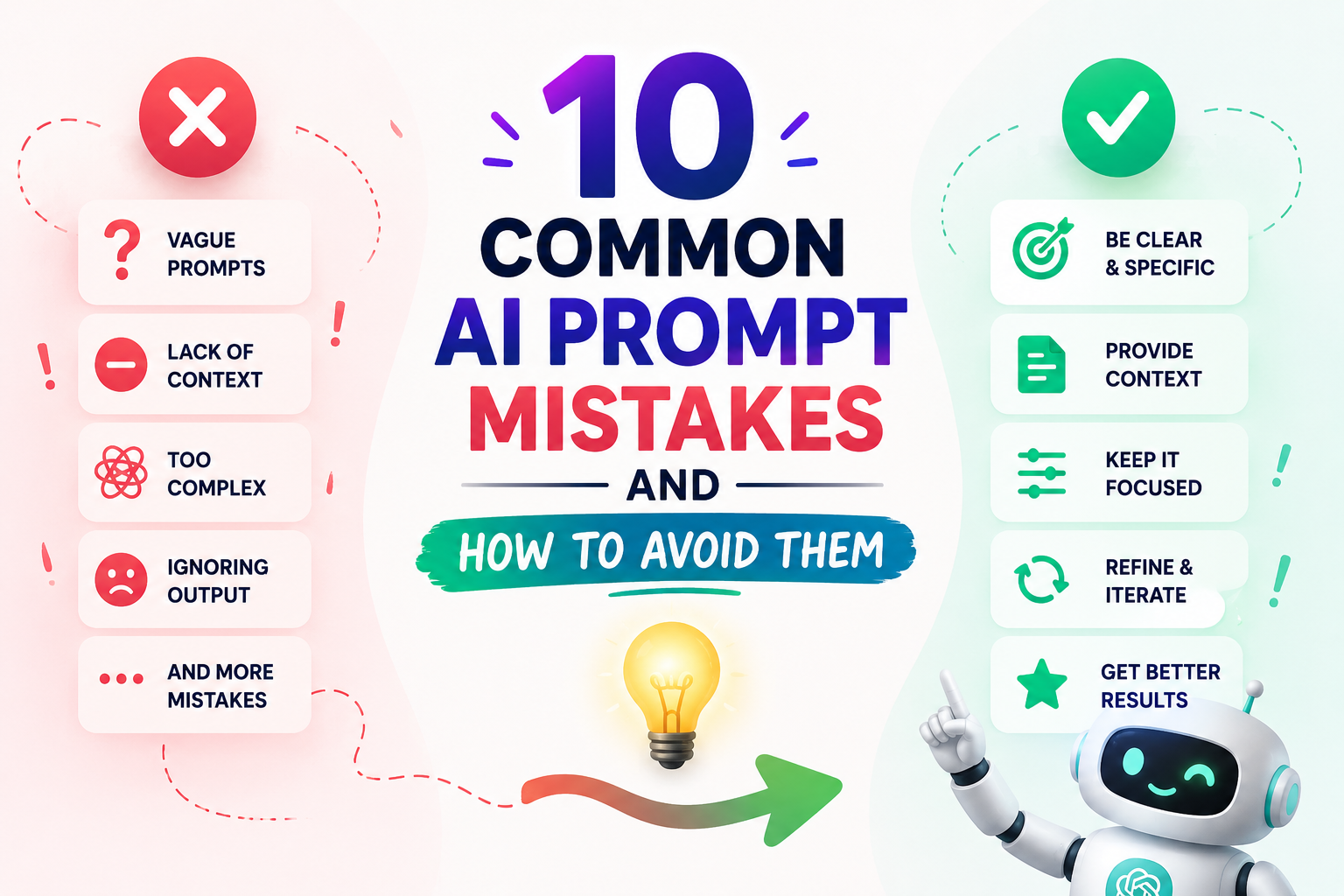
AI can provide highly useful results, but the quality of the output depends largely on how clearly you communicate with it. Many people make common AI prompt mistakes, such as giving unclear instructions, failing to define the target audience, leaving out important details, asking multiple questions at once, or not specifying the desired output format. These mistakes can lead to inaccurate, irrelevant, or incomplete responses.
Nowadays, Artificial Intelligence (AI) is being used rapidly across almost every field. Tools such as ChatGPT, Gemini, Claude, and other AI platforms are making people’s work easier and faster. However, many users still complain that the answers generated by AI do not match their expectations.
The main reason is often not the AI tool itself but the way the prompt is written. If you do not provide clear instructions and relevant context, the AI may not understand exactly what you want.
In this article, we will explore 10 common AI prompt mistakes and learn how to write better AI prompts so you can get clearer, more accurate, and more useful AI responses.
What is an AI Prompt?
An AI prompt is an instruction, question, or set of directions given to an AI tool. The AI interprets the information in your prompt and generates a response based on the instructions and context you provide.
For example:
Bad Prompt: “Tell me about SEO.”
Good Prompt: “What is SEO? Explain five essential SEO techniques for beginners using simple language. Give a short explanation and one practical example for each technique.”
The second prompt is more specific because it explains the topic, audience, language, structure, and expected level of detail.
Understanding prompt engineering principles helps you create clearer instructions and improve the consistency of AI-generated responses.
What Are AI Prompt Mistakes?
AI prompt mistakes are errors people make when giving instructions or questions to an AI tool. These mistakes often lead to poor-quality responses, incomplete answers, irrelevant information, or content that does not match the user’s requirements.
By learning how to avoid common AI prompting mistakes, you can improve the quality of AI-generated content and reduce the amount of editing required.
1. Writing a Very Vague Prompt
One of the most common AI prompt mistakes is providing unclear or incomplete instructions. When you give an AI tool a very vague prompt, it may not understand your exact intention. As a result, the response can be generic, incomplete, or unrelated to your actual needs.
What is an ambiguous prompt?
An ambiguous prompt is one that:
- Does not clearly explain the purpose
- Provides insufficient context
- Misses necessary details
- Does not explain the expected output
For example, instead of asking, “Write about digital marketing,” provide details about the audience, purpose, content length, tone, and format.
This makes it easier for AI to understand what you actually want.
2. Not Providing Necessary Context – A Big Mistake in AI Prompt Writing
People often make a critical mistake when working with AI: they do not provide enough context in their prompts. AI is a powerful tool, but it cannot automatically know your goals, background information, business requirements, or audience expectations.
If you do not provide sufficient information, the AI may generate a response that is technically relevant but not useful for your specific situation.
Key benefits of providing context:
- Gets more accurate answers
- Saves time
- Reduces the need to modify prompts repeatedly
- Produces results closer to your requirements
- Makes the content more useful and relevant
Providing context becomes especially important when using AI for complex marketing, content, or business tasks.
3. Giving Very Long and Confusing Instructions
Many people make another common AI prompt mistake by placing too many instructions into a single prompt without organizing them properly.
They may ask the AI to research a topic, write an article, create social media posts, optimize the content for SEO, create an email, and summarize everything in the same instruction.
Although AI can handle complex requests, poorly organized instructions can make it harder to identify priorities and produce the exact output you expect.
Problems with long and confusing prompts:
- The main purpose may become unclear
- The quality of individual tasks may decrease
- The AI may misunderstand priorities
- Some instructions may be overlooked
Instead of adding unrelated tasks together, organize complex prompts into clear steps and explain which instructions are most important.
4. Failing to Specify the Desired Output Format – A Common AI Prompting Mistake
To get a useful response from AI tools such as ChatGPT, simply stating the subject is not always enough. You should also explain what type of answer you want.
If you do not specify the output format, the AI may provide information in a format that requires significant editing.
Simply put, you need to tell the AI not only what to write but also how you want the information presented.
What is Output Format?
Output format refers to the structure or presentation of the response generated by AI.
For example, you can ask AI to provide information as:
- A bullet-point list
- A comparison table
- A step-by-step guide
- A numbered list
- A short paragraph
- An email
- A content outline
Why is it necessary to specify the Output Format?
- Gets a more organized answer
- Saves editing time
- Makes the output easier to use
- Produces results closer to your requirements
A good prompt should make three things clear:
- What is needed?
- How is it needed?
- In what format should it be provided?
5. Not Specifying the Target Audience
When creating content through AI, people often specify the topic but fail to explain who the content is intended for. This can cause AI to generate a general response that may not be suitable for the intended audience.
Every piece of content should be created with a specific audience in mind. Defining the target audience helps AI select the appropriate language, tone, examples, and level of detail.
What is the Target Audience?
A target audience is the specific group of people that your content is intended to reach.
For example, if you want to create content about “Digital Marketing,” the response can be different depending on the audience:
- For beginners, explain concepts using simple language and practical examples.
- For business owners, focus on benefits, strategies, costs, and practical applications.
- For marketing professionals, provide advanced strategies, data-driven insights, and technical information.
So before creating content, it is important to clearly define who will read or use it.
Why is defining the target audience important?
- Content reaches the right people
- Language and tone become more appropriate
- Audience problems are easier to address
- Examples become more relevant
This small adjustment can prevent many AI prompt mistakes and improve content relevance and engagement.
6. Asking Too Many Questions in a Single Prompt
When using AI, many people ask several unrelated questions in one prompt because they want to save time. However, combining too many tasks or questions without clear structure can make it difficult for the AI to give equal attention to every requirement.
Asking multiple questions in a single prompt is not always wrong. The problem occurs when the questions are unrelated, poorly organized, or lack sufficient context.
What challenges can arise when multiple questions are included in one prompt?
- The main question may become unclear
- Some questions may receive less attention
- The response may become difficult to organize
- Answers to different topics can become mixed together
For complex tasks, separate the instructions into clear steps or ask the AI to answer each requirement in a specific section.
7. Not Giving Examples
Another common AI prompt mistake is explaining what you want without providing examples. Examples can help AI understand your preferred writing style, structure, tone, formatting, or level of detail.
Giving examples can make AI-generated responses more specific and closer to your expectations.
In simple terms, showing AI what a successful output looks like can help guide it toward a similar result.
Why is it necessary to provide examples in an AI prompt?
- AI can understand your requirements more clearly
- Output style becomes more consistent
- Formatting requirements are easier to follow
- Reduces the need for repeated corrections
Examples are particularly useful when you need AI to follow a specific brand voice, writing structure, formatting style, or content pattern.
8. Not Giving the AI a Chance to Refine Its Answer
Many people make the mistake of accepting the first response generated by AI without reviewing or refining it. However, the first response is not always the best possible result.
Refining an AI response is an important part of effective prompt engineering. You can provide additional instructions after receiving the initial answer to make the output clearer, more accurate, or better suited to your requirements.
Simply put, working with AI does not have to be limited to one question and one answer.
What is AI Response Refinement?
AI response refinement is the process of giving additional instructions to improve an existing AI-generated response.
For example, you can ask AI to:
- Simplify the language
- Add more information
- Shorten the response
- Make the writing more professional
- Optimize the content for SEO
- Fix grammar and factual issues
- Improve the structure
Why do people make this mistake?
Many users assume that the first AI response will be perfect. In reality, providing feedback and additional instructions can help guide the AI toward a more useful result.
Why is it necessary to improve an AI response?
- Produces more accurate results
- Improves content quality
- Creates output that better matches your requirements
- Reduces unnecessary editing
9. Not Specifying Keywords and Goals
When using AI to create SEO content, many users provide only the topic and overlook important details such as target keywords, search intent, content goals, and audience needs.
This is a common prompt engineering mistake because AI may create generic content when it does not know what the content is intended to achieve.
For SEO-focused content, the prompt should clearly explain the target keyword, related terms, search intent, audience, content purpose, and desired structure.
Why is it important to state keywords and goals?
- Helps create more focused SEO content
- Helps AI understand search intent
- Keeps the content focused on the topic
- Supports better content planning
- Reduces generic or irrelevant output
For more effective optimization, use SEO writing prompts that align content with search intent rather than asking AI to write generic articles.
10. Not Testing and Optimizing Prompts
When working with AI, many people write one prompt, receive an answer, and stop there. They do not consider whether the prompt could be improved.
In reality, effective prompts often require testing and refinement. Small changes to the instructions, context, examples, or output requirements can produce noticeably different results.
This is an important part of prompt engineering and AI prompt optimization.
Why is it important to test prompts?
- Helps produce better output
- Improves AI understanding of your instructions
- Creates more consistent responses
- Helps identify unclear instructions
Problems caused by not optimizing prompts:
- Generic and incomplete answers
- Inconsistent content quality
- Unclear responses
- SEO requirements may be overlooked
- Audience needs may not be addressed
Testing different versions of a prompt can help you identify which instructions consistently produce the most useful results.
Best Practices for Writing Better AI Prompts
To consistently avoid AI prompt mistakes, follow these simple guidelines:
- Be specific.
- Define your goal clearly.
- Provide relevant context.
- Mention the target audience.
- Specify the desired content length.
- Request a specific output format.
- Include relevant SEO requirements.
- Provide examples when useful.
- Use follow-up prompts for improvements.
- Keep instructions organized.
- Test and refine important prompts.
- Review the final output carefully.
A reusable prompt template can also help you maintain consistency across different AI tasks. For example, you can create a structure containing the role, context, task, audience, requirements, output format, and quality criteria.
For practical guidance on creating high-quality prompts, follow these AI prompt best practices for better results.
FAQs
1. What are AI prompt mistakes?
AI prompt mistakes are common errors people make when giving instructions to AI tools. These mistakes can include vague instructions, missing context, unclear output requirements, undefined audiences, and poorly organized requests. They can lead to inaccurate, incomplete, or low-quality responses.
2. What is the most common AI prompt mistake?
One of the most common AI prompt mistakes is being too vague. When a prompt does not provide enough information about the task, audience, context, or expected result, AI may generate a generic or irrelevant response.
3. How can I avoid AI prompt mistakes?
You can avoid AI prompt mistakes by being specific, providing relevant context, defining your goal, identifying the target audience, explaining the desired format, and reviewing the AI response. Testing and refining prompts can also improve results.
4. Why do AI prompt mistakes affect output quality?
AI generates responses based on the instructions and information provided in the prompt. If the prompt is unclear, incomplete, or poorly structured, the AI may misunderstand the user’s requirements and produce a response that does not meet expectations.
5. Can AI prompt mistakes impact content marketing?
Yes. AI prompt mistakes can result in weak content, irrelevant topics, inconsistent tone, missed SEO requirements, and content that does not match the target audience. Clear prompts help content teams generate more focused and useful first drafts.
6. How do I write better AI prompts?
To write better AI prompts, clearly define the task, provide context, identify the target audience, explain the goal, specify the desired format, include relevant constraints, and provide examples when necessary. You can then refine the response with follow-up instructions.
7. Should I include keywords in an AI prompt?
Yes, when creating SEO-focused content, it can be useful to provide the primary keyword, related terms, search intent, target audience, and content goal. This gives the AI clearer direction and helps keep the generated content focused.
8. Is the first AI response always the best response?
No. The first AI response may need refinement. You can provide follow-up instructions to improve its accuracy, structure, tone, length, clarity, or usefulness. Testing and refining prompts is an important part of effective AI prompting.
Conclusion
Learning to avoid AI prompt mistakes can make a significant difference in the quality of AI-generated content. Whether you are a blogger, marketer, student, agency professional, or business owner, better prompts can lead to clearer, more relevant, and more useful AI responses.
The most common problems include vague instructions, missing context, unclear output formats, undefined audiences, excessive complexity, and failing to refine or test prompts.
By being clear, specific, organized, and intentional with your instructions, you can improve your AI workflow and get better results from tools such as ChatGPT, Gemini, Claude, and other AI platforms.
The next time you use an AI tool, review your prompt before submitting it. Small improvements in your instructions can lead to significantly better outcomes and reduce the amount of editing required.