
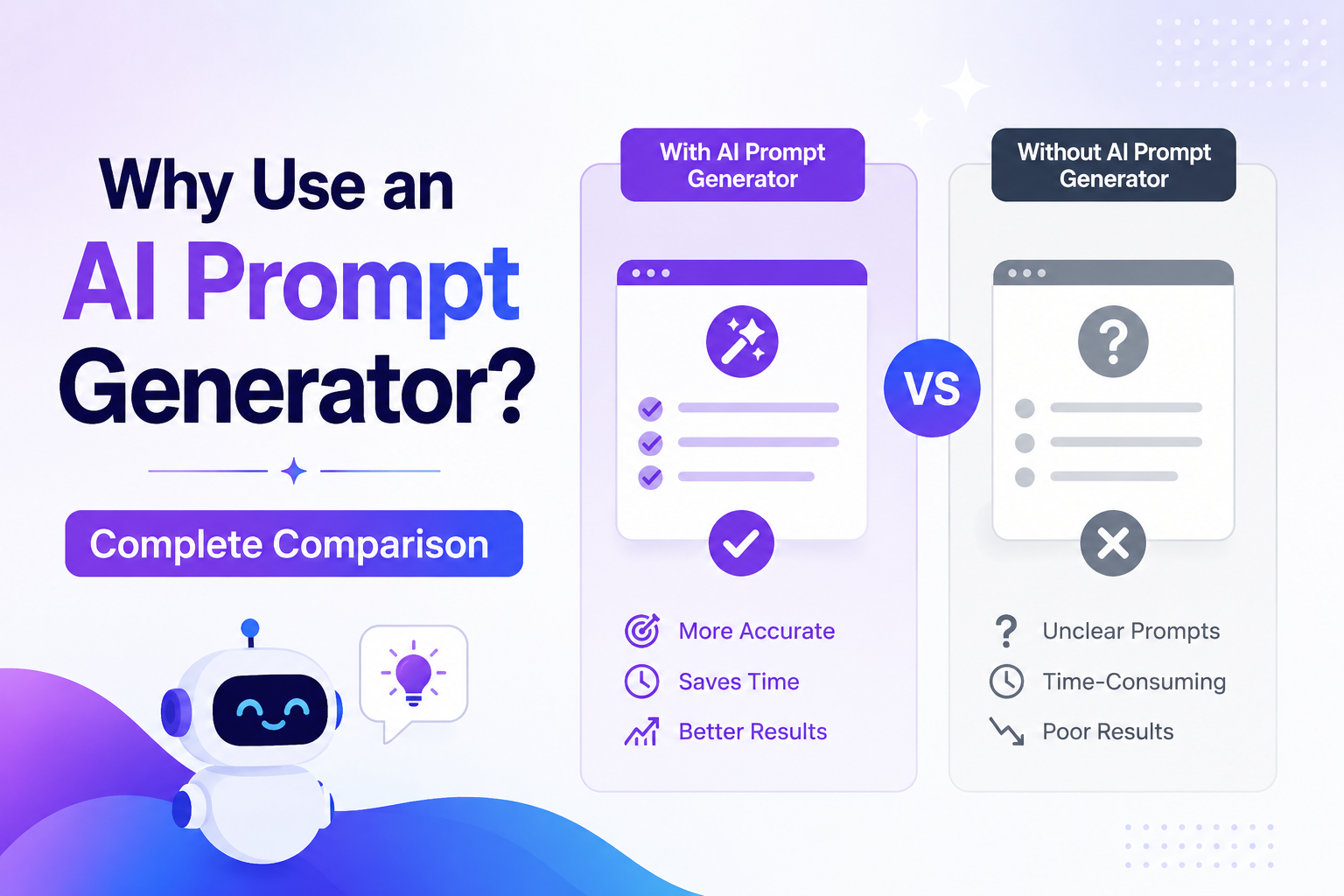
AI Prompt Generator is a tool that helps users create clear, structured, and effective prompts for artificial intelligence. Instead of struggling to decide what to write, users can provide a basic idea and use an AI prompt generator to turn it into a more detailed instruction that an AI tool can understand.
Artificial intelligence is becoming increasingly useful for content creation, marketing, design, coding, research, and business automation. However, getting useful results from AI often depends on how clearly the task is explained. A vague prompt may produce a generic response, while a detailed and well-structured prompt can provide more relevant and useful output.
This is where an AI prompt creator can help. It can guide users in organizing their ideas, adding relevant context, defining requirements, and creating prompts for different AI tasks. This makes prompt creation easier for both beginners and experienced users.
In this article, we will explore what an AI Prompt Generator is, why it is useful, how it works, its key benefits, and the differences between manual prompting and AI-assisted prompt generation. We will also look at how prompt generators can support SEO, content creation, and other AI-powered workflows.
What Is an AI Prompt Generator?
An AI Prompt Generator is a tool that helps users create clear and structured instructions for AI systems. Whether you want AI to write a blog post, compose an email, generate ideas, analyze information, create code, or produce other content, a prompt generator can help turn a simple idea into a more detailed instruction.
Instead of manually deciding how to structure every instruction, users can provide basic information and let the tool organize it into a usable prompt.

How Does an AI Prompt Generator Help Users?
An AI prompt generator can help organize important elements such as the task, context, target audience, tone, constraints, examples, and desired output format.
For example, instead of entering:
“Write a blog about fitness.”
A prompt generator could help transform the idea into a more detailed instruction such as:
“Act as an experienced fitness content writer and create a beginner-friendly 1,000-word article about fitness tips. Use a helpful and conversational tone, include practical examples, organize the article with clear headings, and avoid unsupported health claims.”
The second prompt gives the AI more context and direction, which can make the requested output more useful.
Why Is an AI Prompt Generator Necessary?
AI tools are increasingly used for content writing, SEO, marketing, blogging, coding, and business tasks. However, many users struggle to get useful results because their instructions are too short, vague, or missing important context.
An AI prompt generator can help solve this problem by providing a structured approach to prompt creation. Instead of starting from a blank screen, users can build prompts around a clear framework.
1. Helps You Create Clear and Structured Prompts
An AI prompt creator can help turn a basic idea into a clearer instruction. When a prompt explains the task, context, requirements, and desired output, the AI system has more information to work with.
For users who want to understand prompt structure more deeply, learn how to create clearer and more effective AI prompts using practical prompt engineering principles.
2. Saves Time and Effort
Writing prompts manually for every task can take time, especially when the same types of tasks are performed regularly. Prompt generators can provide templates or automatically structure basic ideas into reusable instructions.
This can be particularly useful for content creators, marketers, SEO professionals, freelancers, and business teams that use AI frequently.
3. Helps Produce More Relevant AI Output
A vague prompt can result in a generic response. A more detailed prompt can give the AI clearer information about what the user expects.
A structured prompt can include:
- Specific task instructions
- Relevant context
- Target audience
- Desired tone
- Content requirements
- Output format
The quality of the final output still depends on the AI model, input information, and review process, but better instructions can make the workflow more consistent.
4. Makes SEO Content Creation Easier
An AI Prompt Generator can help users create structured instructions for SEO-related tasks such as content planning, keyword research, article outlines, title ideas, and search-intent analysis.
For content teams working on search-focused articles, create more effective SEO content using structured AI prompts to build repeatable content workflows.
5. Is Useful for Beginners
Beginners may not know how to provide enough context or structure when communicating with AI. A prompt generator can provide guidance and examples that make the prompting process easier to understand.
Instead of learning every prompting technique before using AI, beginners can start with simple ideas and gradually learn how to improve their instructions.
6. Helps Maintain Consistency
Consistency is important when multiple pieces of content are created with AI. Reusable prompt templates can help maintain similar instructions, formatting, tone, and quality requirements across different tasks.
This is particularly useful for businesses and content teams that produce large volumes of content.
7. Supports More Advanced AI Workflows
Advanced prompts can include multiple requirements, examples, constraints, and output instructions. An AI prompt generator can help organize these elements into a clearer structure.
For example, a marketing prompt might specify the target audience, campaign goal, brand voice, content format, key message, and call to action.
8. Improves Content Strategy
An AI prompt generator can support more than individual writing tasks. It can also help users create prompts for brainstorming, content planning, audience research, campaign development, and other strategic activities.
Key Benefits of an AI Prompt Generator
An AI Prompt Generator can be a useful part of an AI-assisted workflow because it helps users turn simple ideas into more structured instructions. The benefits depend on the quality of the tool and how effectively the generated prompts are reviewed and customized.
- Helps create structured prompts
- Saves prompt-writing time
- Supports clearer AI instructions
- Helps beginners learn prompting
- Supports reusable prompt templates
- Improves workflow consistency
- Encourages more detailed instructions
- Supports creative brainstorming
- Helps organize complex AI tasks
- Supports content and SEO workflows
Manual Prompt vs AI Prompt Generator: Full Comparison
Both manual prompting and AI prompt generation can be useful. Manual prompting gives users complete control over every instruction, while an AI prompt generator can help users structure and refine their initial ideas.
| Factor | Manual Prompt | AI Prompt Generator |
|---|---|---|
| Time | Can take more time because the user creates and structures the prompt manually. | Can reduce prompt creation time by helping structure the initial idea. |
| Quality | Depends largely on the user’s prompting knowledge and experience. | Can provide a structured starting point, although the result should still be reviewed. |
| Simplicity | Requires the user to understand how to structure effective instructions. | Can simplify prompt creation by guiding users through important prompt elements. |
| Accuracy | Depends on how complete and specific the user’s instructions are. | Can help organize relevant details, but accuracy still depends on the information provided. |
| Creativity | Depends on the user’s knowledge, experience, and ideas. | Can suggest different approaches, structures, and prompt variations. |
| Customization | Offers complete control over the prompt from the beginning. | Allows customization after the generated prompt is created, depending on the tool. |
When Is Manual Prompting Better?
Manual prompting can be useful when users understand the AI model well and need precise control over the instructions. Experienced users may prefer writing prompts themselves for specialized or highly specific workflows.
When Is an AI Prompt Generator Better?
An AI prompt generator can be useful when users are beginners, need help structuring ideas, or frequently create similar prompts. It can also provide a useful starting point when the user knows what they want but does not know how to communicate it effectively to an AI system.
How Does an AI Prompt Generator Work?
An AI Prompt Generator generally takes information provided by the user and transforms it into a more structured instruction. The exact process depends on the tool, but many prompt-generation workflows follow a similar pattern.
AI Prompt Generator Working Process
- Takes the user’s basic idea or input
- Identifies the intended task
- Analyzes relevant context
- Organizes the instructions
- Adds useful requirements or constraints
- Defines the desired output format
- Generates a structured prompt
- Allows the user to review and customize the prompt
Example of the Prompt Generation Process
Basic idea: “Create a social media campaign for a new product.”
The generator may turn this into a more detailed instruction containing:
- Marketing role
- Product information
- Target audience
- Campaign objective
- Brand tone
- Social media platform
- Content format
- Call to action
The user can then review the generated prompt and make any necessary changes before sending it to an AI model.
Relationship Between AI Prompt Generators and AI Content Creation
AI prompt generation and AI content creation are closely connected, but they are not the same process. A prompt generator helps create the instructions, while an AI content tool uses those instructions to produce an output.
How Prompt Quality Affects Content Creation
The instructions given to an AI system can influence the relevance, structure, tone, and format of its response. A detailed prompt provides more context than a vague instruction, which can make it easier for the AI to understand the requested task.
For example:
Basic prompt: “Write about digital marketing.”
Structured prompt: “Act as a digital marketing strategist and create a beginner-friendly guide to digital marketing for small businesses. Explain five practical strategies, use clear headings, provide examples, and maintain a professional but conversational tone.”
The structured version gives the AI more information about the expected result.
AI Prompt Generator vs AI Content Writing Tools
Many people consider AI Prompt Generators and AI Content Writing Tools to be the same, but their primary functions are different. An AI prompt generator focuses on creating instructions, while an AI content writing tool focuses on producing the requested content.
| Factor | AI Content Writing Tools | AI Prompt Generator |
|---|---|---|
| Primary Work | Generates content based on user instructions. | Creates or improves instructions for AI systems. |
| Output | Articles, emails, social posts, summaries, and other content. | Structured prompts or instructions. |
| Usage | Used for direct content generation. | Used to create better instructions for AI tasks. |
| SEO Role | Can assist with SEO-focused content creation. | Can help create structured prompts for SEO workflows. |
| Primary Role | Content creation assistant. | Prompt creation and optimization assistant. |
How They Can Work Together
These two types of tools can be used together. A prompt generator can help create a structured instruction, and an AI writing tool can then use that prompt to generate the requested content.
For example:
Idea → AI Prompt Generator → Structured Prompt → AI Writing Tool → Draft Content → Human Review
This workflow can be useful for businesses and content teams that want a repeatable AI-assisted content process.
How Does an AI Prompt Generator Improve SEO?
AI Prompt Generators can support SEO workflows by helping users create clearer instructions for keyword research, content planning, search-intent analysis, article creation, and optimization. However, using an AI prompt generator does not automatically make content rank higher. SEO performance depends on many factors, including content quality, relevance, search intent, technical SEO, competition, authority, and user experience.
Supports Keyword Optimization
A prompt can instruct an AI system to use relevant primary, secondary, and long-tail keywords naturally without excessive repetition.
Helps Match Search Intent
Users can specify the search intent, target audience, and purpose of the content so the AI can create a more focused output.
Creates Structured Content
Prompt generators can help users specify headings, sections, lists, examples, FAQs, and other content elements.
Supports Content Quality
Detailed prompts can request useful explanations, examples, comparisons, and audience-specific information rather than generic content.
Improves Readability
Users can specify sentence length, tone, reading level, formatting, and structure to make AI-generated content easier to understand.
Supports Better Content Planning
AI prompts can help with topic research, article outlines, content briefs, FAQs, and other planning activities before the writing stage begins.
For broader AI-assisted article creation, discover SEO-friendly methods for creating articles with AI and combine them with human editing and fact-checking.
How to Create an Effective Prompt Without a Generator
An AI prompt generator is useful, but you can also create effective prompts manually. A simple framework can help you communicate your requirements clearly.
Define the AI Role
Tell the AI what role it should take, such as SEO writer, marketing strategist, teacher, developer, researcher, or customer support assistant.
Provide Relevant Context
Explain the background information the AI needs to understand the task. The more relevant context you provide, the easier it is for the AI to tailor its response.
Explain the Task Clearly
Use direct instructions that explain exactly what you want the AI to produce.
Add Constraints and Requirements
Specify word count, tone, audience, language, formatting, information requirements, or restrictions where necessary.
Specify the Output Format
Tell the AI whether you want a paragraph, table, list, article, outline, email, code example, or another format.
Review and Refine the Result
Do not assume the first AI response is perfect. Review the result, identify missing information, and refine the prompt when necessary.
Future of AI Prompt Generators
AI prompt generators are likely to become more integrated with AI applications as prompting becomes part of everyday digital workflows. Instead of simply generating text instructions, future tools may provide more contextual assistance based on the user’s task, industry, preferred AI model, and previous workflows.
Voice-Based Prompt Creation
Users may increasingly describe their requirements through voice instead of typing long instructions manually.
Personalized Prompt Suggestions
AI systems can provide prompt recommendations based on a user’s task, preferences, previous prompts, or workflow requirements.
Industry-Specific Prompt Generation
Prompt generators may increasingly offer specialized templates for industries such as marketing, education, e-commerce, software development, customer support, and business operations.
Automated Prompt Optimization
Future tools may automatically identify unclear instructions, missing context, or formatting requirements and suggest improvements before a prompt is submitted.
Multi-Model Prompt Workflows
As users work with multiple AI models, prompt tools may help adapt instructions to different systems and workflows.
FAQs
1. What is an AI Prompt Generator?
An AI Prompt Generator is a tool that helps users create clear and structured prompts for AI systems. It can transform a basic idea into a more detailed instruction containing relevant context, requirements, and output guidelines.
2. Why should I use an AI Prompt Generator?
You can use an AI Prompt Generator to save time, organize your ideas, create reusable prompts, and get help structuring instructions for AI tools. It can be especially useful for beginners who are still learning how to write effective prompts.
3. How does an AI Prompt Generator work?
An AI Prompt Generator takes a user’s basic idea or task and transforms it into a more structured instruction. Depending on the tool, it may add context, requirements, constraints, examples, and an output format.
4. What are the benefits of an AI Prompt Generator?
The main benefits include faster prompt creation, clearer instructions, reusable prompt structures, easier content planning, improved workflow consistency, and support for users who are new to AI prompting.
5. Is an AI Prompt Generator better than writing prompts manually?
It depends on the user’s needs and experience. Manual prompting provides direct control over every instruction, while an AI Prompt Generator can simplify the creation process and provide a structured starting point. Both approaches can be effective.
6. Can an AI Prompt Generator help with SEO?
Yes. An AI Prompt Generator can help create structured prompts for SEO content planning, keyword research, search-intent analysis, article outlines, and content optimization. However, using a prompt generator alone does not guarantee higher search rankings.
7. Can beginners use an AI Prompt Generator?
Yes. AI Prompt Generators can be particularly helpful for beginners because they provide a structured way to turn simple ideas into detailed instructions. Users can also learn from the generated prompts and gradually develop their own prompting skills.
8. Can I create effective AI prompts without a prompt generator?
Yes. You can create effective prompts manually by defining the role, context, task, requirements, constraints, examples, and desired output format. A prompt generator is a helpful tool, but it is not required.
Conclusion
AI Prompt Generators are useful tools for creating clearer, more structured, and reusable instructions for artificial intelligence. They can make prompt creation easier for beginners while also helping experienced users develop repeatable workflows.
Manual prompting still provides complete control and can be highly effective when users understand how to structure their instructions. However, an AI prompt generator can save time and provide a useful starting point when users need help turning a basic idea into a detailed prompt.
Whether you use AI for content creation, SEO, marketing, coding, research, or business tasks, the quality of your instructions matters. The most effective approach is to combine clear prompting, appropriate AI tools, accurate information, and human review.